Summary
Editor's rating
Value: not cheap, but you get more than just a strip of LEDs
Design: discreet pucks and neat cable covers that actually look decent on the house
Packaging and unboxing: practical, complete, and a bit heavy-duty
Durability and weather resistance: built to stay up, not to babysit
Performance: colors, whites, music sync and the reality of smart controls
What you actually get in the box (and what that means in real life)
Pros
- Very clean, permanent installation thanks to sliding mounts and cable covers
- Good light quality with real warm/cool whites plus bright colors and smooth scenes
- Complete kit with all hardware included, no extra trips to the DIY store
Cons
- Matter/HomeKit integration is limited for complex scenes and can frustrate Apple-focused users
- Installation is time-consuming and requires drilling a lot of holes
- Price is high if you only need simple white outdoor lighting

Specifications
View full product page →| Brand | Nanoleaf |
Smart garden lights that look great… when they actually behave
I set these Nanoleaf Matter Smart Permanent Outdoor Wall Lights up along the edge of my terrace and part of the roofline, roughly covering 12–13 meters of the 15 m kit. I’ve been using them in the evenings for a few weeks now, mostly with Alexa and the Nanoleaf app, plus some basic schedules. Overall, the effect on the garden is pretty solid, but there are a few things that annoyed me, especially around HomeKit and the setup time.
First clear point: this is not a quick plug-and-play fairy light strip. You have to plan where the pucks go, drill a bunch of holes, route the cable, snap the covers, and only then start playing with scenes. If you’re expecting to throw this up in 30 minutes before a barbecue, forget it. It’s more like a half-day job if you want it neat and permanent. Once it’s up though, it does look clean and well thought out.
On the smart side, it’s a bit mixed. With Alexa and the Nanoleaf app, things run fine: on/off, scenes, brightness, no big drama. But if you’re deep into Apple HomeKit and want full control there, you’re going to be a bit disappointed. You can do basic stuff, but the fancy dynamic scenes and complex animations stay stuck in the Nanoleaf app. One Amazon review even said HomeKit basically only does on/off and can’t change colors properly, and I get why that would annoy people who bought it mainly for that.
So my first takeaway: the hardware and lighting effects are pretty good, the installation kit is really complete, but the smart home side is not perfect, especially if you expect Matter/HomeKit to handle everything smoothly. It’s the kind of product that’s satisfying once installed, but you need patience, a drill, and to accept that you’ll often use the Nanoleaf app instead of just Apple Home.
Value: not cheap, but you get more than just a strip of LEDs
Let’s be clear: these are not budget lights. You can easily find cheaper RGB outdoor strings or LED strips that will give you some color for a fraction of the price. The big question is whether what Nanoleaf adds on top is worth the extra money for you. For me, the value comes from three things: the complete installation kit, the overall look once installed, and the smart features (when you actually use the Nanoleaf app).
The kit is very complete: mounting hardware, cable covers, adapters, screws, and even some spare parts. One reviewer pointed out that you don’t have to run to the hardware store, and I agree. That saves time and frustration, especially if you’re not very handy. If you tried to replicate the same clean, permanent look with cheap strips, you’d end up buying separate conduit, brackets, power supplies, and you’d still have a less tidy result. So part of the price is really paying for a “semi-pro” finish that’s easier to achieve.
On the downside, the energy label is G, so it’s not the most efficient system ever, and the 72 W rating is something to keep in mind if you plan to run bright scenes for long hours every night. It’s not going to ruin you, but it’s not the most frugal either. Also, if you only care about a static warm white glow and never use the colors, animations, or music sync, then you’re wasting money here. In that case, a simple outdoor LED wall washer or regular wall lights will be better value.
I’d say the value is good if you want: permanent, neat exterior lighting with lots of color options, smart control, and you’re okay using the Nanoleaf app. It’s less good if you mainly want deep HomeKit/Matter integration, or if you just want basic white light. For those users, you’re paying a premium for features you either can’t fully use or won’t care about.
Design: discreet pucks and neat cable covers that actually look decent on the house
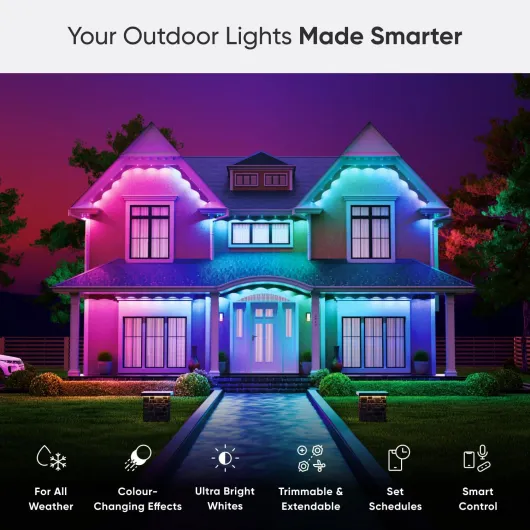
Visually, the design is pretty sober, which I liked. The pucks are round and relatively small, and once installed in a straight line under the roof edge, they don’t shout for attention when they’re off. The main thing that stands out is how tidy the whole run looks thanks to the cable covers between each light. This is where these beat a lot of cheaper LED strips: instead of having a sagging wire between bulbs, you get a continuous, clean line along the wall.
The anti-glare lens does its job. Instead of a harsh dot of light, you get more of a wall-wash effect. On my brick wall, the light spreads nicely without blinding you when you walk close. It’s not architectural-level lighting, but it looks clean and not cheap. The pucks sit slightly off the wall, which helps spread the light and also lets water drain so it doesn’t pool around the fixtures.
In terms of physical layout, you do need to think ahead. Once you’ve drilled and placed the mounts, moving them is annoying because you’re left with holes in the wall or soffit. I had to reposition one section because I misjudged the corner, and patching those holes on exterior render is not fun. So design-wise, it’s flexible enough while you’re still in the planning stage, but once screwed in, consider it fixed. This is not a seasonal light string you put up and take down every year; it’s meant to stay.
Overall, I’d say the design is practical and neat rather than flashy. It looks good on modern houses and doesn’t clash with older ones, as long as you stick to warm white or simple scenes. If you go full rainbow with fast animations, it can look a bit like a theme park, but that’s more about how you use it than the design itself.
Packaging and unboxing: practical, complete, and a bit heavy-duty
The box is fairly big and has some weight to it (around 2.7 kg for the kit). Inside, everything is well organized: the lights are coiled, the power supply and controller are in separate sections, and the mounting hardware and cable covers are bagged and clearly separated. It feels more like unboxing a piece of equipment than a simple set of decorative lights. No fancy presentation, just functional organization, which I actually prefer for this kind of product.
I appreciated that Nanoleaf included all the screws and accessories. It sounds basic, but too many products send you hunting for the right screws or wall plugs. Here, you open the box, and you’re basically ready to go as long as you have a drill and a screwdriver. The instructions are fairly clear, with diagrams that explain the sliding mount system and cable cover installation. I still had to check an online video to be sure about the spacing and the best way to run around corners, but nothing dramatic.
There’s a decent amount of plastic packaging, which is pretty standard for something with this many small parts, but it’s not completely over the top. You won’t be drowning in foam. The main thing is that you don’t feel like anything is missing. One Amazon reviewer praised the inclusion of all accessories and tools, and I’m on the same page: you pay a premium, but at least you’re not nickel-and-dimed on brackets or connectors.
In short, the packaging is practical and complete. It’s not designed to impress on Instagram, but it’s well thought out for someone who’s actually going to install the thing. You open it, sort the parts, plan the run, and you’re ready. For a product that demands a bit of DIY, that’s exactly what you want.
Durability and weather resistance: built to stay up, not to babysit
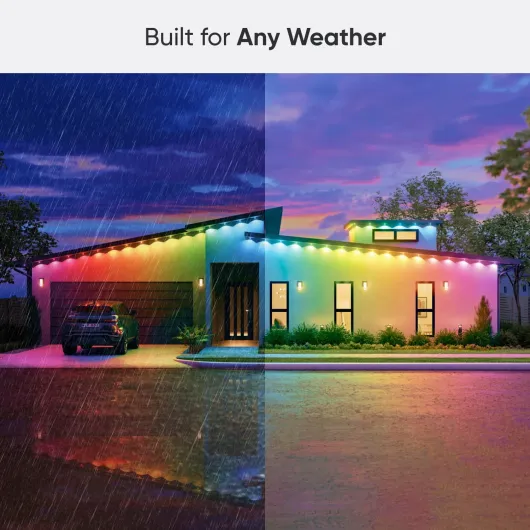
I haven’t had these installed for a full year yet, so I can’t pretend I know how they’ll look after five winters. But based on the build and what I’ve seen in bad weather so far, they feel ready for long-term outdoor use. The IP67 rating on the lights themselves is reassuring: they’re made to handle heavy rain and splashes. I’ve already had a couple of proper storms and plenty of moisture, and there were no flickers, no water in the lenses, and no weird behavior.
The plastic housings and cable covers are thick enough that they don’t feel flimsy. They’re still plastic, so if you smack them with a ladder or a football, they’ll probably crack, but for normal use they seem fine. The UV resistance is hard to judge in the short term, but they don’t feel like the cheap plastic that goes yellow in three months. I mounted mine partially exposed to sun, and after weeks there’s no discoloration or warping. Time will tell, but the first impression is positive.
The more “durable” aspect is really the installation itself. Once you’ve drilled all the holes and fixed everything, you’re not going to want to take this down every season. One German reviewer mentioned exactly that: they’re testing it properly before committing to drilling under the roof because reversing it later would be a pain. I agree with that approach. If you’re not sure about the layout, tape the run temporarily, test it for a few evenings, and then drill.
From an electrical standpoint, the power supply and controller feel reasonably robust, but I wouldn’t leave the power brick fully exposed to the elements. I placed mine in a sheltered area, and I think that’s the right move, even if the rating says it’s weather resistant. In short: the system is built to be permanent, but treat the power components with a bit of care and plan the layout well. If you do that, you probably won’t have to touch it much after installation, beyond the occasional app update.
Performance: colors, whites, music sync and the reality of smart controls
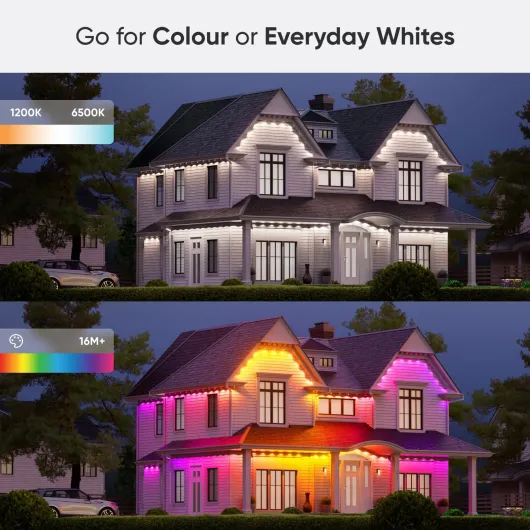
On the lighting side, performance is pretty solid. Each puck has separate warm and cool white LEDs plus RGB, so the whites actually look like real white, not that washed-out bluish tone you get from cheap RGB strips. The stated 50 lumens per puck isn’t floodlight level, but across 15 m it’s enough to light a patio path and make the house visible from the street. For security or just avoiding tripping over stuff, it does the job. I wouldn’t use it as the only light source for a big garden, but for wall washing and ambiance, it’s decent.
Colors are bright enough and the gradients look smooth. The RGBICW setup means you can have multiple colors along the same run, which gives you nice effects for Christmas, Halloween, etc. The built-in scenes in the Nanoleaf app are varied: slow fades, faster party modes, seasonal themes. You can also create your own scenes if you’re willing to spend time tweaking. The music sync works reasonably well: the lights react to the beat with some delay but nothing shocking for a home setup. It’s fun for a barbecue or a small party, but don’t expect nightclub-level precision.
Where things get more mixed is the smart control. With the Nanoleaf app, I had no real stability issues: scenes load, brightness changes quickly, and schedules fire as expected. With Alexa, basic commands (on/off, brightness, switching scenes) worked fine most of the time. The problem is when you try to rely only on Apple Home or other Matter-based apps. One verified Amazon review flat-out said it’s useless for HomeKit because they couldn’t change colors and only on/off worked. I didn’t hit that exact bug, but I did notice that complex scenes and animations just don’t translate well into Home. You end up with a much more basic experience.
So if you’re okay living inside the Nanoleaf app most of the time, performance is good: smooth animations, decent brightness, real whites, and reactive music mode. If your priority is “everything must be native in Apple Home with full control”, then performance drops to “meh, it works but feels limited”. In that case, you might be better with simpler, non-addressable outdoor lights that integrate more cleanly.
What you actually get in the box (and what that means in real life)
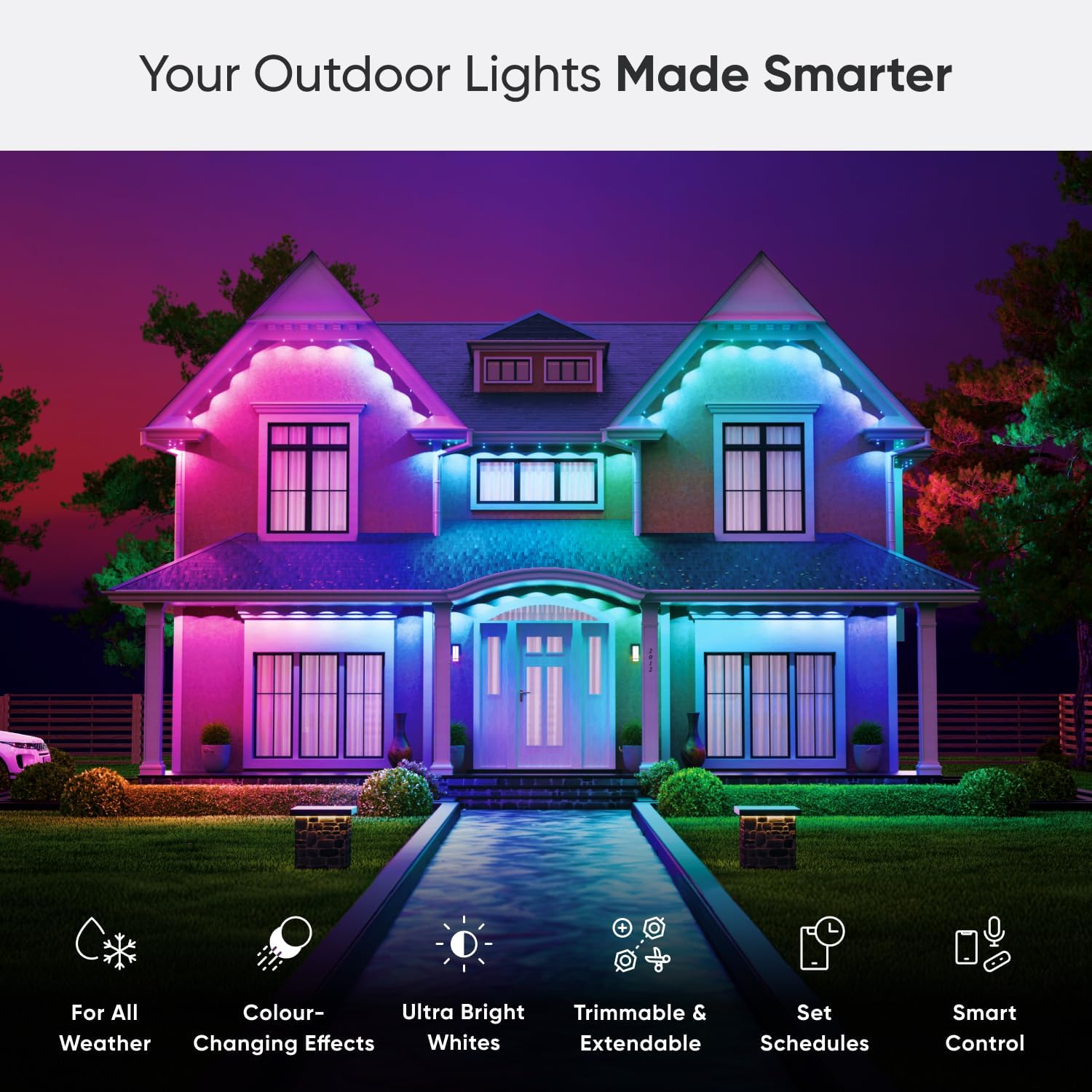
This starter kit is basically a 15 m run of small round LED "pucks" designed to sit permanently on your exterior walls or under the roofline. Each puck has RGB plus dedicated white LEDs (warm and cool), which means you can use it for both party colors and plain white security lighting. It’s rated IP67 for the lights and IP65 for some parts, so in practice it’s meant to survive rain, snow, and sun without you worrying about it every winter.
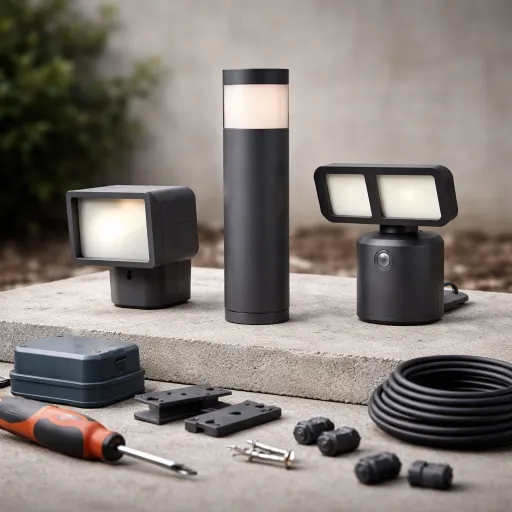
In the box, Nanoleaf has thrown in a lot: the pucks already wired, the power supply, the controller, multiple mounting brackets, screws, cable covers, and even some spare bits. One of the Amazon reviewers is right: you don’t really need a trip to the hardware store unless your wall is weird or you’re missing tools like a drill. The system is designed to be screwed in place, so this is not for renters who can’t put holes in the façade. The sliding mounting system is a nice touch: you screw the base in, then slide the puck on so the screw is hidden.
On the tech side, it connects over Wi‑Fi and supports Matter, plus it works with Alexa, Google Assistant, Apple Home, and SmartThings. In reality, you’ll still need the Nanoleaf app at least once for setup and firmware updates. The app also unlocks all the dynamic scenes, music sync, and the color animations, which you can’t reproduce fully in the native smart home apps. If you’re the type who wants to do everything from a single Apple Home or Alexa interface, you’ll feel a bit limited.
So in practice, what you’re buying is: a long, permanent, semi-pro style lighting system for your house exterior, with full-color effects, a complete mounting kit, and fairly advanced app control. But you’re also buying into Nanoleaf’s ecosystem, with the good (lots of scenes, frequent updates) and the bad (you juggle multiple apps and sometimes deal with Matter/HomeKit quirks).
Pros
- Very clean, permanent installation thanks to sliding mounts and cable covers
- Good light quality with real warm/cool whites plus bright colors and smooth scenes
- Complete kit with all hardware included, no extra trips to the DIY store
Cons
- Matter/HomeKit integration is limited for complex scenes and can frustrate Apple-focused users
- Installation is time-consuming and requires drilling a lot of holes
- Price is high if you only need simple white outdoor lighting
Conclusion
Editor's rating
After a few weeks of use, I’d summarize these Nanoleaf Permanent Outdoor Wall Lights like this: the hardware and visual result are good, the app is decent, but the smart home integration (especially with Apple Home) is not as smooth or complete as the Matter logo on the box suggests. As permanent exterior lights, they look clean, handle bad weather, and offer enough brightness and color options to cover everything from everyday white lighting to party mode.
I’d recommend them to people who like tinkering with scenes, don’t mind using the Nanoleaf app regularly, and want a neat, "installed once and forget" lighting solution along a roofline, terrace, or garden wall. If you host a lot of evenings outside, enjoy music-reactive lighting, and care about the visual finish (no dangling cables, consistent spacing), you’ll probably be happy with the result despite the price.
If, on the other hand, your priority is deep HomeKit control with complex scenes directly in Apple Home, or you just want simple warm white lighting without all the color features, I’d look elsewhere. You’re paying for addressable RGB, animations, and a full mounting kit. If you don’t use those, or if you get frustrated by smart home quirks, the value drops quickly. Overall, it’s a solid product with clear strengths, but not the perfect fit for every smart home setup.


![TP-Link Smart Bulb, Smart WiFi LED Light, E27, 8.3W, Works with Amazon Alexa(Echo and Echo Dot) and Google Home, Colour-Changeable, No Hub Required L530E [Energy Class F]](https://www.smart-light-guru.com/storage/939170/conversions/61umAkCvEzL._AC_SL1000_-medium.webp)