Summary
Editor's rating
Value for money: nice light, steep price
Design: clean look, but clearly a plastic smart gadget on your ceiling
Materials & build: mostly plastic, solid enough but not premium
Performance: bright, flexible, but colours are less punchy than the photos
Installation & setup: simple wiring, but plan your app setup properly
What the Philips Hue Centris 4-Light actually is
Effectiveness in real life: daily use, smart features, and small annoyances
Pros
- Very bright (around 4000 lumens) and easily lights a 10–12 m² room on its own
- Flexible lighting with central panel plus four adjustable spots for both task and ambient light
- Integrates well with Hue ecosystem, app scenes, and Alexa voice control when used with a Hue Bridge
Cons
- High price compared to simpler smart lights or DIY combinations
- Mostly plastic build that doesn’t feel very premium for the cost
- Colours look less saturated and punchy than in the official marketing photos, especially with the central panel on

Specifications
View full product page →| Brand | Philips Hue |
A ceiling light for people who go a bit too far with smart bulbs
I’ve been using Philips Hue stuff for years (bulbs, lightstrips, sensors…), but I’d never tried one of their more “serious” fixtures like this Centris 4-Light. I bought it to replace a basic ceiling light in an open kitchen / living area and see if a single unit could handle both normal white light and the more playful colour stuff. I wired it in, added it to the Hue app, and used it every day for a couple of weeks before writing this.
First thing: this is not a cheap light. You feel the hit on the credit card right away, so I went in with fairly high expectations. I wanted strong brightness, simple control from the app and Alexa, and something that didn’t look like a UFO stuck on the ceiling. I also wanted to see if it could realistically light a room on its own or if it was more of a mood light that still needs extra lamps around it.
During these two weeks, I used it like a normal person: cooking, working at the table, watching TV at night, hosting a couple of friends. So no fancy “light scenes photo shooting”, just real life use. I played with both white and colour modes, tested dimming, tried it with and without a Hue Bridge, and checked how it behaves when you just flip the wall switch like a regular lamp.
Overall, it does the job and it’s pretty solid, but it’s not perfect. It’s bright and flexible, and if you’re already deep into the Hue ecosystem, it fits in nicely. But the price is high, the colours are not as punchy as the marketing photos suggest, and the fact that it’s a big plastic block on the ceiling might bother some people. I’ll break down the good and the bad so you can see if it’s worth it for your setup.
Value for money: nice light, steep price
Now, about the price: this is where things get a bit harder to justify. The Centris 4-Light costs significantly more than a standard ceiling light plus a few smart bulbs. You are paying for the integrated design, the Hue ecosystem, and the combo of spots + panel in one unit. If you compare it to buying four Hue GU10 colour bulbs plus a basic ceiling bar and a separate panel, you’re still roughly in the same price zone, sometimes even cheaper with a DIY combo depending on the brands you choose.
From what I felt after using it, the value is good if you tick these boxes: you’re already deep into Hue, you want a clean all-in-one solution for a main room, and you use scenes and automation daily. In that case, the comfort of having everything in one fixture with full app control and voice commands is nice. It lights a medium room well, handles both functional and mood lighting, and integrates perfectly into the rest of your Hue setup. In that context, the price is high but somewhat acceptable.
If, on the other hand, you just want colour for fun sometimes and don’t really care about fine-tuning whites or using routines, then the value drops. There are cheaper RGB ceiling lights and spot bars that will give you colours and remote control without needing a Hue Bridge. You’ll lose some polish and ecosystem integration, but you’ll save a lot of money. Also, the plastic build and the colours that are less intense than the marketing photos make the premium price feel a bit stretched. One Amazon review in Italian basically says the colours are washed out compared to the photos and that the product is disappointing for the cost, and I partially agree on that point.
So in short: if you’re a Hue fan who wants a neat ceiling fixture that plays nicely with the rest of your system, the Centris can make sense despite the price. If you’re starting from scratch or just want something simple and cheap, there are clearly more budget-friendly options that will light your room just fine. You’re paying here for ecosystem convenience and flexibility more than for raw materials or crazy colour performance.

Design: clean look, but clearly a plastic smart gadget on your ceiling
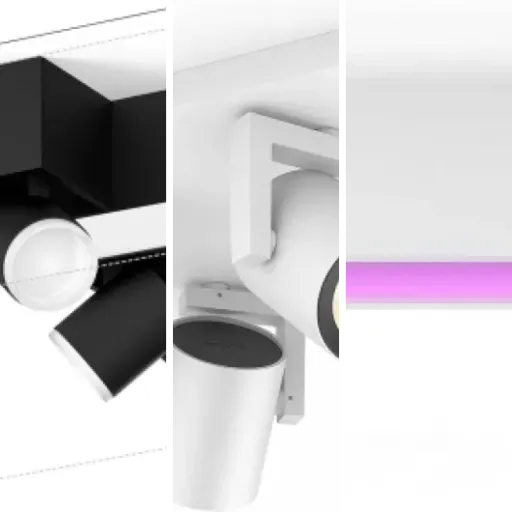
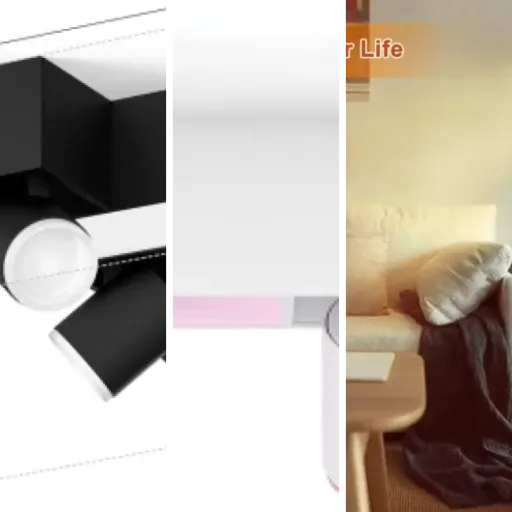
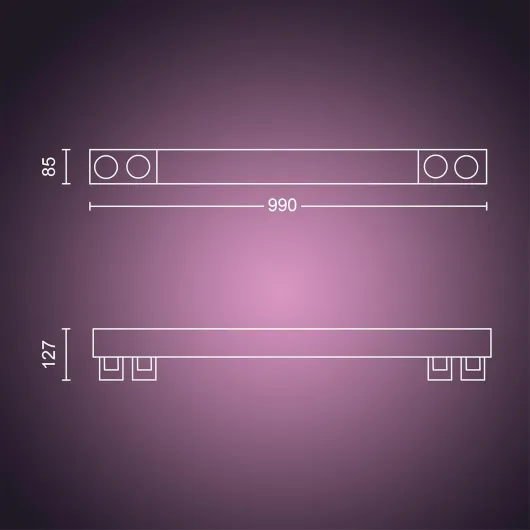
Design-wise, the Centris is pretty straightforward: a long white rectangular bar (about 78 cm long) with four small cylindrical spots and a central panel. It’s lacquered white, so it blends fairly well into a white ceiling. When you look up, it doesn’t scream “industrial office”, but it also doesn’t look like a fancy designer lamp. It’s somewhere in between: functional, modern, and clearly from the “tech” category more than the “decorative” one.
The spots can be rotated and angled, which is handy. I pointed two towards the kitchen worktop, one towards the table, and one slightly towards a wall to create a bit of indirect light. The central panel gives a broad, diffuse light. That combo works well: you get a main wash of light plus more focused beams where you want them. Visually, when it’s off, it just looks like a white bar with little canons stuck on it. When it’s on, the mix of panel + spots gives a bit of depth to the room, especially if you use different whites or add some colour on the spots.
The downside is the material feel. It’s mostly plastic, and you feel it when you handle it during installation. It doesn’t feel fragile, but it doesn’t give that heavy, metal, premium vibe either. On the ceiling you don’t really touch it anymore, so it’s not a huge problem, but for the price, I expected at least some parts in metal or a slightly more solid feel. Also, the bar is long, so in a small room it dominates the ceiling quite a bit. If you have a low ceiling or a very small room, it can look oversized.
From a practical point of view, the design is smart. The spots don’t blind you too much if you angle them correctly, and the panel avoids the “four harsh beams in your face” effect. But if you’re very picky about aesthetics and want something that looks more like a designer pendant, this is not it. This is more: clean, tidy, does the job, clearly a smart light rather than a decorative piece.
Materials & build: mostly plastic, solid enough but not premium
Let’s be clear: for a product at this price level, the material choice is a bit underwhelming. The Centris is mainly plastic with a lacquered white finish. When you take it out of the box, you immediately notice that it doesn’t have that cold, heavy feel of metal. It’s not flimsy, nothing creaks, but it’s clearly built to be light and easy to mount rather than to impress when you hold it in your hands. Once it’s on the ceiling, you don’t touch it anymore, so day-to-day it doesn’t matter much, but for the price, it feels a bit cheap in the hand.
The spots themselves are small plastic cylinders housing GU10 Hue bulbs. The joints for adjusting direction feel okay; they hold their position well and don’t sag over time (at least during the first couple of weeks of use). I rotated them multiple times while testing different layouts (towards the counter, towards the sofa, towards a painting), and they stayed where I left them without any issue. The central panel diffuser is also plastic, with a uniform look when lit. No weird hot spots or patchy areas, so at least the optical side of the materials is handled properly.
From a safety and installation standpoint, the light is not water-resistant (no IP rating for bathrooms), so it’s clearly meant for dry interiors: living room, bedroom, hallway, office, kitchen as long as it’s not directly over a steamy shower area. The fixture is fairly heavy (about 3.8 kg), so you feel that the internal structure is not hollow junk. The weight suggests there is some metal frame inside, but what you see and touch is mostly plastic. The finish is smooth, and cleaning dust is easy with a cloth. No sharp edges or weird gaps.
If you’re used to IKEA or basic DIY store fixtures, this feels a bit better than the cheapest stuff, but not by a huge margin. Considering the price, most of what you’re paying for is the smart part (Hue ecosystem, colour LEDs, app support) rather than luxurious materials. If you expect brushed aluminium and glass, you’ll be disappointed. If you just want something that looks neat and doesn’t feel like it will fall apart, it’s fine, just not impressive.
Performance: bright, flexible, but colours are less punchy than the photos
In daily use, the Centris is strong on brightness and flexibility. With its 4000 lumens, in my ±12 m² kitchen / dining area, I never felt like I was missing light. At 100%, the white light is honestly quite intense, even a bit too much for the evening, so I usually kept it at around 60–70% for normal use and lower for TV time. The dimming is smooth in the app, and Alexa voice control ("Alexa, dim kitchen to 30%") worked reliably once everything was paired correctly.
For white light, the range from cool to warm is good. I used cool white (around 4000–5000K) for cooking and cleaning, and warm white (2700K-ish) for dinners. The difference is clearly visible, and it’s easy to switch scenes in the Hue app. The central panel plus spots combo really helps to fine-tune things: you can keep the panel neutral and make the spots warmer or cooler depending on what you’re doing. For pure functional lighting, I have no complaints; it gets the job done easily.
On the colour side, this is where expectations need to be realistic. Compared to the marketing photos from Philips, the colours look less saturated and less “sharp”. Reds and blues are decent but not as deep as on the official visuals. On light walls, colours tend to look a bit washed out, especially if you also have the central panel on in white. If you turn off the panel and only use the spots in colour, it looks better, but still not like the glossy product shots. It’s not awful, just not as intense as advertised. If you come from other Hue colour bulbs, you’ll find it roughly in the same ballpark, but not beyond that.
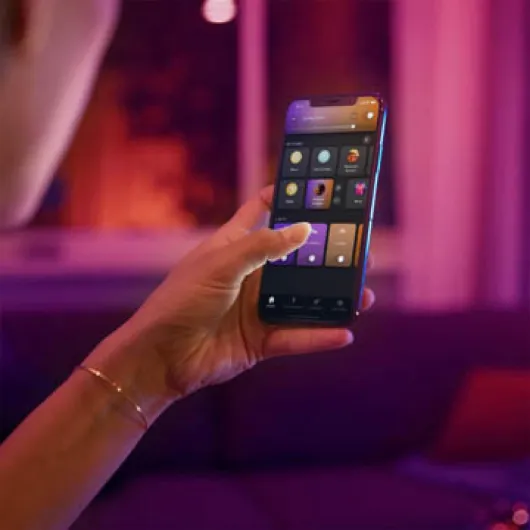
Responsiveness is okay: changing brightness and colours in the app happens with a small delay but nothing dramatic. With a Hue Bridge, automation and scenes work well. Without a Bridge, you can still control it via Bluetooth with the phone, but it’s more limited and you lose remote control and proper automation. For a main ceiling light that you use all the time, I’d say the Bridge is basically mandatory if you want to get the most out of it. Overall, performance is solid for white light and decent for colours, but don’t expect miracle colour quality for the price.
Installation & setup: simple wiring, but plan your app setup properly
On the installation side, this is relatively straightforward if you’re comfortable changing a ceiling light. There’s no assembly of the fixture itself; it comes as one piece with the GU10 bulbs included. You remove your old ceiling light, connect the two wires (phase and neutral, plus earth if you have it) into the terminal block of the Centris, fix the bracket to the ceiling, and then hook the bar onto it. The most annoying part is the weight and the length: doing it alone on a ladder is possible but a bit awkward. With two people, it’s much easier.
The manual is basic but clear enough. No exotic wiring, no weird connectors. Once mounted, you turn the power back on and add the light to the Hue app. If you already have a Hue Bridge, it’s just a matter of pressing search and letting it find the new lamps. The system detects the different points (spots + panel), which you can then group into a room and scenes. If you don’t have a Bridge, you can still use the Bluetooth app, but you’ll lose the advanced features like remote control when you’re not at home, proper routines, and easy integration with voice assistants.
After physical installation, the most time-consuming part is actually configuring scenes and groups in the app so you don’t have to control each light one by one. My recommendation: create at least these scenes from the start: “All white bright”, “All warm dimmed”, and one colour scene. That way, a single tap or voice command is enough most of the time. If you skip this, you’ll end up opening the app and dragging sliders for every single spot, which gets annoying really fast.
No need for special tools beyond a drill (if your old fixture holes don’t match), screwdriver, and maybe a voltage tester if you want to be safe. If you’re not at ease with mains wiring, obviously call an electrician, because this is still a 240V fixture. Once installed, there’s not much to touch anymore. So overall, installation is simple enough for someone used to changing lights, but the app setup is where you need to spend a bit of time to make it pleasant to use.
What the Philips Hue Centris 4-Light actually is
The Centris 4-Light is basically a rectangular ceiling bar with four adjustable GU10 spots plus an integrated central light. Think of it as a main ceiling fixture that tries to combine normal functional lighting with Hue’s coloured effects. It runs on Zigbee, works with the Hue app, and you can control it via Alexa if you link everything properly. On paper, it pumps out around 4000 lumens with 44W total power, which is quite a lot for a single fixture, especially in smaller rooms.
Out of the box you get the bar, the four GU10 Hue colour spots already included, and the central panel. No need to buy extra bulbs if you don’t want to. The idea is: you mount it on the ceiling, connect the two wires, add it to the app, and that’s it. Philips says it’s fine for rooms like kitchens, living rooms, or offices. I used it in a space of about 12–13 m², and it was enough as the main light. I also tried it briefly in a larger 20 m² living room, and there it started to feel a bit borderline if you like very bright general lighting.
In the app, the Centris shows up with multiple controllable light points: the spots and the central part. That’s both a strength and an annoyance. On the positive side, you can set the central light to a warm white and the spots to colour, or mix different whites for zones (like bright on the worktop, softer over the table). On the downside, if you don’t use a Hue Bridge and scenes/groups correctly, you end up tapping around to adjust each light individually, which gets old quickly.
So in practice, this product is for people who want an all-in-one smart fixture in a room where they’d normally put a big ceiling light plus a few spots. If you just want simple on/off and a fixed warm white, this is overkill and too expensive. If you’re already using Hue bulbs and scenes, it fits into that logic and gives you a central piece that can do both daily white light and more playful coloured lighting.
Effectiveness in real life: daily use, smart features, and small annoyances
In everyday use, the Centris is effective as a main light, especially if you’re already using Hue. After a few days, I had a couple of go-to setups: bright cool white for cooking/cleaning, warm dimmed white for evenings, and a mixed scene with coloured spots and warm central light for when friends came over. Switching scenes from the app is fast enough, and voice commands via Alexa (through a Hue Bridge) worked almost every time. The feeling is: it just works, which is what you want for a main ceiling light.
The strong point is the combination of direct and indirect lighting. Being able to aim the spots exactly where you need them is genuinely useful. I pointed one at the sink, one at the stove, one at the table, and one towards a wall. That way, even with the central panel slightly dimmed, I could still see clearly where I was working. This is more practical than just a single bulb in the centre of the ceiling. For a 10–12 m² room, it’s perfectly fine on its own. For bigger rooms, you’ll probably need extra lamps if you like a very bright environment.
There are still some annoyances though. Without a Hue Bridge, managing the five light points (4 spots + panel) one by one is tedious. One Amazon review says “Hue bridge’ye hiç gerek yok”, but in my experience, if you want to use it daily and change scenes more than once a week, the Bridge makes a big difference. Another user comment says “Hub kesin gerekli”, and I’m closer to that opinion. Also, if you cut power from the wall switch, the light obviously loses its smart features until you switch it back on. That’s typical for Hue, but it’s worth mentioning if you live with people who love flipping wall switches instead of using the app.
As for colour effectiveness, it’s more about ambience than dramatic effects. For kids or parties, it’s fun enough: you can put purple on one spot, blue on another, and keep the centre warm white. But again, colours are not super intense, especially compared to some cheaper RGB spots that focus only on colour. So as a smart main light for everyday life, the Centris works well. As a colour showpiece, it’s decent but not mind-blowing.
Pros
- Very bright (around 4000 lumens) and easily lights a 10–12 m² room on its own
- Flexible lighting with central panel plus four adjustable spots for both task and ambient light
- Integrates well with Hue ecosystem, app scenes, and Alexa voice control when used with a Hue Bridge
Cons
- High price compared to simpler smart lights or DIY combinations
- Mostly plastic build that doesn’t feel very premium for the cost
- Colours look less saturated and punchy than in the official marketing photos, especially with the central panel on
Conclusion
Editor's rating
After living with the Philips Hue Centris 4-Light for a while, my feeling is that it’s a solid smart ceiling light mainly aimed at people who are already into the Hue ecosystem. It’s bright enough to handle a small to medium room on its own, the combination of central panel and adjustable spots is genuinely practical, and the app/voice control works well once you’ve set up your scenes. For everyday white lighting, it does a very good job, and the ability to tweak colour temperature and brightness for different moments of the day is genuinely useful, not just a gimmick.
On the flip side, the product is expensive, the build is mostly plastic and doesn’t feel premium for the price, and the colours are clearly less intense than what the glossy Philips photos suggest. You also really need a Hue Bridge to get the most out of it; otherwise, managing multiple light points becomes annoying. If you’re already using Hue bulbs and like playing with scenes and automation, this fixture will fit nicely and simplify your ceiling setup. If you just want a normal ceiling light with some colour here and there, you can get similar practical results for much less money with other brands or a DIY combination.
So: good product, not perfect, and definitely not cheap. It makes sense for Hue enthusiasts who want a clean, all-in-one smart light in a key room. If you’re price-sensitive or not tied to Hue, I’d look at cheaper smart ceiling lights or separate spots plus bulbs instead.
![NEW White and Colour Ambiance Smart Light Bulb Starter Kit, 75W - 1100 Lumen [E27 Edison Screw] 2 Bulbs + Smart Button - With Bluetooth - Works with Alexa, Google Assistant and Apple Homekit E27 2 Pack Starter Kit + Button](https://www.smart-light-guru.com/storage/1015385/conversions/71yJIPbE0LL._AC_SL1500_-medium.webp)