Summary
Editor's rating
Value for money: nice piece… if you’ve already accepted the Hue “tax”
Design: modern look that actually cleans up the room
Materials & build: feels solid enough, but not luxury
Durability & long-term feel: should last, but bulbs aren’t really user-upgradable
Brightness, colors and daily use: does it light well enough?
What this Centris 2-spot actually is (and what it isn’t)
Smart features & app control: works well, but shines if you already have a Hue Bridge
Pros
- Very bright with flexible warm-to-cool white and full color options
- Two individually adjustable spotlights plus main bar give both general and task lighting
- Integrates smoothly with Hue Bridge, app, and voice assistants for reliable daily use
Cons
- High price compared to a normal fixture with separate Hue bulbs
- Mostly plastic build and integrated design make repairs or upgrades harder

Specifications
View full product page →| Brand | Philips Hue |
A cool-looking smart light that also hurts the wallet
I’ve been using Philips Hue stuff for a while (bulbs, lightstrips, motion sensors), but this Centris 2-spot ceiling fixture was my first time buying one of their full-on light fixtures instead of just screwing bulbs into something cheap from IKEA. I put it in my living room, roughly in the middle of the room, to replace an old boring flush-mount light. So this is coming from someone who already likes Hue, but also knows it’s pricey and sometimes a bit overhyped.
Right away: this thing is not cheap, and you feel that when you click “order”. I basically bought it because I liked the look and I wanted something clean that worked natively with Hue without fiddling with separate bulbs. I’ve been using it for a few weeks now, playing with colors, scenes, voice control, all that. It’s been on every day, usually a few hours in the evening and on weekends pretty much all day.
In daily use, it does what it’s supposed to do: it lights the room well and the two spotlights let you point light where you actually need it. But it’s not some magical object; it’s a ceiling light with Hue inside and a nice design. If you already have regular Hue GU10 spots and a basic fixture, the jump to this doesn’t feel like a night-and-day upgrade in terms of pure lighting, more in terms of finish and convenience.
So if you’re expecting a life-changing experience, calm down. If you just want a good-looking smart fixture that plugs nicely into an existing Hue setup and you’re okay paying the Hue tax, then it starts to make sense. I’ll go through what I liked, what annoyed me, and who I think this is actually for.
Value for money: nice piece… if you’ve already accepted the Hue “tax”
Let’s talk about the annoying part: the price. Like most Philips Hue products, this Centris fixture is not cheap at all. If you compare it to a regular ceiling spotlight bar plus a couple of standard LED bulbs, it’s clearly way more expensive. Even if you compare it to buying a standard bar and putting Hue GU10 bulbs in it, this fixture still often comes out pricier. So purely on paper, the value per lumen is not great.
Where it starts to make some sense is if you care about: 1) the integrated design, 2) having fewer separate pieces to deal with, and 3) a clean look with all the smart functions built-in. For me, replacing an old, ugly fixture with something that looked good and worked perfectly with my existing Hue setup justified the cost… barely. I wouldn’t say it’s a bargain; it’s more like: I knew I was overpaying a bit for the convenience and the look, and I accepted it.
If you’re just getting into smart lighting and you’re on a budget, I’d say this is not the right starting point. You’re better off buying a couple of Hue bulbs and using your existing lamps to see if you even like the ecosystem. Once you’re hooked and you want to clean up your ceiling with something more polished, then fixtures like this become more logical.
Bottom line: for what it does, the price is high but not shocking if you’re already used to Hue pricing. It’s good, it works well, but there are cheaper ways to get similar light and smart control if you’re willing to compromise on the integrated design. If you can catch it on sale, it becomes a lot easier to recommend; at full price, it’s more of a treat than a rational purchase.
Design: modern look that actually cleans up the room
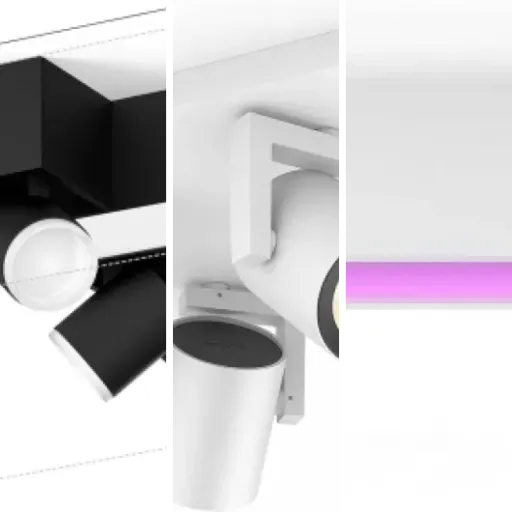
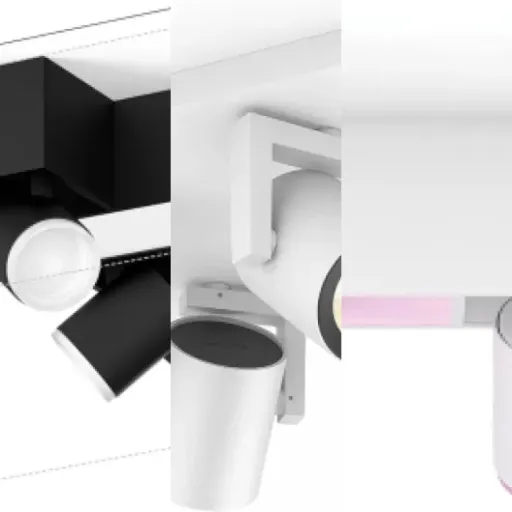
The main thing that pushed me to buy this instead of just adding more Hue bulbs to my old fixture was the design. It’s a rectangular bar in white with two spots hanging off it, and the whole thing sits fairly close to the ceiling. In a normal living room, it looks modern and tidy without screaming “look at my tech toy.” If you already have white walls and simple furniture, it blends in nicely and doesn’t fight for attention.
The two spots can rotate about 350 degrees and tilt, so you can really aim them. In my case, I aimed one towards the sofa / TV area and the other towards a bookshelf. That’s actually practical: you get general light from the bar plus more focused beams where you need them. Moving them around is easy; they don’t feel loose or wobbly, and once you set them, they stay put. It’s not some flimsy hinge that droops after a few days.
Physically, the unit is longer than you might think from photos. One Amazon review pointed out a dimension mismatch and I get why that matters. You need to really check the length (around a meter for the bigger versions, this 2-spot is shorter but still not tiny) against your room. If you have a narrow hallway or a small nook, it can visually overwhelm the space or just not fit. In my medium-sized living room, it looks proportional, but in a tiny kitchen, it might look like overkill.
Overall, I liked the look. It made the room feel cleaner compared to the old round fixture with random bulbs sticking out. But don’t expect high-end designer vibes; it’s a simple, practical modern design that fits most contemporary interiors. If your home is more rustic or classic, it may look a bit out of place and too “techy”.
Materials & build: feels solid enough, but not luxury
On the materials side, the specs say plastic with a painted or lacquered finish. In hand, it doesn’t scream “plastic toy,” but it’s also not heavy metal like some premium fixtures. The weight (around 2.6 kg) is enough that it feels like a proper ceiling light, not something hollow. When I took it out of the box, there were no creaks, no weird gaps, and the paint was even with no obvious defects.
The spots themselves feel a bit more solid than the bar, probably because of the internal mechanics for rotation. Adjusting them doesn’t feel risky; you can grab and twist without thinking you’ll snap something off. That said, this is still a mostly plastic product, so if you’re expecting brushed aluminum and glass everywhere, you’re going to be disappointed. For a light that costs this much, I wouldn’t have complained about a bit more metal in the construction.
One good point: once installed, you don’t touch it much. It’s not like a lamp you move around. So as long as it stays fixed, the plastic is less of a problem. Dusting it is simple: soft cloth, quick wipe, done. The white finish will show dust and the occasional insect if one decides to die on it, but that’s the same with any white ceiling fixture. After a few weeks, no yellowing or weird marks, but that’s something you really see over months or years, not days.
In terms of perceived quality, I’d say it’s pretty solid but not premium. You feel you partly pay for the Hue electronics and ecosystem, not just the raw materials. If you compare it to a standard non-smart fixture at the same price, those usually feel more “luxurious” in hand. But in practice, once it’s on the ceiling and doing its job, the mix of plastics is fine and doesn’t look cheap.
Durability & long-term feel: should last, but bulbs aren’t really user-upgradable
I haven’t had it for years obviously, so I can’t pretend I know how it will age in 10 years, but based on a few weeks and on other Hue products I own, I have a decent idea of what to expect. Hue LEDs usually last a long time; I have bulbs that have been running for more than 4 years almost daily without problems. So I’m not too worried about the electronics in this Centris. Once installed, it’s not moved or bumped, which already helps a lot.
One thing to note: even though the specs mention GU10 bases, this is sold as a non-removable fixture. Replacing individual light sources is not as straightforward as just swapping a standard bulb in a regular bar from the hardware store. That’s the trade-off with integrated smart fixtures: if something fails out of warranty, you’re probably looking at a more annoying repair or a full replacement, not a cheap bulb swap. For an expensive product, that’s something to keep in mind.
On the physical side, the mounting system feels secure. Once it’s locked into the ceiling bracket, there’s no play or rattling. I’ve opened and closed windows near it, slammed a door or two (not on purpose), and the fixture doesn’t move or buzz. Heat-wise, it gets warm after a few hours at high brightness but not alarmingly hot. No plastic smell, no discoloration so far.
My guess: as long as you install it correctly and don’t mess with it, it should last many years like other Hue lights. But if you’re someone who prefers gear that you can easily repair or upgrade, this kind of integrated smart fixture is less attractive. You’re betting on Philips’ reliability and on not having a random failure right after the warranty ends.
Brightness, colors and daily use: does it light well enough?
Performance-wise, no big surprises: it’s basically a very bright Hue setup in a single housing. The claimed 6000 lumens (for the whole unit) translates in real life to: my 20–25 m² living room is fully lit without any dark corners. At 100% brightness with a cool white, it’s almost too much if you’re just watching TV. I usually keep it around 40–60% brightness in the evening and bump it up when I’m cleaning or working on something.
The White & Color Ambiance part is exactly what you’d expect if you’ve used Hue bulbs before. Warm whites go down to a very cozy, almost candle-like tone, and cool whites are crisp enough for reading or working. Colors are decent: blues, greens and purples look strong, reds a bit less intense but still fine. I don’t buy Hue for disco lighting anyway; I mostly use slightly tinted whites or soft colors during movie nights. For that, this fixture does the job without fuss.
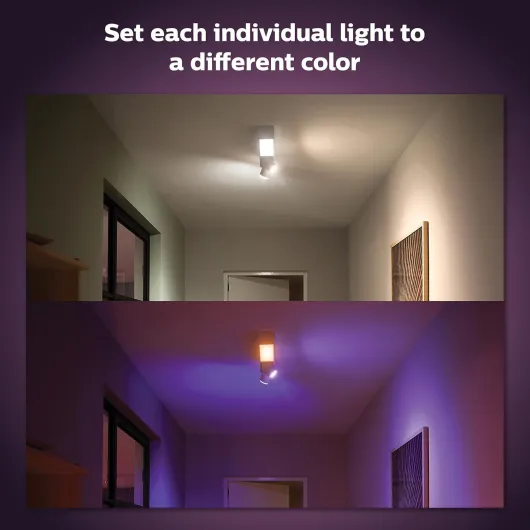
Response time is quick. Using the Hue app or voice with Alexa/HomeKit, the lights react in about a second or less. Scenes that involve both spots and the main bar apply correctly, and each spotlight can be tuned separately. For example, I set a scene where the bar is warm white at 30%, one spot is cool white on a desk at 70%, and the other is a pale blue on a plant at 40%. It remembers everything perfectly when I turn it off and on again via the app or a Hue switch.
In daily life, the main advantage is flexibility: one fixture, but you can have general lighting, task lighting and a bit of accent lighting all at once. It’s not perfect—if you want super precise accent lighting on artwork, dedicated track lighting is better—but for a living room or office, it’s more than enough. I never felt like I “lacked” light with this on the ceiling, which for me is the main test.
What this Centris 2-spot actually is (and what it isn’t)
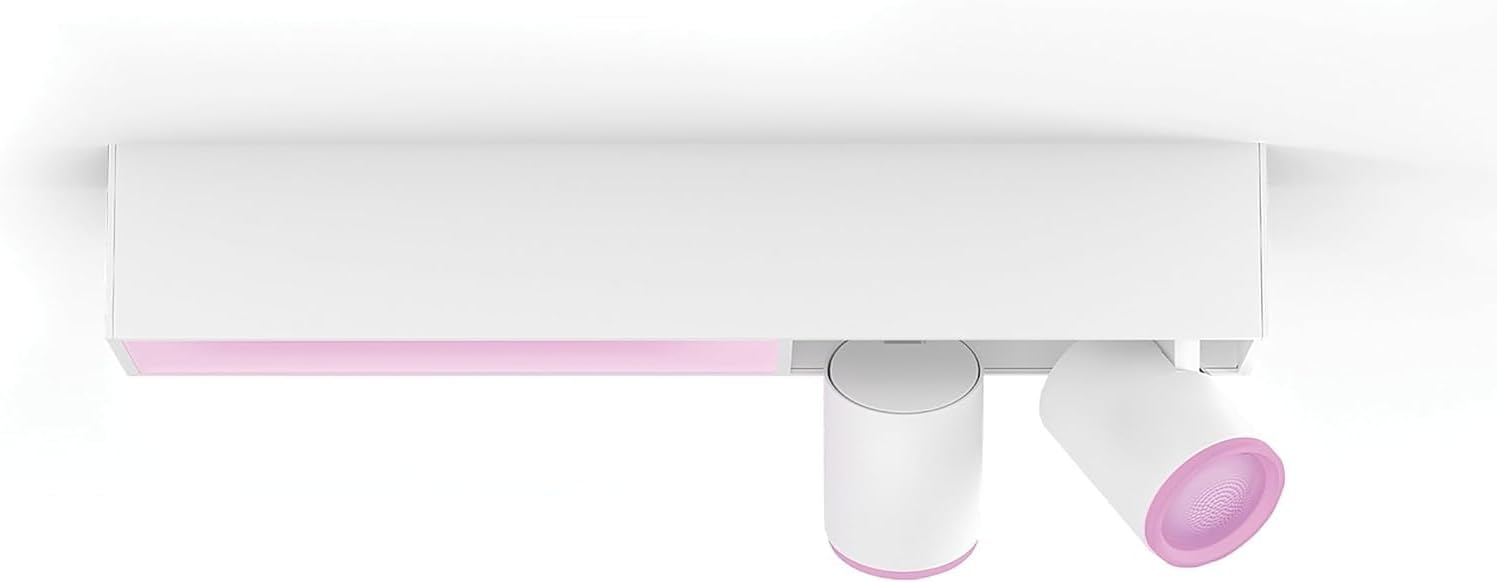
On paper, the Philips Hue Centris 2-spot is a semi-flush mounted ceiling fixture with two adjustable spotlights and a built-in light bar. The whole thing is one unit that you mount directly to the ceiling. It’s part of the White & Color Ambiance range, so you get full RGB colors plus warm-to-cool white. It’s controlled via the Hue app, works with Bluetooth out of the box, and integrates with Alexa, Google Assistant, and Apple HomeKit if you have the Hue Bridge or use Matter.
Each spotlight is individually controllable in the app, which is the main interest here. You can set one to a warm white over the sofa and the other to a cooler white over a desk area, or give them different colors if you’re into that. Official specs mention around 6000 lumens total, which in real life feels like: yes, this can light a medium living room or a large office area without you needing extra lamps, as long as your room is not huge.
It’s meant for indoor use only (no bathroom or outdoor), and there’s no physical switch on the fixture itself; you keep your wall switch on and control everything via app/voice or a Hue remote. It mounts like a standard ceiling fixture: power wires in a terminal block, then the fixture hooks to the bracket. The product page says plastic material and painted finish, but in hand it doesn’t feel toy-like; it’s closer to what you’d expect from mid-range modern lighting rather than a cheap plastic dome from a discount store.
In short, it’s basically Philips Hue taking a normal ceiling spotlight bar and integrating their smart guts directly into it. If you’re hoping for some hidden extra features (built-in motion sensor, speaker, whatever), forget it. It’s a smart light, period. The interest is: all-in-one, clean look, and deep integration with the Hue ecosystem.
Smart features & app control: works well, but shines if you already have a Hue Bridge
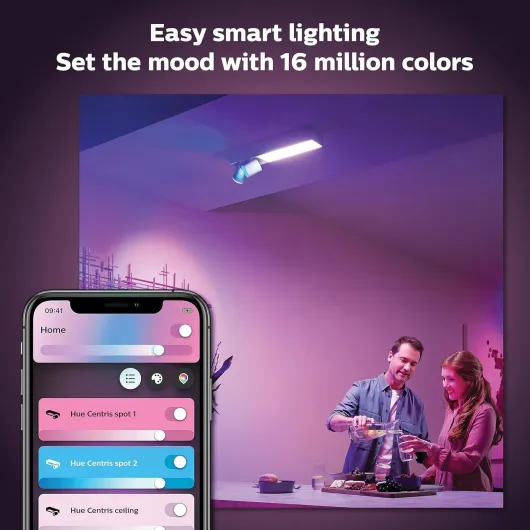
On the smart side, the Centris behaves like any other Hue light, which is a good thing. If you only use Bluetooth, you can still control it from the Hue Bluetooth app, but you lose a bunch of features like advanced automations, remote access, and better stability. I already had a Hue Bridge, so I just added it there, and everything synced quickly. Pairing was straightforward: power on, open the app, search, name the light, done.
Voice control is where it gets comfortable. I tested it with Alexa and HomeKit. Commands like “set living room lights to 30%” or “turn the spots blue” worked consistently. Because each spotlight is seen as a separate light in the app, you can be precise: “turn bookshelf light to warm white at 50%” while leaving the other one brighter. There were no weird delays or desync issues in my use. That’s the advantage of the Hue ecosystem: it’s boring in a good way; it just works most of the time.
The real interest comes when you start playing with routines and scenes. I set a morning routine where the bar gradually brightens from warm to neutral white over 15 minutes, while one spotlight comes on slightly later over the desk. In the evening, a single tap on a Hue Dimmer switch switches to a low, warm scene that’s easy on the eyes. All this is standard Hue stuff, but having it in a central ceiling fixture instead of random lamps makes the room feel more coherent.
If you don’t plan to use a Bridge and just want Bluetooth/app control, it still works, but honestly you’re not getting the full value. For the price of this fixture, it’s a bit of a waste to not use automations, remote control, and the more stable Zigbee connection. In short: as a “dumb” light with Bluetooth, it’s overkill. As part of a real Hue setup with a Bridge, it’s very effective and fits right in.
Pros
- Very bright with flexible warm-to-cool white and full color options
- Two individually adjustable spotlights plus main bar give both general and task lighting
- Integrates smoothly with Hue Bridge, app, and voice assistants for reliable daily use
Cons
- High price compared to a normal fixture with separate Hue bulbs
- Mostly plastic build and integrated design make repairs or upgrades harder
Conclusion
Editor's rating
After using the Philips Hue Centris 2-spot for a while, my feeling is pretty clear: it’s a solid, practical smart ceiling light that looks good and works smoothly, but you absolutely pay for the brand and the ecosystem. The brightness is more than enough for a living room or office, the two adjustable spots are genuinely useful, and the integration with the Hue app and voice assistants is clean. If you already have a Hue Bridge and other Hue lights, it fits right in and makes the room feel more coherent than a random mix of lamps and bulbs.
On the downside, the price is high, the materials are good but not premium, and you’re locked into an integrated fixture that’s not as easy to repair or upgrade as a simple bar with separate GU10 bulbs. If you just want smart lighting on a budget, this is not the smartest way to spend your money. But if you care about design, want fewer separate pieces on your ceiling, and you’re already deep into Hue, it’s a nice upgrade that gets the job done every day without drama.
So, who should buy it? People who already live in the Hue ecosystem, want a clean modern ceiling light with good brightness and flexible spots, and are okay paying extra for that convenience. Who should skip it? Anyone just starting with smart lights, anyone on a tight budget, or people who prefer more repairable, non-integrated fixtures with separate bulbs.
![NEW White and Colour Ambiance Smart Light Bulb Starter Kit, 75W - 1100 Lumen [E27 Edison Screw] 2 Bulbs + Smart Button - With Bluetooth - Works with Alexa, Google Assistant and Apple Homekit E27 2 Pack Starter Kit + Button](https://www.smart-light-guru.com/storage/1015385/conversions/71yJIPbE0LL._AC_SL1500_-medium.webp)