Summary
Editor's rating
Is it worth the price for what it actually does?
Playful design that actually changes how you use it
Battery life and charging: fine, but not all-day portable
Mostly plastic, decent build but not luxury
Everyday durability and how it handles bumps
Light output, colors, and smart features in real use
What the CONO lamp actually is (and isn’t)
Pros
- Playful, flexible design that works as both decor and portable light
- Good RGB colors and smooth app/voice control once set up
- Cordless use with rechargeable battery makes it easy to move around
Cons
- Not very bright, more mood light than real task lighting
- Price feels high for mostly plastic build and limited brightness

Specifications
View full product page →| Brand | Nanoleaf |
A design lamp that’s more toy than traditional light
I’ve been using the Nanoleaf x Umbra CONO lamp (Sierra version) for a couple of weeks, mainly on my bedside table and sometimes on my desk. If you’re expecting a classic nightstand lamp that really lights up a room, this isn’t it. It’s more of a portable mood light that happens to look pretty cool and hooks into your smart home. That’s the mindset you need to have, otherwise you’ll be disappointed.
The first thing that struck me is how small and light it is. The pictures online make it look almost like a full-size table lamp, but in reality it’s closer to a chunky flashlight disguised as decor. It’s clearly designed more for ambiance and decoration than for serious lighting. After the first night, I stopped trying to read under it and just used it as a background glow.
Nanoleaf pushes the whole Matter over Thread thing, which basically means it’s supposed to play nicely with different smart home systems and be responsive. In practice, setup was mostly fine but not totally frictionless. I had one annoying moment where it wouldn’t show up in my app until I reset it. Once it was paired, though, it behaved pretty well with app and voice control.
Overall, my early impression was: nice idea, fun to play with, but you really need to know what you’re buying. It’s not a bright desk lamp, it’s a stylish little light toy with smart features. From there, the rest of the experience makes more sense, both the good parts and the stuff that feels a bit overpriced for what it does.
Is it worth the price for what it actually does?
Value is where opinions will split. You’re paying for a combination of design, portability, and smart features. In terms of pure lighting, you can get brighter bedside or desk lamps for a lot less money. Even other RGB smart bulbs and simple fixtures can give you color and app control for cheaper. So if you only care about light output per euro, this is not a great deal.
Where it starts to make more sense is if you specifically want a small, nicely designed, portable smart lamp that works with Matter and can be moved around easily. Compared to generic LED mood lights from no-name brands, this feels more thought-through: the shape is more practical, the app and ecosystem are more polished, and integration with smart home setups is better. You’re basically paying a design and ecosystem premium.
For me personally, I’d say the value is “pretty solid but not amazing”. I like the design, I like the portability, and I like that it fits into a smart home setup without too much pain. But I’m also aware that a chunk of the price is just for the look and the brand. If this were 20–30% cheaper, I’d be a lot more enthusiastic. At its usual price point, I think it’s best suited to people who already like Nanoleaf products or really care about design-focused gadgets.
If you just want a bedside lamp that you can dim and maybe change color sometimes, there are cheaper and simpler options that will do the job. If you want something that doubles as a decorative object, a portable night light, and a smart gadget you can control by voice, then the price starts to feel more acceptable, even if it’s not a bargain.
Playful design that actually changes how you use it
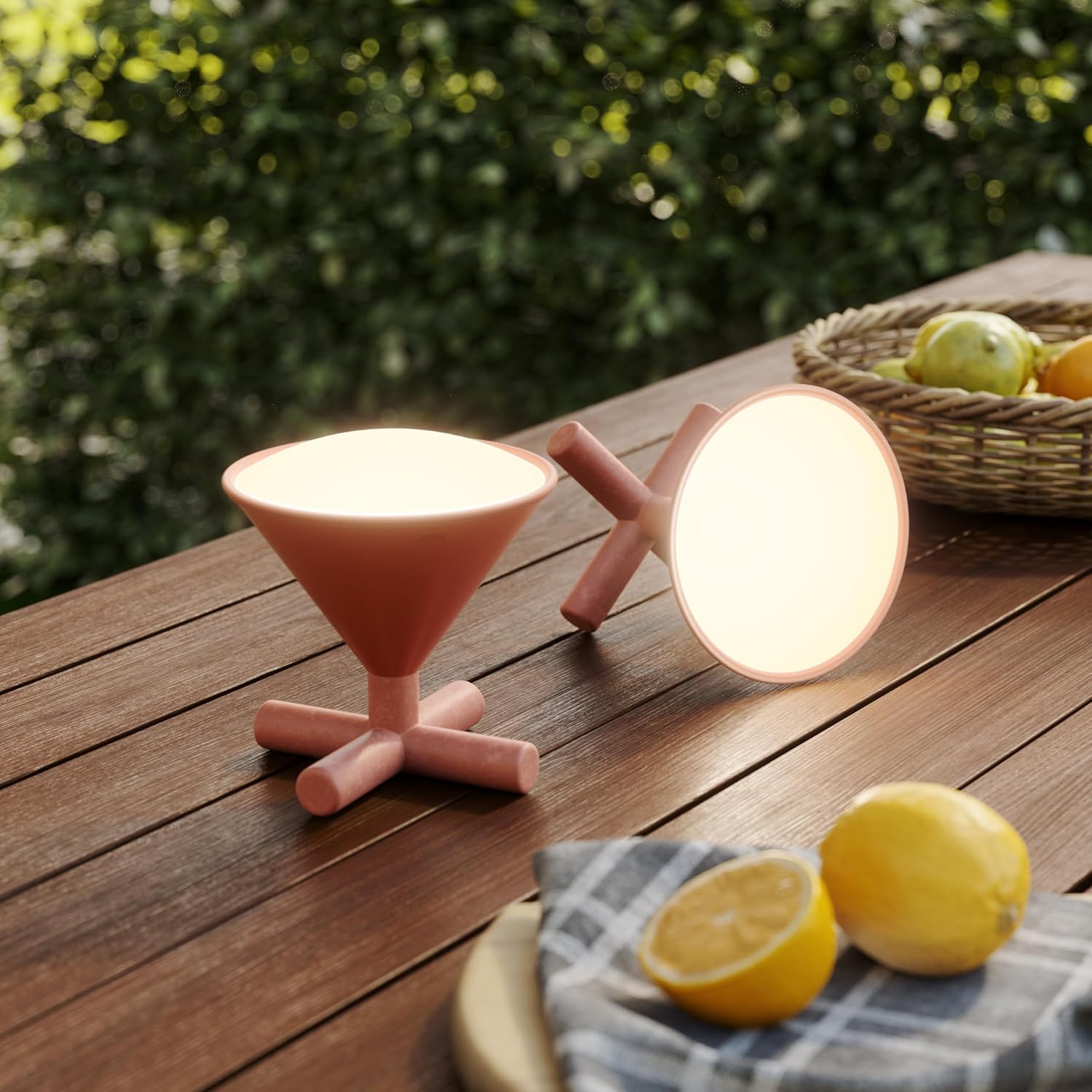
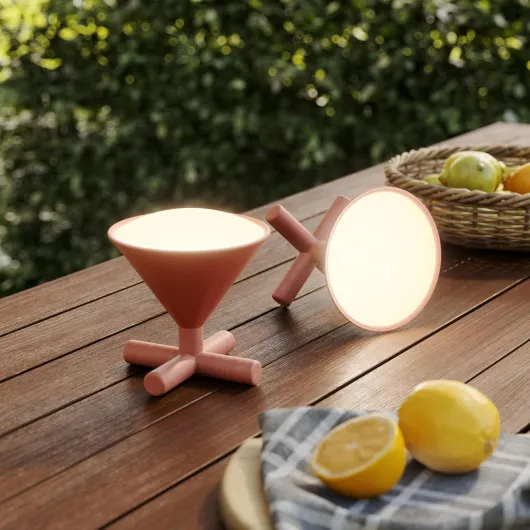
The design is the main reason you’d even look at this lamp. It has this cone-shaped body with three legs that look a bit like a small tripod crossed with a handle. You can tell Umbra had a say in it, because it looks more like decor from a design shop than a generic tech gadget. On my bedside table, it doesn’t scream “smart device”, it just looks like a small modern object that happens to light up.
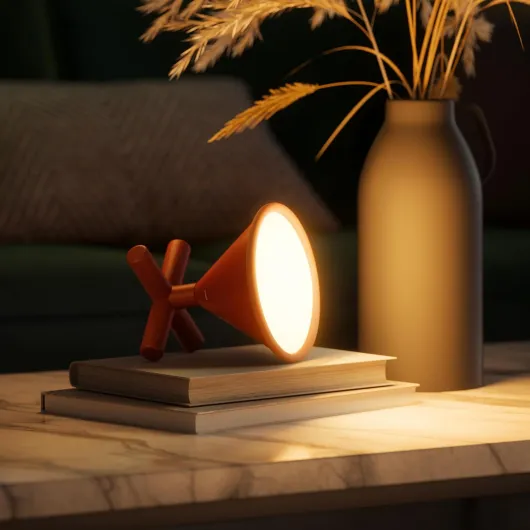
The cool part is that the shape actually affects how you use it. You can place it upright for a more focused beam, lay it on its side to wash a wall with color, or flip it around to get a more indirect glow. I ended up using it sideways most of the time, aiming it at the wall or ceiling to avoid light directly in my eyes. Compared to a normal lamp with a fixed shade, this flexibility is handy, especially in a small room where you don’t want a harsh light in your face.
As a handheld light, the legs as a handle idea is decent. I grabbed it a few times at night to walk to the kitchen without turning on the main lights. It’s more comfortable to hold than a big bulb-shaped lamp, and it feels stable in the hand. That said, it’s still a bit awkward if you carry it for more than a couple of minutes; it’s not as practical as a real flashlight, but it’s fine for short trips around the house.
Visually, the matte finish and the multicolored lighting look good together. It doesn’t look cheap, but it also doesn’t feel super premium in the hand – you can tell it’s mostly plastic. For a bedside or desk setup, the design is the highlight: it’s original, playful, and easy to move around. If you care about your space looking a bit different from the usual IKEA lamp, this checks that box without going overboard.
Battery life and charging: fine, but not all-day portable
The lamp is rechargeable and cordless in day-to-day use, which is one of its main selling points. In practice, the battery life depends heavily on brightness and how crazy you go with colors and effects. With a warm white at about 40–50% brightness, I was getting roughly an evening and a half of use (around 6–8 hours total) before feeling the need to plug it in. On brighter levels or more dynamic color scenes, it dropped closer to 4–5 hours.
For my routine, that meant I could use it every night for a few hours before bed for two days, then charge it on the third night. If you leave it on all evening at higher brightness, you’ll probably be plugging it in more often. It’s not really a “carry it around all weekend without charging” device; think more “evening lamp you recharge regularly”, like you would with wireless headphones you use daily.
Charging is through a corded connection (it’s not wireless charging), and it’s straightforward. Plug it in, leave it for a couple of hours, and it’s full again. It’s not especially fast or slow – just average. You can technically use it while it’s plugged in, but that kind of defeats the whole clean cordless look. I mostly charged it during the day so it stayed cable-free at night.
Overall, battery performance is decent but not impressive. It’s good enough if you treat it as a portable lamp you use in sessions, not something that has to stay on 24/7. If you’re thinking of using it as a permanent accent light that’s always running, you’ll either keep it plugged in or get annoyed at how often you’re recharging it. For occasional handheld use and nightly ambiance, the battery is acceptable.
Mostly plastic, decent build but not luxury
Material-wise, the CONO lamp is mainly plastic with some metal elements inside. The base and shade are plastic, with a matte finish that hides fingerprints pretty well. When you pick it up, it feels light, which is nice for a portable lamp but also reminds you that you’re not dealing with heavy, premium materials. It doesn’t feel fragile, just very “consumer gadget” rather than furniture-grade.
The joints and legs feel solid enough. I tossed it onto the bed and moved it around by the legs several times and nothing creaked or felt loose. I also accidentally knocked it over from my bedside table once (so about 60–70 cm high) onto a hardwood floor. No cracks, no marks, everything still worked. So while it’s not built like a tank, it can handle normal everyday clumsiness without falling apart.
The shade is a transparent/colourless plastic that diffuses the LEDs. You can see a bit of the internal structure if you look closely when it’s off, but once it’s on, the light blends fairly well. It doesn’t have that glass-lamp feel, but it’s also less scary to move around – I had no hesitation carrying it one-handed while juggling my phone in the other because I knew I wasn’t going to shatter anything.
For the price, I think the materials are okay but nothing special. You’re clearly paying more for the design and the smart features than for high-end construction. If you’re expecting metal, glass, or something that feels heavy and premium, this will feel a bit cheap. If you just want something light, practical, and reasonably sturdy for indoor use, the materials get the job done without any big red flags.
Everyday durability and how it handles bumps
After a couple of weeks of normal use, the CONO lamp holds up fine. Like I mentioned earlier, I dropped it once from bedside-table height onto a hard floor and it survived without any visible damage. No cracks, no weird rattling, no change in behavior. That gave me a bit more confidence that it’s not super fragile, even though it’s mostly plastic.
The matte finish also hides small scuffs pretty well. I slid it around my desk and nightstand quite a bit, and I don’t see obvious scratches or shiny spots developing. If you really abuse it, of course it’ll mark, but for normal home use – moving it, grabbing it by the legs, tossing it onto soft surfaces like a bed or sofa – it seems to handle it fine. There’s no sense that something is going to snap off easily.
One thing to note: it’s not water resistant at all. The specs are clear on that, and you can tell from the build. I wouldn’t use it in a bathroom with a lot of steam, and I definitely wouldn’t take it outside if there’s any chance of rain or moisture. This is an indoor-only device, best kept away from sinks, bathtubs, and balconies. I kept it in the bedroom and living room only, just to be safe.
Long-term durability is harder to judge in a couple of weeks, but based on the materials and the way it’s put together, I’d say it should be fine for regular indoor use if you’re not reckless. It feels like a typical smart home gadget: sturdy enough for normal life, not built to survive serious abuse. If you have kids who like to throw things, I’d keep it out of reach. For adults using it as a bedside or desk light, I don’t see major durability concerns.
Light output, colors, and smart features in real use
In terms of light performance, this lamp is firmly in the mood-light category. On max brightness with white light, it’s enough to light up a small corner or act as a bedside light for getting ready for bed, but it’s not strong enough for detailed work or long reading sessions. I tried reading a book with only the CONO on, and after about 10 minutes I turned on another lamp because my eyes were getting tired. So if you want a proper reading light, this should be a secondary lamp, not the main one.
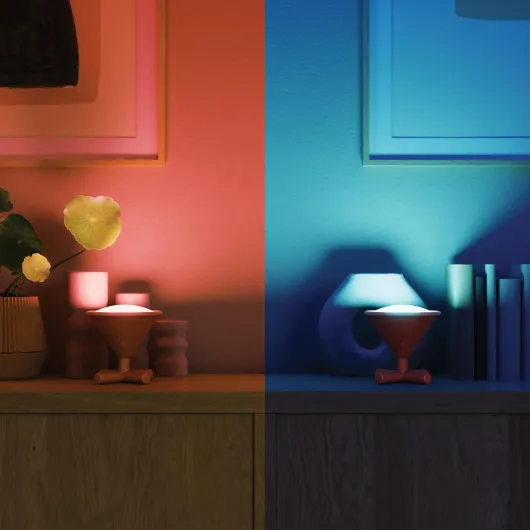
Colors are where it makes more sense. The RGB modes are smooth and fairly rich. I used warmer oranges and soft pinks at night, and cooler blues/greens when it was just running in the background during the day. The transitions in animated scenes are smooth, no weird flickering. It’s not as bright or intense as Nanoleaf wall panels, but for a compact table lamp, the color coverage is pretty solid. You can easily set up different scenes for “movie night”, “relax before bed”, or “barely there nightlight”.
On the smart side, once connected, the app control is fine: you can adjust brightness, color, and scenes without any big delay. Voice control also worked reliably for me with basic commands like turning it on/off, changing color, or dimming. The Matter over Thread part is more behind-the-scenes; in day-to-day use, what you notice is that it responds fairly quickly and doesn’t randomly drop off the network. I did have one app freeze during the first setup, but after that, it was mostly stable.
So overall, performance is good for what it is: an accent light with smart features. It’s not a powerhouse lamp, but it does ambient lighting and color effects well enough. If you go in expecting practical, bright lighting, you’ll be let down. If you want a smart mood lamp that responds quickly and plays nice with your other devices, it does the job pretty well.
What the CONO lamp actually is (and isn’t)
On paper, the Nanoleaf x Umbra CONO is a rechargeable, cordless, RGB smart lamp that you can plop on a table, carry around like a torch, and control with an app or voice assistants. The model I tried is the Sierra colorway. The dimensions are roughly 14.6 × 17.2 × 14.6 cm, so it’s compact. The lamp uses LEDs, connects over Bluetooth and Wi‑Fi, and supports Matter over Thread, which is the new smart home standard that’s supposed to make devices less of a headache.
In real life, it behaves like a portable mood light that you can angle in different ways. You can stand it upright, lay it on its side, or flip it so it points up or towards a wall. The legs double as a handle, so it feels natural to grab and move it around the room. I used it on my nightstand, carried it to the hallway a couple of times at night, and once just dropped it on the coffee table in the living room to add some color during a movie.
Lighting-wise, you get full RGB colors plus white tones, but the strength is clearly on the ambient side. It’s not bright enough to replace a normal desk lamp for work or a serious reading light. It’s more in the category of “soft glow in the background” or “accent light for a corner or shelf”. If you already have main lighting and just want a bit of color or a cozy vibe, it fits that role. If this is your only light source in a room, you’ll find it weak.
So the way I’d sum it up: it’s a decorative smart light with portable, torch-like use as a bonus. It’s aimed at people who like to tweak colors, play with scenes, and integrate their lamp with an existing smart home setup. If you just want a simple bedside lamp that plugs in and works like a regular light, this is probably more complex and more expensive than you need.
Pros
- Playful, flexible design that works as both decor and portable light
- Good RGB colors and smooth app/voice control once set up
- Cordless use with rechargeable battery makes it easy to move around
Cons
- Not very bright, more mood light than real task lighting
- Price feels high for mostly plastic build and limited brightness
Conclusion
Editor's rating
The Nanoleaf x Umbra CONO lamp is a nice little smart mood light with a playful design that actually changes how you use it. As a portable accent lamp for a bedroom or living room, it works well: easy to move, flexible positioning, decent colors, and smooth integration with smart home systems once it’s set up. It’s not trying to be a serious work light, and if you treat it as a decorative gadget that also happens to be useful at night, it feels coherent.
On the flip side, it’s not very bright, the materials feel more gadget-like than premium, and the price is a bit steep if you look only at raw functionality. The battery is okay for evening use but not mind-blowing, and the initial setup can be slightly annoying if Matter or the app decides to be fussy. For the cost, you’re clearly paying for design, brand, and smart features more than for sheer performance.
I’d recommend it to people who already use smart home gear, like Nanoleaf or similar brands, and want a small, stylish lamp for ambiance rather than strong lighting. It also suits folks who enjoy tweaking colors and scenes and appreciate having something that looks a bit different on their bedside table. If all you need is a bright, simple, plug-in lamp to read under or light up a whole desk, or if you don’t care about apps and voice control, you’ll find better options for less money and this will feel like overkill.


![L510E Smart Bulb, Smart WiFi LED Light, E27, Works with Amazon Alexa(Echo and Echo Dot), Google Home, Dimmable Soft Warm White, No Hub Required [Energy Class F] 1 Pack](https://www.smart-light-guru.com/storage/939180/conversions/71WGq8rBN-L._AC_SL1500_-medium.webp)