Summary
Editor's rating
Value: great if you’re deep into Hue, questionable if you just need light
Design: clean look, good wall effect, but very directional
Build quality and materials: feels solid, but check the outdoor side of things
Early durability check: feels robust, but brightness ceiling is fixed
Brightness, colors, and smart features in real use
Installation and setup: doable solo, but not plug-and-play
What you actually get with the Dymera
Pros
- Two independently controllable beams (top and bottom) that integrate cleanly into the Hue app
- Solid metal construction with a clean, modern look and a nice wall-wash effect
- Works well in the Hue ecosystem with reliable control, scenes, and voice assistant support
Cons
- Not very bright for the price – more of an accent light than a main outdoor light
- Requires a Hue Bridge to really make sense outdoors and for full smart features
- Integrated LEDs mean you can’t just swap a brighter bulb later if you want more light

Specifications
View full product page →| Brand | Philips Hue |
A pricey wall light I actually wanted to play with
I’ve been using Philips Hue stuff for a while (bulbs, light strips, a couple of outdoor fixtures), so when the Dymera came out I grabbed one to test on a side wall by my patio door. I’ve had it running for a bit now, through a few evenings of normal use and one small get-together. My take is pretty simple: it looks good, works well in the Hue ecosystem, but you pay quite a bit for what is basically a decorative wall light that isn’t crazy bright.
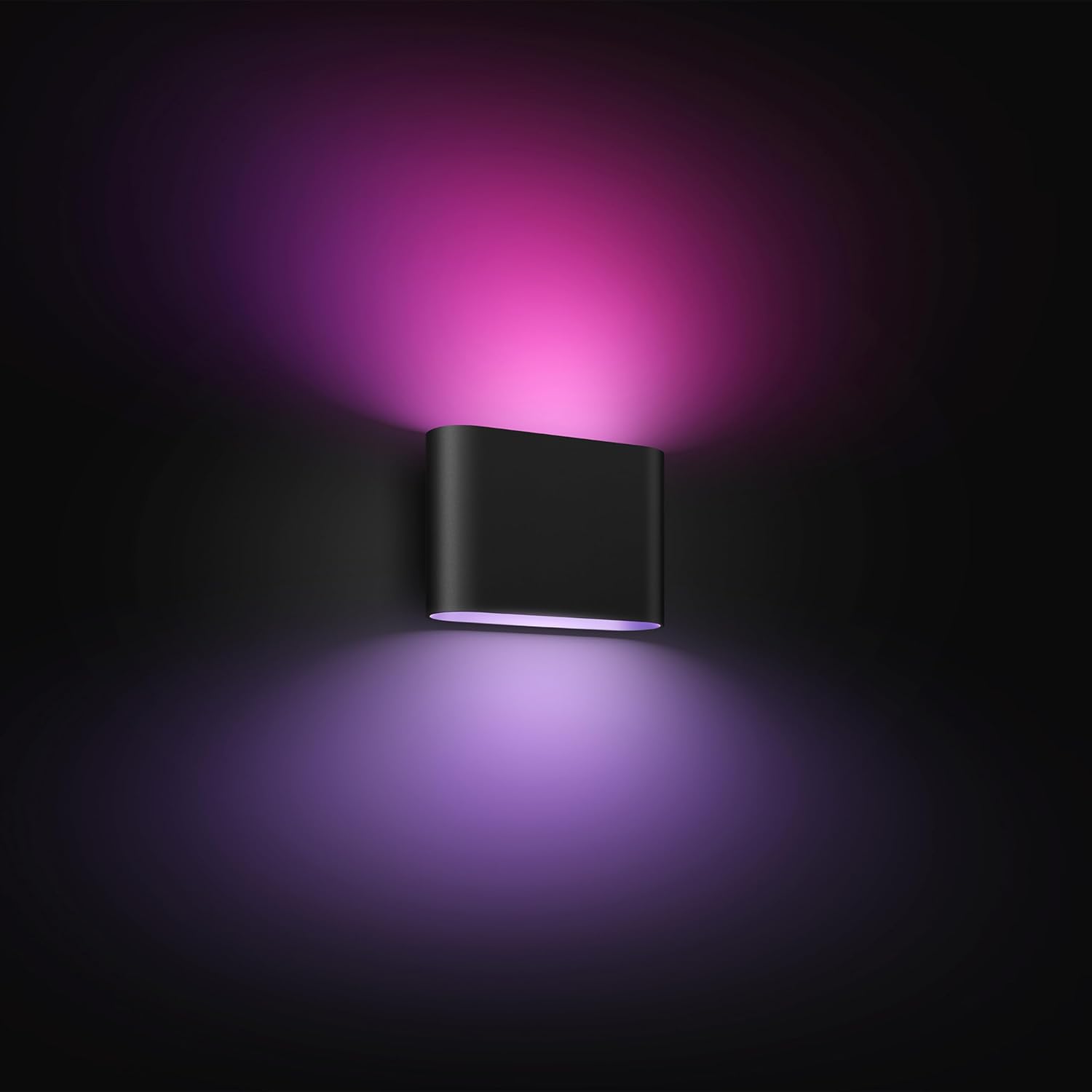
The big selling point is the two independently controllable beams – one up, one down. That’s the thing that made me buy it. I wanted to be able to put a warm white on the bottom for actual visibility, and a color on top for mood lighting. In practice, that part works exactly like I hoped. In the Hue app, you see two separate segments and can set them however you want. No weird pairing issues, no lag once it’s set up correctly with the Bridge.
Where it’s less impressive is the raw brightness. On paper it’s around 1020 lumens total, and you can feel that. It’s fine for decor and for marking out an entry, but it’s not going to light your whole yard or a big driveway. If you’re expecting a floodlight vibe, this isn’t it. I ended up keeping my other brighter outdoor light for real visibility and using the Dymera more as accent lighting.
Overall, after living with it, I’d say it’s a nice-looking, smart accent light that makes a lot of sense if you’re already into Hue and scenes. If you’re just trying to light up a dark area cheaply, there are better and cheaper options. The Dymera is more about looks, colors, and control than pure utility.
Value: great if you’re deep into Hue, questionable if you just need light
Let’s talk money because that’s where the Dymera is a bit harder to justify. It’s not cheap for a single wall sconce, especially when you compare it to regular outdoor lights that cost a fraction of the price and are brighter. What you’re paying for here is mainly the integration with the Hue ecosystem, the dual-beam control, and the brand’s track record for decent software and long-term support. If those things matter to you, the price is easier to swallow. If you just want a porch light so you don’t trip over the steps, this is overkill.
Compared to other smart options, like cheaper Wi-Fi RGB fixtures from random brands, the Dymera is more expensive but generally offers better app experience, better ecosystem, and more reliable updates. I’ve had enough cheap Wi-Fi smart lights flake out or lose connection that I personally prefer Hue for main areas. But again, you’re paying a premium for that stability and for the Hue name. For most people who aren’t into smart home setups, that premium won’t feel worth it.
The main downside in terms of value is that brightness-to-price ratio. For the money, you might expect something that can replace a more powerful outdoor fixture. Instead, you get a good-looking accent light that plays nicely with scenes. If you factor in the cost of a Hue Bridge (if you don’t own one yet), the total climbs even more. At that point, it makes sense mainly for people who already have Hue all over the house and want to keep everything in one system.
So my honest opinion: the Dymera is good, but not exactly a bargain. It makes sense if you’re already invested in Hue, care about color scenes, and like the dual-beam style. If you just need functional outdoor lighting or are on a tight budget, you can get brighter and cheaper fixtures, and maybe just stick a single Hue bulb or a dumb LED in them instead.
Design: clean look, good wall effect, but very directional
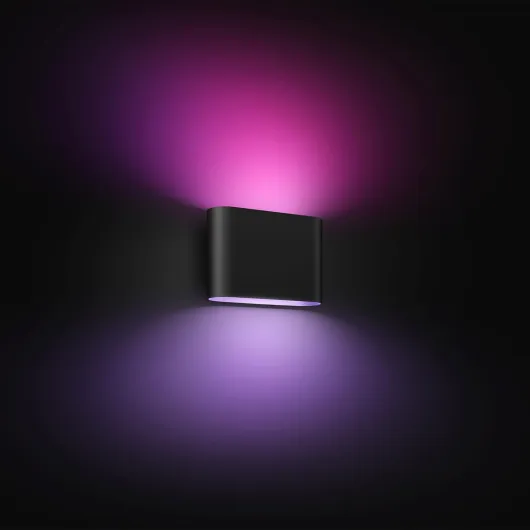
Design-wise, the Dymera is pretty minimal and boxy. Mine is the black version, and it basically looks like a solid rectangular block that sits a little off the wall. No glass dome or visible bulb, just a metal housing with light spilling out from the top and bottom. On my white exterior wall, it blends in visually during the day and looks a lot nicer at night when the light beams show up. If you like fuss-free, modern shapes, it fits that style. If your house is more traditional, it might look a bit out of place.
The main design trick is the two separate beams. The light goes straight up and straight down, creating two cones or columns of light on the wall. With white light, it gives that typical “architectural” look you see on newer houses or in hotel corridors. With colors, it can get a bit more playful – like warm white down and a soft blue or purple up. In the Hue app, the top and bottom show as two different controllable zones, which is honestly the best part of this product. It’s simple to set up a scene where the top is static and the bottom reacts to a routine, for example.
One thing to be clear about: because of how it’s designed, most of the light stays on the wall. It’s not a wide flood that throws light far into the yard. From the side, the light spreads a bit, but the main effect is vertical. On my patio, it looks nice on the wall but doesn’t light the seating area by itself. If you want more general lighting, you’d need to pair this with other fixtures or overhead lights.
In terms of size, it’s not tiny. Around 23 x 15.7 x 9.4 cm, so it has some presence. On a narrow column or small wall it will stand out. On a larger wall or beside a garage door, it looks more proportional. Personally, I like the design – simple, modern, not flashy – but it really is more about the light pattern than the fixture itself.
Build quality and materials: feels solid, but check the outdoor side of things
The Dymera housing is metal with a powder-coated finish, and it does feel solid in the hand. It doesn’t creak, there are no loose parts, and the edges are cleanly finished. It feels more like a proper exterior fixture than a cheap plastic smart gadget. When I mounted it, nothing flexed or felt fragile, which is nice given the price. It has a decent weight to it (around 1.77 kg), so it doesn’t feel hollow or flimsy.
The powder coating on my unit looks consistent, no weird shiny patches or rough spots. I’ve had a few light rain showers hit it directly and some dust and pollen, and so far it wipes off easily with a damp cloth. I can’t comment on multi-year durability yet, but based on other Hue outdoor products I have, they usually hold up pretty well as long as you don’t live in super extreme conditions. Still, I’d avoid mounting it where it’s constantly blasted by sprinklers or direct sea spray if you can help it.
One confusing thing is that some spec sheets mention “not water resistant”, which doesn’t match the way Philips markets this as indoor/outdoor. In reality, Hue outdoor fixtures normally have an IP rating. The unit I installed clearly feels like it’s built for outdoor use – gasketed back, sealed LED area, and the usual outdoor wiring setup. I treated it like any other exterior fixture and wired it accordingly, and so far there’s been no issue with moisture or flickering. But if you’re super picky about exact IP ratings, you might want to double-check the official Hue site for your region before buying.
Overall, on the materials side, I’d say it’s pretty solid for a wall sconce. It doesn’t scream luxury, but it also doesn’t look cheap or plasticky. For the price, I would expect this level of build quality at minimum, and it meets that. Time will tell how the finish holds up to sun and rain, but out of the box it feels like it should survive normal outdoor use without drama.
Early durability check: feels robust, but brightness ceiling is fixed
I haven’t had the Dymera for years, so I can’t pretend to know exactly how it will age, but after some weeks of use and a few weather changes, nothing has given me a bad feeling. No water ingress, no flickering, no weird noises from the driver. The housing still feels tight on the wall, and the finish hasn’t shown any marks beyond normal dust. I’ve turned it on and off a lot while testing scenes and automations, and it responds the same every time.
Like most Hue products, the LEDs are non-removable. That’s normal for this style of fixture, but it does mean that when the LEDs eventually degrade or fail, you’re replacing the whole unit, not just a bulb. Philips usually rates their LEDs for a long life, and I’ve had Hue bulbs running for years without issues, so I’m not too worried, but it’s something to keep in mind given the price. If it dies early, you’re out a fairly expensive piece of kit instead of a $15 bulb.
In terms of brightness over time, there’s obviously no way to upgrade it. If later you decide you want more light in that spot, you can’t just pop in a brighter bulb. You’d need to replace the whole fixture with something else. That’s the trade-off of this integrated design. So if you’re already on the fence about brightness, I’d think carefully before committing, because you’re stuck with what it is from day one.
Overall, early signs point to good durability on the physical side and typical Hue reliability on the electronics side. Just remember that you’re buying an integrated system: if something fails out of warranty, you’re likely replacing the whole thing, not repairing it. If you’re okay with that and you’ve had decent luck with Hue gear before, it’s probably fine. If you like to keep fixtures for decades and just swap bulbs, this style might annoy you.
Brightness, colors, and smart features in real use
In daily use, the Dymera is good for ambiance, average for raw lighting power. The 1020 lumens are split between top and bottom, so each beam isn’t super intense. For my side patio, it’s enough to see the wall and not trip on anything right near the door, but it’s not something I’d rely on as my only exterior light. Compared to a typical 1500–2000 lumen outdoor fixture, this feels noticeably softer. One Amazon review saying “nice, but not very bright” is pretty accurate. If you want bright white light, you can crank it to a cool white and max brightness, but it still stays in the accent-light territory.
On the color side, it behaves like any other Philips Hue color light: lots of color options, decent saturation, and smooth transitions. Some colors are naturally weaker (like pure green and bright yellow never look as intense as in marketing photos), but that’s true for most RGB smart lights. The nice thing is that you can have, for example, warm white downward for actual usefulness and a colored beam upward for atmosphere. For holidays or parties, being able to sync the Dymera’s two beams with your other Hue scenes is pretty fun and makes the wall a bit of a feature.
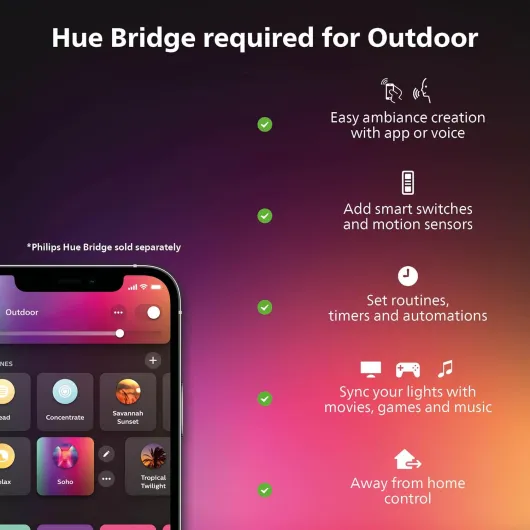
Control-wise, with a Hue Bridge, it’s stable. I didn’t get random disconnects or lag when switching scenes. It shows up instantly in the Hue app, and each beam is treated as a separate controllable channel. Voice control through Alexa/HomeKit worked like any other Hue light: “set top light to blue, bottom light to warm white” type commands are easy if you name them clearly in the app. Without a Bridge and just using Bluetooth, the range and reliability are worse, and you lose a lot of the smart scheduling and remote control, so I wouldn’t buy this just for Bluetooth use.
So in short: performance is solid within the Hue ecosystem, but brightness is on the modest side. If you go in expecting a stylish smart accent light, you’ll probably be happy. If you expect a powerful security or work light, you’ll be disappointed. It does what it’s built to do, just don’t confuse its role.
Installation and setup: doable solo, but not plug-and-play
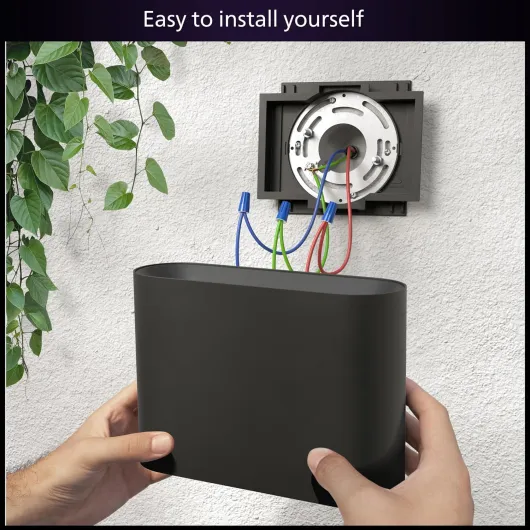
Installing the Dymera is standard hardwired wall light work. This is not a plug-in lamp, so if you’re not comfortable turning off breakers and wiring neutral/line/ground, you might want someone handy to do it. The included mounting plate is actually pretty user-friendly. I managed to do the whole thing alone without feeling like I needed a second person to hold the fixture. You screw the plate to the wall, connect the wires, and then hook the light onto the plate and secure it. The weight is manageable, but you do feel the 1.7 kg when you’re on a ladder.
The instructions are clear enough, nothing fancy, just diagrams for the wiring and how to attach the housing. There’s enough room in the back cavity to tuck the wires in without fighting the fixture. I mounted it on a standard exterior junction box and didn’t have any alignment problems. If your wall is uneven or your box is crooked, you might need to fiddle a bit to get it level, but that’s normal for any wall sconce.
Once powered, pairing with the Hue app was painless. The app found it quickly through the Bridge, and it showed up as a Dymera with two controllable segments. I renamed the top and bottom beams to something simple so I could control them via voice. From there, adding it to scenes and automations was just like any other Hue light. I set up a routine where it turns on at sunset with warm white on the bottom and a softer color on top, and turns off around midnight.
The only catch is: if this is your first Hue product and you don’t have a Hue Bridge, you’re stuck with Bluetooth, which is way more limited and not ideal for an outdoor fixture. Also, you’ll need an existing junction box or have someone run a line to where you want it. So I’d call installation pretty straightforward if you’re used to swapping light fixtures, but definitely not as simple as screwing in a smart bulb.
What you actually get with the Dymera
Out of the box, the Dymera is pretty straightforward: you get the fixture itself, the mounting plate, screws/anchors, and the usual paper instructions. No Hue Bridge in the box, which is worth repeating: if you want to use this outdoors with all the smart features, you basically need a Bridge. You can pair it over Bluetooth indoors, but the Bluetooth control is limited and not great for automations or controlling from outside the house.
The light is rated at around 1020 lumens, 39W, with two LED segments (top and bottom). It supports the usual Hue color range (they talk about 16 million colors, which just means it does full RGB plus white tones). You control it via the Hue app, and it’s compatible with Alexa, Google Assistant, Apple HomeKit, and Matter, as long as it’s tied into a Bridge. I tested it with a Hue Bridge and HomeKit, and it showed up like any other Hue light, split into two controllable zones.
In terms of role, I’d call this a decorative wall sconce with smart features, not a primary light source. The beam is fairly focused up and down, so it’s more about creating that architectural stripe of light on the wall than bathing the whole area. On my patio wall it looks nice and gives enough light to see where you’re walking, but if I turn off my other exterior lights, the space feels a bit dim.
If you’ve never used Hue before, this might feel like overkill as a first product. There’s the price of the fixture itself plus the Bridge if you don’t already have one. If you’re already running a Hue system, then it slots right in and basically just feels like another color-capable fixture with a slightly more interesting design than a simple bulb.
Pros
- Two independently controllable beams (top and bottom) that integrate cleanly into the Hue app
- Solid metal construction with a clean, modern look and a nice wall-wash effect
- Works well in the Hue ecosystem with reliable control, scenes, and voice assistant support
Cons
- Not very bright for the price – more of an accent light than a main outdoor light
- Requires a Hue Bridge to really make sense outdoors and for full smart features
- Integrated LEDs mean you can’t just swap a brighter bulb later if you want more light
Conclusion
Editor's rating
After using the Philips Hue Dymera for a while, I’d sum it up like this: it’s a well-built, good-looking smart accent light that fits nicely into a Hue setup, but it’s not a powerhouse and it’s not cheap. The dual-beam control is genuinely useful – being able to set different colors or whites for the top and bottom is the feature that actually makes it interesting. For evenings on the patio or to highlight an entryway, it does the job and looks pretty clean on the wall.
Where it falls short is mainly brightness for the price. It’s fine for ambiance and for marking out a door or a path, but if you expect it to replace a stronger outdoor light, you’ll likely be underwhelmed. Add in the fact that you more or less need a Hue Bridge to get the full experience, and the total cost climbs fairly quickly. So it’s not a universal recommendation.
I’d say the Dymera is for people who are already into Philips Hue, like to play with scenes and colors, and specifically want that up-and-down light effect on a wall. If you’re just starting with smart lights, on a budget, or mainly care about raw brightness and security lighting, you’re better off with a simpler, brighter fixture and maybe a cheaper smart bulb. It’s a solid product, but very much aimed at a specific type of user rather than everyone.
![NEW White and Colour Ambiance Smart Light Bulb Starter Kit, 75W - 1100 Lumen [E27 Edison Screw] 2 Bulbs + Smart Button - With Bluetooth - Works with Alexa, Google Assistant and Apple Homekit E27 2 Pack Starter Kit + Button](https://www.smart-light-guru.com/storage/1015385/conversions/71yJIPbE0LL._AC_SL1500_-medium.webp)