Summary
Editor's rating
Is it worth the price? Depends how deep you are into Hue
Slim, modern, and easy to place… if you have a wall nearby
Build quality: feels decent, but mostly plastic
Long-term use and reliability (so far, so good)
Light quality and smart features: great ambience, limited as a real lamp
What this lamp actually is (and isn’t)
Does it actually change the feel of a room?
Pros
- Great ambient light with smooth gradient colour effects on the wall
- Integrates very well with Philips Hue ecosystem, voice assistants, and Hue Sync
- Slim design with small footprint, easy to place on desks or bedside tables
Cons
- High price for an accent lamp with limited brightness
- Mostly plastic build and integrated LED means no simple bulb replacement

Specifications
View full product page →| Brand | Philips Hue |
A pricey little light bar I actually kept
I’ve been using the Philips Hue Signe Gradient Table Lamp (black version) for a few weeks on my desk and then next to the bed, and I’ll be straight: it’s a nice lamp, but the price bites. I already had a Hue Bridge and a bunch of Hue bulbs around the flat, so adding this was basically plug-in, open the app, done. If you’re new to Hue, this is a pretty expensive way to start, but if you’re already in the Hue world, it fits in without any drama.
Out of the box, it’s literally the lamp and the power supply, that’s it. No assembly, no fiddly parts. I plugged it in, opened the Philips Hue Bluetooth app first just to see how it behaves without the Bridge, and it paired in under a minute. Later I moved it over to the Bridge in the main Hue app so I could sync it with other lights and use automations. Both setups were simple, so on that part, Philips did a good job.
The first thing that stood out is that this is clearly mood lighting, not a main light and not a proper reading lamp. If you expect it to replace a bright desk lamp, you’ll be disappointed. It throws a nice wash of colour on the wall, the gradient effect looks good, but for actual tasks like reading small print or doing paperwork, I still need a separate white light source. The marketing pictures make it look like it lights up half the room; in reality it’s more of a background effect.
Overall, my first impression was: looks good, works well, too expensive. Over time I’ve come to like it more because it integrates nicely with the rest of my Hue stuff, but if this was my first smart light, I’d probably question my life choices when seeing the price. So yeah, it’s not perfect, but it does its job and feels solid enough that I don’t regret keeping it.
Is it worth the price? Depends how deep you are into Hue
This is where things get a bit rough. The Philips Hue Signe Gradient Table Lamp is not cheap, especially when you remember it’s basically a decorative accent light with integrated LEDs. For roughly the same money, you can buy several smart bulbs from other brands, or even a full floor lamp from cheaper smart lighting companies. So purely on paper, the value for money doesn’t look great if you compare lumens per pound or number of lights per pound.
Where it starts to make more sense is if you’re already invested in Hue and you care about reliability and integration more than raw price. Hue stuff tends to be stable, the app is mature, and the ecosystem is big. This lamp slots right in: it works with Alexa, Google Assistant, and Apple HomeKit (especially smooth with the Bridge), it plays nicely with scenes and routines, and you don’t have to juggle multiple apps or random cloud accounts from unknown brands. If you’ve already spent a lot on Hue, this is just another piece of that puzzle.
On the flip side, if this is your first Hue product, I’d honestly say start with cheaper Hue bulbs or a light strip first. You’ll get a feel for the ecosystem without dropping this much on a single accent lamp. The Signe is more of a “nice extra” than a core item. Also, because the LED is integrated, there’s a long-term risk: if it fails after the warranty, you’ve paid a premium for something you can’t easily repair or reuse.
So my take: the value is okay for Hue fans, especially if you really want that gradient wall effect and a slim design. For someone just looking for a cool smart lamp at a good price, this is hard to justify. You’re paying for brand, ecosystem, and design more than for raw performance or materials. If you’re fine with that trade-off, you’ll probably accept the price. If not, there are plenty of cheaper alternatives, even if they’re a bit less polished.
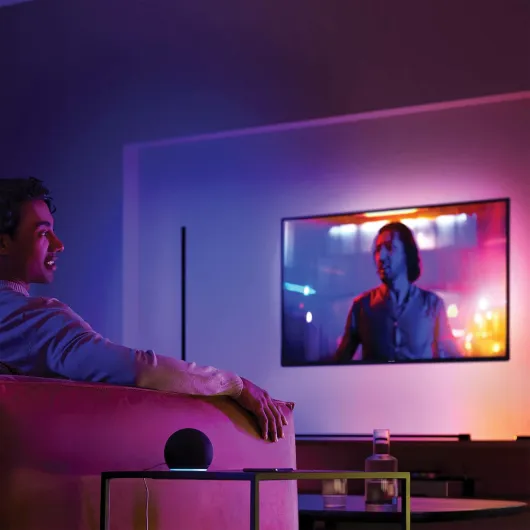
Slim, modern, and easy to place… if you have a wall nearby
Design-wise, this lamp is pretty straightforward: a slim vertical bar on a small round base, all in black with a powder-coated finish. The footprint is tiny (about 11 x 11 cm), so it fits easily on a crowded desk, a narrow shelf, or a small bedside table. I like that it doesn’t scream for attention when it’s off. It just looks like a simple modern piece of tech, not some weird art object. If you’re into clean, minimal setups, it blends in nicely.
The lamp is clearly designed to sit close to a wall and point the light towards it. When I placed it a few centimetres from a white wall behind my monitor, the colour wash looked pretty solid, and the gradient effect made more sense. When I tested it in the middle of a sideboard, away from any wall, it looked a bit pointless. It doesn’t throw enough light forward to be useful like a classic lamp shade, and without a wall to bounce off, the effect is much weaker. So realistically, you want it in a corner, behind a screen, or next to a wall.
The height (55.3 cm) is enough so the light spreads vertically quite well. On my desk, it illuminated most of the wall behind the monitor, which gives that nice ambient vibe without shining directly in my eyes. Next to the bed, it gave a soft glow across the wall, good for winding down. One thing I noticed: because the LED strip is integrated and runs along one side, if you look directly at the light source from the front, it can be a bit harsh at higher brightness. But since the intended use is to face it towards the wall, it’s not a big issue if you place it correctly.
Overall, the design is practical and thought-through, but it’s very specific. It’s not a flexible lamp you can use in ten different ways. It’s basically a vertical ambient light bar that works great against a wall and is just okay anywhere else. If you like that type of look, you’ll probably be happy. If you prefer classic lampshades or more decorative shapes, this will feel a bit too “techy” and plain.
Build quality: feels decent, but mostly plastic
The lamp weighs about 720 grams, so it’s light but not flimsy. The base is plastic with a powder-coated finish, and the vertical bar also feels like plastic with a matte coating. If you’re expecting heavy metal construction at this price, you’ll be disappointed. That said, in the hand it doesn’t feel cheap or hollow; it’s more “good plastic” than bargain-bin stuff. The finish is consistent, no rough edges, no rattling parts. You can tell Philips didn’t cut every corner, but they also didn’t go premium metal for everything.
The power supply is the usual Philips Hue style brick with a fairly long cable. It’s white, while the lamp is black, which visually is a bit annoying if your cable is visible. Not a deal-breaker, just something that feels a bit lazy at this price point. The connector into the lamp feels secure, but I wouldn’t yank it around too much. Once you place it, you’ll probably leave it there anyway, so it’s fine.
Because the LED is integrated, there’s no bulb base to change in practice, even though the spec mentions GU10. That’s more a technical detail than something you ever touch. The upside of integrated LEDs is usually better control over the light and slimmer design. The downside is obvious: when the LED eventually fails, you’re not swapping a cheap bulb; you’re tossing or repairing the whole lamp. Hue products usually have decent lifespans, but it’s still something to keep in mind given the cost.
In daily use, I didn’t notice any worrying heat. The bar gets slightly warm at higher brightness, but nothing dramatic. No buzzing, no flickering, no weird noises from the power supply. Overall, materials and build feel solid enough for a living room or bedroom. I wouldn’t put it in a place where kids might knock it over constantly, because it’s still a tall, thin stick on a small base. But for normal home use, it feels reliable and well put together, just not luxurious for the price.
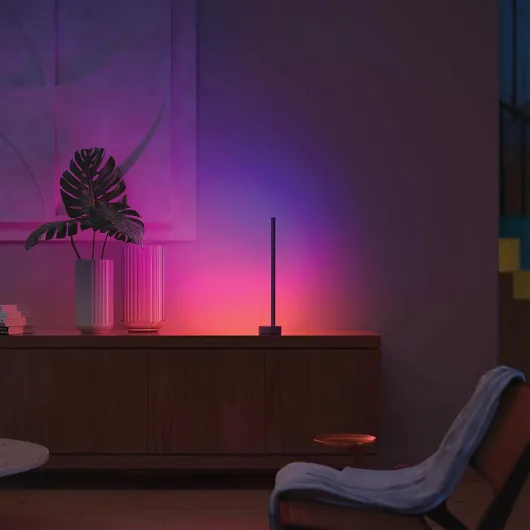
Long-term use and reliability (so far, so good)
I haven’t had this lamp for years obviously, but based on a few weeks of daily use and my experience with other Hue products, I can give a reasonable idea of durability. The lamp has been on for several hours most evenings, sometimes at high brightness for tests, sometimes very low overnight. No flicker, no colour shift, no random disconnects from the Bridge. It behaves like other Hue lights I own: you plug it in, set it up once, and then mostly forget about it because it just works.
The physical build hasn’t shown any issues either. I moved it around a few times (desk, living room, bedroom) to test different placements. The base stayed stable, the bar didn’t wobble more than you’d expect from a tall, thin lamp, and the finish didn’t scratch easily. Obviously, if it takes a serious hit or a fall, it’s not going to be indestructible, but for normal home use, it feels solid enough. Just don’t expect the heft of a metal floor lamp; this is light and more suited to places where it won’t be knocked every five minutes.
The weak spot in terms of long-term durability is the integrated LED. That’s standard for smart lamps like this, but it still matters. If something goes wrong with the LED strip or the internal electronics after the 2-year warranty, you’re likely replacing the whole lamp, not repairing it. Philips usually rates their LEDs quite high in hours, and my other Hue gear has lasted years without visible degradation, so I’m cautiously optimistic. Still, I can’t pretend it’s as simple as swapping a cheap bulb.
Overall, my feeling is: reliability and durability are good, but tied to the usual smart-lighting trade-off. It should last several years if you don’t abuse it, the electronics are stable, and the construction is fine for home use. Just remember that when it finally dies, you’ll probably be buying a new lamp, not a new bulb. At this price, that’s something to keep in the back of your mind.
Light quality and smart features: great ambience, limited as a real lamp
Let’s talk about how it actually performs. As an ambient light, it does its job really well. The colours are rich, the white tones go from warm to cool, and the gradient feature gives a nice layered effect on the wall. I tried a few of the default scenes in the Hue app (like the sunset-style ones and the cooler, more neutral ones), and the transitions are smooth. No obvious banding, no stuttering when changing colours. Dimming is also very fine-grained; you can go from very bright to barely on, which is handy at night.
Where it falls short is as a practical light. Even at full brightness, it doesn’t replace a proper desk lamp or a bright table lamp. It’s good as a background glow for watching TV, gaming, or relaxing, but I wouldn’t rely on it to read small text in bed. When I tried using it alone as bedside lighting for reading, I ended up turning on another light after a few minutes. So if you buy this, think of it as an add-on light, not your main source.
Smart performance is where Hue usually shines, and it’s the same here. With Bluetooth only, control from the Philips Hue Bluetooth app was okay: a bit slower sometimes, and limited to the room where you are. Once I added it to my Hue Bridge, it became more responsive and integrated nicely into my existing rooms and routines. It reacts quickly to app commands, scenes, and voice control through Alexa. I also tested syncing it with music and games on PC using Hue Sync, and it worked smoothly, matching the colours on screen reasonably well. It’s not essential, but it’s fun if you’re into that kind of setup.
In short, performance is strong for ambience and smart features, weaker for raw brightness and task lighting. If your expectations match that (you want mood, not daylight), you’ll probably be happy. If you think this will light up your whole living room on its own, you’re going to be underwhelmed.
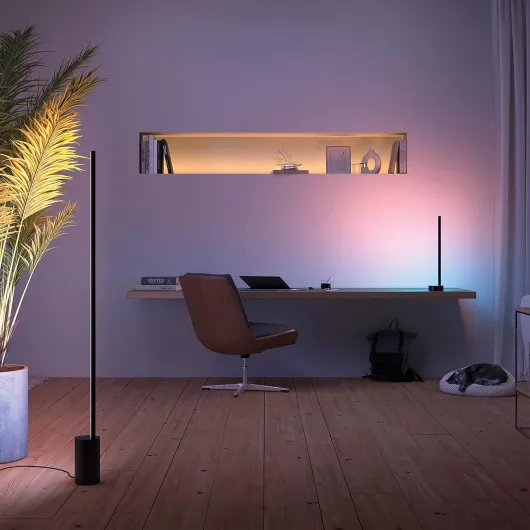
What this lamp actually is (and isn’t)
In simple terms, the Philips Hue Signe Gradient Table Lamp is a vertical light bar on a round base that plugs into the wall and connects to your phone via Bluetooth or to a Hue Bridge via Zigbee. It’s about 55 cm tall, so roughly the height of a small desk lamp, but with a very narrow, slim profile. The light source is an integrated LED strip; you don’t change bulbs on this, so when it dies, the whole lamp is basically done. Philips gives a 2‑year warranty, which is decent but not mind-blowing for the price.
Function-wise, it does white and full colour, just like other Hue colour bulbs, but the gradient part means you can have several colours at once along the length of the lamp. In the app you can pick scenes that use 2–3 colours that blend together, and it actually looks quite smooth. No harsh lines, just a soft transition. It’s clearly meant to sit close to a wall so the light bounces off and gives that “wash” effect. If you put it in the middle of a room, it looks a bit odd and less effective.
Connectivity-wise, you have two options: use it with the free Philips Hue Bluetooth app (no Bridge needed) for basic stuff like on/off, dimming, colours and scenes in a single room; or pair it to a Philips Hue Bridge (sold separately) if you want the full package: remote control from outside the house, routines, syncing with music/movies via Hue Sync, voice control with Alexa/Google/HomeKit in a more reliable way, and grouping with all your other Hue lights. With Bluetooth only, it works, but it’s more limited and you might notice a bit more lag or less reliability if your phone isn’t nearby.
What it is not: it’s not a cheap entry-level smart lamp and not a work light. It’s mainly decorative lighting. If your goal is to brighten a dark room on a budget, there are much better options. If your goal is to add a stylish accent to a gaming setup, living room TV area, or bedside corner and you already like Hue, then it starts to make more sense. Just go in with the right expectations, or you’ll feel like you paid too much for a glowing stick.
Does it actually change the feel of a room?
In day-to-day use, the main thing this lamp does well is set the mood in a room. When I used it behind my monitor, it made long evenings at the computer feel a bit less harsh compared to just having a bright ceiling light. With a warm scene at low brightness, it’s easy on the eyes and gives that cosy background glow. When I switched to more colourful scenes for gaming or music, the room definitely felt more lively, even though the actual brightness wasn’t huge.
Next to the bed, I tested it with the Hue wake-up automation. The lamp starts very dim and gradually brightens with warm sunrise colours over about 20–30 minutes. For me, that worked surprisingly well. I’m not a morning person at all, but waking up to a slow light increase was less brutal than being hit with a bright ceiling light or a phone screen. It’s not magic, but after a week I did notice I felt a bit less groggy when getting up. So for that specific use, I’d say it’s pretty effective.
In the evening, using it as the only light in the bedroom on a low, warm setting created a calm atmosphere. It’s bright enough to move around, get ready for bed, or watch something on a tablet, but not so bright that it wakes you up fully. If you’re sensitive to harsh lighting at night, this kind of soft wall wash is a nice compromise. The fact that you can dim it very low without flicker is a big plus.
However, if your idea of effectiveness is “can this replace two or three other lamps?”, then no, it can’t. It’s more like a finishing touch. It improves the overall feel of a room that already has basic lighting sorted. On its own, it’s too limited. Combined with other Hue lights or normal lamps, it works well as that extra layer that makes the space feel more deliberate and less bare.
Pros
- Great ambient light with smooth gradient colour effects on the wall
- Integrates very well with Philips Hue ecosystem, voice assistants, and Hue Sync
- Slim design with small footprint, easy to place on desks or bedside tables
Cons
- High price for an accent lamp with limited brightness
- Mostly plastic build and integrated LED means no simple bulb replacement
Conclusion
Editor's rating
The Philips Hue Signe Gradient Table Lamp is a stylish, slim ambient light that does exactly what it’s meant to do: add a nice colour wash to a wall and integrate smoothly into the Hue ecosystem. The gradient effect looks good, the colours and whites are high quality, and the smart features (especially with a Hue Bridge) are reliable and easy to use. As a mood light for a desk, living room corner, or bedside, it works very well. It’s also surprisingly decent for wake-up routines and relaxed evening lighting.
Where it falls short is on raw practicality and value. It’s not bright enough to replace a main lamp or a serious reading light, and the price is high for something that’s basically an accent piece with integrated LEDs. The materials are fine but mostly plastic, and long-term you’re tied to the life of the built-in LED. Because of that, I’d mainly recommend it to people who are already invested in Philips Hue and want to add a good-looking ambient lamp to their setup. If you’re just starting out with smart lighting or you’re on a tighter budget, there are more sensible ways to spend this amount of money.
![NEW White and Colour Ambiance Smart Light Bulb Starter Kit, 75W - 1100 Lumen [E27 Edison Screw] 2 Bulbs + Smart Button - With Bluetooth - Works with Alexa, Google Assistant and Apple Homekit E27 2 Pack Starter Kit + Button](https://www.smart-light-guru.com/storage/1015385/conversions/71yJIPbE0LL._AC_SL1500_-medium.webp)



![Signe White and Colour Ambiance Gradient Table Lamp [Black], Smart Bedroom Lighting with Bluetooth, Plug-in Lamp Works with Alexa, Google Assistant and Apple Homekit - Signe Table Lamp Black](https://www.smart-light-guru.com/storage/797086/71a1fMzwXxL._AC_SL1500_.jpg)