Summary
Editor's rating
Value for money: good product, painful price
Design: modern look, but it’s a big piece of hardware
Materials and build: solid enough, but not luxury
Performance: brightness, colours, and real-world use
Installation and setup: not hard, but not plug-and-play either
What you actually get with this Centris 3-piece cross
Everyday effectiveness: does it actually make life easier?
Pros
- Very bright and practical mix of central panel plus three adjustable spots
- Full Hue integration with individual control of each light, scenes, and automations
- Solid metal build and modern look that fits well in contemporary interiors
Cons
- High price compared to simpler fixtures plus a few smart bulbs
- Needs a Hue Bridge and ideally extra accessories (switch/sensor) to really shine

Specifications
View full product page →| Brand | Philips Hue |
A ceiling lamp for people who really like playing with light
I’ve been using Philips Hue stuff for a while (bulbs, lightstrips, a couple of spots), and this Centris 3-piece cross lamp is the first time I’ve tried a full-on smart ceiling fixture instead of just swapping bulbs. I installed it in my living room, roughly 20 m², replacing a basic Ikea ceiling lamp with a couple of dumb LED bulbs. So I had a decent before/after comparison right away.
The first thing I noticed: this thing is bright. The specs say 1600 lumens, and in real life it easily lights the whole room. Before, I always had a floor lamp on in the corner. With the Centris, I just use the ceiling light most evenings and it’s enough. The mix of the central panel plus the three GU10 spots actually makes sense in daily use, not just on paper.
Of course, it’s a Philips Hue product, so you get the usual package: 16 million colours, app control, works with Alexa, and Zigbee via the Hue Bridge if you want the full smart home stuff. If you already have a Hue ecosystem at home, it slides into place without drama. If you don’t, you can still use it with Bluetooth/app, but honestly you’re only getting half the experience that way.
Overall, my first impression after installing it and using it for a week was: solid product, very practical, but clearly aimed at people who are already into Hue and are ready to pay for the comfort and the app control. If you just want light and don’t care about scenes or colours, this is probably overkill.
Value for money: good product, painful price
Let’s be blunt: the Centris 3-piece cross is not cheap. You’re paying for a full fixture + 3 Hue GU10 colour spots + an integrated colour panel + all the smart features. If you compare that to a basic ceiling lamp with two generic LED bulbs, the difference is huge. Even compared to just buying three Hue GU10 bulbs and shoving them into a cheap rail, this Centris still comes out more expensive.
So the real question is: do you get enough out of it to justify the price? If you’re already in the Hue ecosystem, have a Bridge, use scenes and automations, and you specifically want your main ceiling light to be smart and colourful, then I’d say the value is decent. You get a clean, integrated setup that looks coherent and works well. The individual control of each spot plus the panel is something you’d struggle to replicate cheaply with random fixtures and bulbs.
If, on the other hand, you just want more light in your room, or you only care about dimming and basic warm/cool whites, then the Centris is frankly overkill. You could get a nice regular ceiling light and one or two smart bulbs for a fraction of the price and still have app control and voice commands. You’d only really miss the more advanced colour scenes and the slightly cleaner look of an integrated product.
Personally, I think the value is good but not spectacular, and only for a specific type of user: someone who likes tinkering with lighting, already uses Hue, and wants to centralize everything in one strong ceiling fixture. If that’s you, you’ll probably be satisfied despite the price. If you’re more casual about lighting, there are clearly cheaper ways to get 80% of the functionality.
Design: modern look, but it’s a big piece of hardware
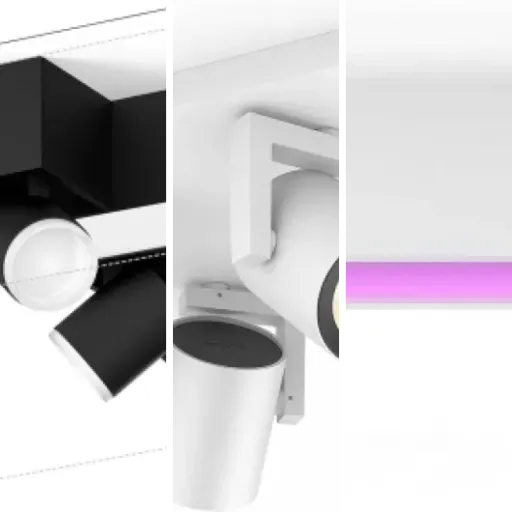
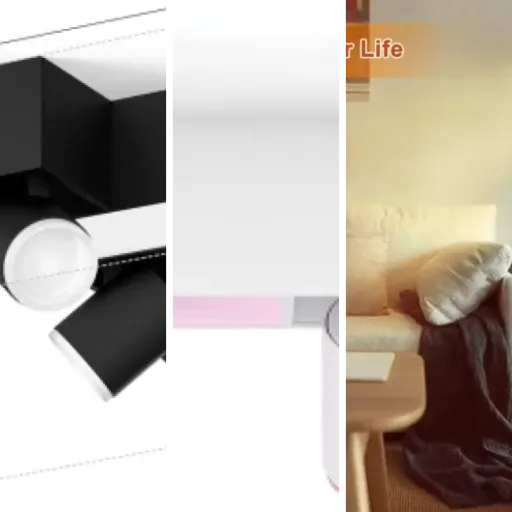
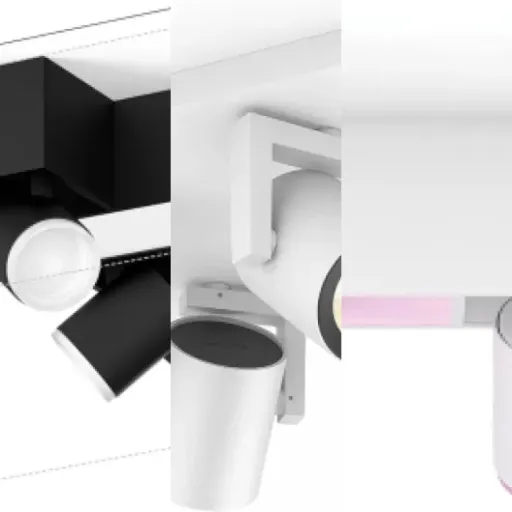
Design-wise, the Centris 3-piece cross is pretty straightforward: a black metal cross with a flat central panel and three cylindrical spots around it. It’s clearly in the modern/minimalist bucket. In my living room with white ceiling and light gray walls, it actually looks decent – the black makes it stand out a bit, but not in a bad way. If you’re more into classic or rustic decor, this will probably look out of place. It screams "modern apartment" more than "country house".
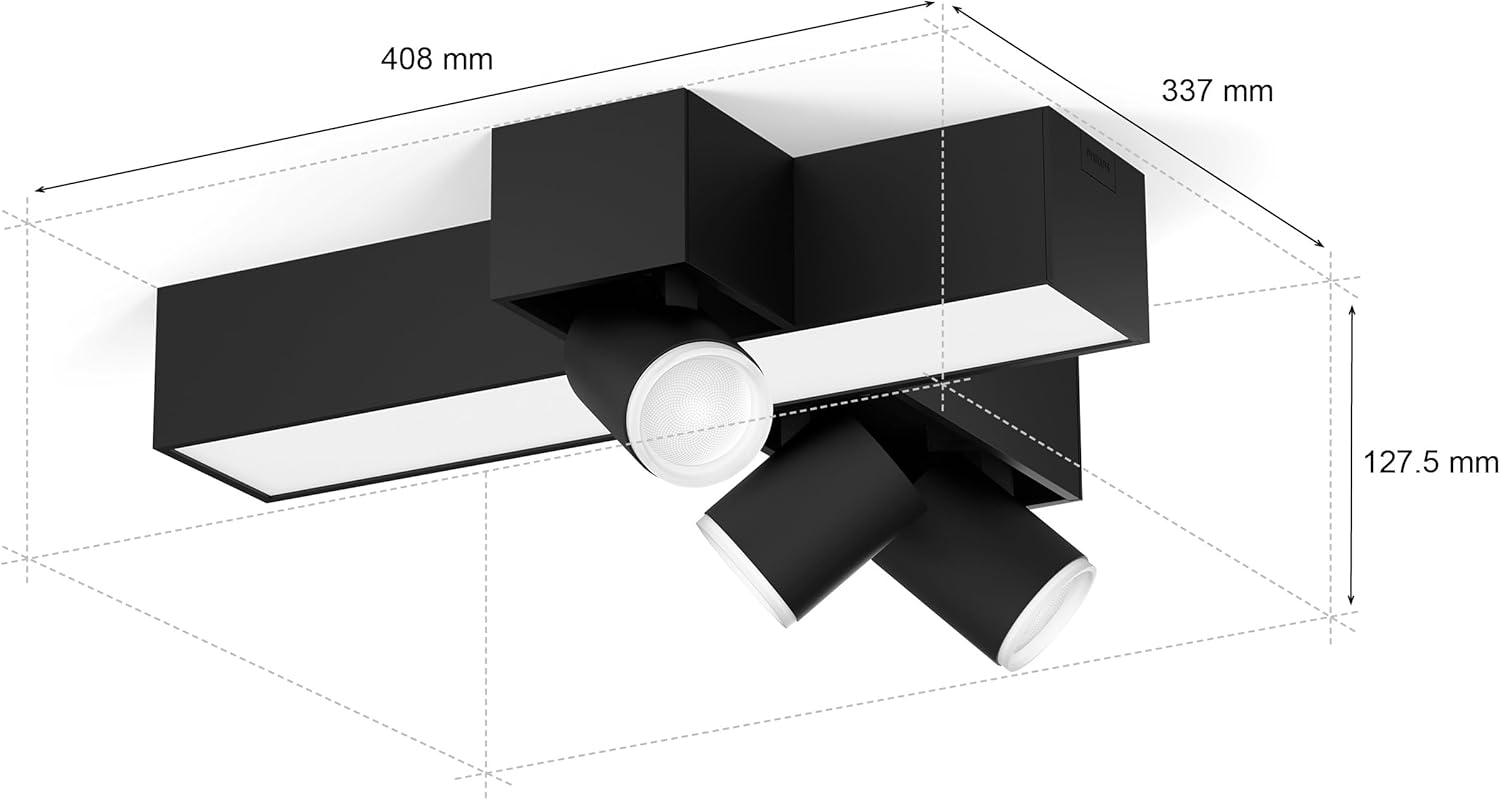
The size is not tiny: around 33.6 x 40.8 x 12.7 cm. When I first unboxed it, I was slightly surprised how bulky it felt. Once on the ceiling, it’s fine, but if you have a very small room or a very low ceiling, keep that in mind. The spots can be oriented, which is actually useful; I have one pointing towards the sofa, one towards a bookshelf, and one towards the desk. You can tweak them until you’re happy, and then you basically forget about them.
What I liked is that the design is consistent with other black Hue fixtures and spots, so if you already have black Hue tracks or wall lights, it doesn’t clash. The finish is painted metal, not plastic pretending to be metal, so it feels decently solid in hand. It’s not luxury-level build, but for a mass-market smart light it’s fine. The cables and mounting plate are all hidden once it’s up, so visually it’s clean.
On the downside, you don’t have many style options: it’s black, metal, modern – that’s it. No white version in this exact format in my region, no wood, no softer shapes. So either it matches your style or it doesn’t. Personally, I’m okay with it, but if you care a lot about interior design and want the light to be more discreet, you might find this a bit too visible and technical-looking.
Materials and build: solid enough, but not luxury
The fixture is mostly metal with a painted black finish. In hand, it feels sturdy, not flimsy. The weight is around 3.2 kg, which is not light for a ceiling lamp, so you clearly feel you’re dealing with a real piece of hardware, not a hollow plastic shell. During installation, that weight is both reassuring and slightly annoying: you need a good anchor in the ceiling and ideally two hands (or a second person) to hold it while fixing it.
The finish itself is clean: no sharp edges, no obvious paint defects on my unit. The spots rotate and tilt with enough resistance so they don’t move on their own, but they’re not too stiff either. I’ve adjusted them a few times and they still feel the same, no signs of loosening. The central panel diffuser spreads the light evenly; you don’t see the individual LEDs, it just looks like a flat lit surface, which is what you want from this kind of product.
The GU10 bulbs included are standard Philips Hue White & Color Ambiance spots, which is nice because if one dies or you want to swap it, you can just buy a normal Hue GU10 and you’re not stuck with some proprietary weird thing. The only non-replaceable part is the LED part of the central panel – if that dies in a few years, you’re probably replacing the whole fixture. That’s the usual story with integrated LED panels, not specific to this model.
Overall, I’d say the materials and build quality fit the price range: not premium designer-level, but clearly better than budget fixtures you grab in a supermarket. It feels like something that will survive years of use, as long as your ceiling mount is solid and you don’t keep taking it down or moving it around.
Performance: brightness, colours, and real-world use
In terms of performance, the Centris does what it says on the box. The claimed 1600 lumens feel accurate. In my 20 m² living room, at 100% brightness with a cool white setting, it’s properly bright – almost too bright for evenings, to be honest. I usually run it at 40–60% for normal use and bump it to 80–100% only when I’m cleaning or working on something that needs a lot of light. The mix of central panel + three spots gives a good spread: you don’t get a single harsh point of light, and you can aim the spots to kill shadows in specific corners.
The colour part is classic Hue: 16 million colours, with the usual presets in the app (Relax, Read, Concentrate, etc.). For movies and evenings, I use warm whites and some soft orange/purple combos on the spots, and it looks nice. Colours are not neon-bright like some RGB gaming lights, but they’re strong enough for mood lighting. Whites are where it shines the most (no pun intended): you can go from very warm to very cool and it actually makes a difference for work vs chill time.
Control-wise, with a Hue Bridge it reacts quickly. From the app or from Alexa commands, the light responds in about a second or less, no obvious delay in daily use. I’ve set up a motion sensor in the hallway that also triggers a dim scene on this lamp after sunset, and that works fine. One Amazon reviewer mentioned motion sensor being “top”, and I’d agree – as long as your sensor is set up properly, the light just does its thing and you forget about switches.
If I nitpick, the main limitation is the usual Hue one: if your internet or network is acting up, the app can be sluggish or not find the Bridge right away. Also, if you don’t have a physical Hue Dimmer Switch or similar, you’re basically stuck with voice/app, which isn’t always ideal when guests are around. But overall, as a smart ceiling light, performance is solid and predictable, which is what you want.
Installation and setup: not hard, but not plug-and-play either
Philips sells this as "easy installation", and I’d say: it’s easy if you’re already comfortable installing ceiling lights. If you’ve never touched wiring before, this is not the product that will magically change that. The process is classic: cut power, remove old fixture, connect the live/neutral/earth to the Centris mount, fix the bracket to the ceiling, then attach the fixture. The weight (around 3.2 kg) means you either need a second person to hold it or a good way to support it while you connect the wires.
In my case, it took about 30–40 minutes, mostly because I had to fiddle with the old ceiling box and make sure the screws had a solid grip. Once the bracket was in place, hanging the lamp and tightening the screws was straightforward. The GU10 bulbs are already included; you just push them in and twist. The spots are adjustable, so you can point them where you want before or after powering on.
On the smart side, pairing with the Hue app via the Bridge took maybe 5 minutes. Open app, add light, it found it automatically, I named each part ("Centris panel", "Centris spot 1", etc.) and added them to the living room. After that, I created a few scenes and linked the lamp to Alexa. From "box closed" to "fully configured", I’d say the whole process took me about an hour, without rushing.
Where it’s less ideal is if you don’t have a Hue Bridge. Yes, you can still use Bluetooth and the app, but you lose a lot: no remote access, weaker automations, and sometimes slower response. Also, there is no physical switch included, so if you want a wall control that doesn’t cut power (which you should, with Hue), you need to buy a separate Hue Dimmer Switch or similar. That’s another extra cost and another thing to install. So overall: installation is fine for someone a bit handy, but not exactly idiot-proof, and it’s definitely not just “plug in and go”.
What you actually get with this Centris 3-piece cross
On paper, the Philips Hue White & Color Ambiance Centris 3-piece cross is a ceiling-mounted light with four light sources: one central panel plus three adjustable GU10 spots. It’s black, metal, and meant for indoor use only (not water resistant). It runs on 240 V, uses LED, and talks via Zigbee (so it wants a Hue Bridge for the full package) and can also be controlled by app and voice (Alexa, etc.). Out of the box, you get the fixture and the GU10 bulbs already included, so you don’t have to buy extra bulbs for it.
In daily use, the key thing is that each light can be controlled individually in the Hue app: the central panel and each spot can be set to different colours or brightness. For example, I’ve been using the panel in a warm white around 40% in the evening, and one spot in cool white aimed at the desk when I work, while the others are dimmed way down. It’s not just a gimmick – it’s actually practical when you’re trying to mix “cozy” and “task lighting” in the same room.
The product is clearly designed to play nice with the rest of the Hue range. If you already have a Hue Bridge, adding it takes two minutes: open the app, add a light, it pops up, you assign it to a room, and done. If you don’t have a Bridge and try to run everything via Bluetooth, control is more limited and automations are weaker. In my case, I already had a Bridge, so I went straight to the full setup with scenes, routines, and motion sensor triggers.
In terms of target user, I’d say this is for people who:
- Already have (or are planning) a Hue setup
- Want the main room light to be smart, not just accent lighting
- Don’t mind paying a premium for app control and colours
Everyday effectiveness: does it actually make life easier?
After a couple of weeks with the Centris as the main light in the living room, the big question for me was: is this just a fancy toy, or does it actually make daily life easier? Honestly, it’s a bit of both, but more on the useful side. The fact that I can have different brightness and colours on each of the four light sources makes a real difference. I can keep the room comfortable for relaxing while still having one spot brighter for reading or working at the table.
For example, in the evening I usually run a scene where the main panel is at 30% warm white, the spot over the sofa is at 40% warm white, and the spot over the bookshelf is almost off. When I switch to “work mode”, I just hit a different scene: central panel at 70% neutral white, desk spot at 80% cool white. It takes two taps in the app or one voice command and the whole ambiance changes. It’s not life-changing, but it’s genuinely practical compared to my old single-bulb ceiling lamp that was either on or off.
Another point where it’s effective is automation. I have a routine that turns it on at low brightness in the morning on weekdays, and another that turns it off automatically at night if we forget. With kids around, this is handy – no one has to remember to hit the switch. Combined with a motion sensor (as the Amazon review mentions), it becomes basically a “set and forget” ceiling light. You enter the room, it lights up at the right level depending on the time of day, and that’s it.
So in terms of effectiveness, I’d say it delivers: it lights well, it adapts easily to different uses, and once your scenes and routines are set, you hardly touch the app anymore. The only caveat: all this comfort depends on having and configuring a Hue Bridge and maybe a motion sensor or switch. If you don’t want to deal with that, you’re not getting the full benefit, and then the lamp starts to feel overpriced for what you actually use.
Pros
- Very bright and practical mix of central panel plus three adjustable spots
- Full Hue integration with individual control of each light, scenes, and automations
- Solid metal build and modern look that fits well in contemporary interiors
Cons
- High price compared to simpler fixtures plus a few smart bulbs
- Needs a Hue Bridge and ideally extra accessories (switch/sensor) to really shine
Conclusion
Editor's rating
After living with the Philips Hue Centris 3-piece cross for a while, my overall feeling is: it’s a solid smart ceiling light for Hue fans, but definitely not a bargain. It lights a medium-sized room easily, the mix of central panel and adjustable spots is genuinely practical, and the colour + scene options make it easy to switch from "work" to "chill" with a tap or a voice command. Once you’ve set up your routines and maybe a motion sensor, it quietly does its job every day without needing much attention.
Where it stings is the price and the fact that you really need a Hue Bridge (and ideally a separate switch or sensor) to get the full value. If you’re already in the Hue world and you want your main room light to be smart, this fixture makes sense: good brightness, decent build, clean design, and tight integration with the app and Alexa. If you’re just starting with smart lighting or you don’t care much about colours and automation, it’s probably too much money for features you won’t fully use.
In short: great fit for someone building a proper Hue-based smart home and willing to invest. For everyone else, a cheaper fixture plus a couple of Hue bulbs will get you most of the way there for a lot less cash.
![NEW White and Colour Ambiance Smart Light Bulb Starter Kit, 75W - 1100 Lumen [E27 Edison Screw] 2 Bulbs + Smart Button - With Bluetooth - Works with Alexa, Google Assistant and Apple Homekit E27 2 Pack Starter Kit + Button](https://www.smart-light-guru.com/storage/1015385/conversions/71yJIPbE0LL._AC_SL1500_-medium.webp)