Summary
Editor's rating
Is it worth the price, or are you just paying for the logo?
Looks like a normal bulb, behaves like a smart one
The smart button battery situation
Build quality and how long I expect this stuff to last
Brightness, colours and how well it actually responds
What you actually get in the box and how it behaves
Does it actually make your lighting smarter, or just more complicated?
Pros
- Very reliable connection and fast response with the bridge, app and voice assistants
- Good overall brightness for a normal living room, with flexible white and colour options
- Smart button and automations (Home & Away, routines) are practical and easy to live with
Cons
- Higher price than many other smart bulbs with similar basic specs
- Colours are decent but less vibrant than some competitors like LIFX
- Bridge feels like overkill if you only ever want one or two smart bulbs

Specifications
View full product page →| Brand | Philips Hue |
Smart bulbs that don’t throw a tantrum every night
I’ve been using this Philips Hue White and Colour Ambiance Starter Kit (E27, 75W equivalent, 1100 lumen, 2 bulbs + bridge + smart button) for a few weeks now in my living room. Before this, I’d tried a couple of cheaper Wi-Fi bulbs and one LIFX bulb, and honestly, half the time something would be offline, frozen, or refusing to respond to Alexa. So I went into this Hue kit thinking, “Okay, it’s more expensive, it better at least work properly.”
I set it up in a pretty normal flat: one bulb in a ceiling pendant, one in a floor lamp, both in the living room. I connected the bridge to my router, added the bulbs in the Hue app, and paired the smart button. I also linked it to Alexa and Apple HomeKit because I use both. So this isn’t just a quick unboxing impression; I’ve actually lived with it day-to-day – TV evenings, reading, getting up at night, and leaving the flat.
The short version: it works well and consistently, colours are fun, and the app is solid. But it’s not perfect. The brightness is good but not insane, colours are decent but not super punchy like some LIFX bulbs I’ve seen, and the price is clearly on the high side. It feels like you’re paying mainly for reliability and ecosystem, not raw specs.
If you just want cheap smart bulbs for occasional fun, this kit will probably feel overpriced. If you’re tired of buggy Wi‑Fi bulbs and want something that just responds every time you press a button or talk to Alexa, then this starts to make sense. That’s basically where I ended up after a couple of weeks of use.
Is it worth the price, or are you just paying for the logo?
Now the touchy part: value for money. Philips Hue is not cheap, and this starter kit is no exception. You can easily find smart bulbs for half the price, sometimes even less, especially Wi‑Fi-only ones. So if you just look at lumens and colour features, this doesn’t look like a bargain at all. You’re paying for the bulbs, plus the bridge, plus the smart button, and that adds up quickly if you’re on a tight budget.
But here’s the thing: the cheaper bulbs I tried were a pain. Random disconnects, apps that crash, voice control that works 8 times out of 10 but fails when you really want it to work. After a while, that gets old. What you’re basically paying for with Hue is reliability and ecosystem. The bridge keeps the bulbs off your Wi‑Fi load, the app is stable, integrations with Alexa/Google/HomeKit actually work, and if you want to expand later, you’ve got a whole range of lights and accessories that speak the same language.
So is it good value? I’d say it depends who you are. If you only want one or two smart bulbs for fun colours in a bedroom and you don’t care if they glitch now and then, this kit is overkill and too expensive. You’d be better off with a couple of decent Wi‑Fi bulbs. But if you want to slowly build a smart lighting setup across several rooms and you care more about things working consistently than squeezing every euro, then the price starts to make sense.
Personally, I think it’s pretty solid value if you commit to the ecosystem, but not great if you treat it as a one-off purchase. You’re paying a premium, but you do get a system that actually behaves like proper home infrastructure instead of a toy that works only when it feels like it. For me, that trade-off is acceptable, but it’s definitely not the cheapest way to get coloured lights in your living room.
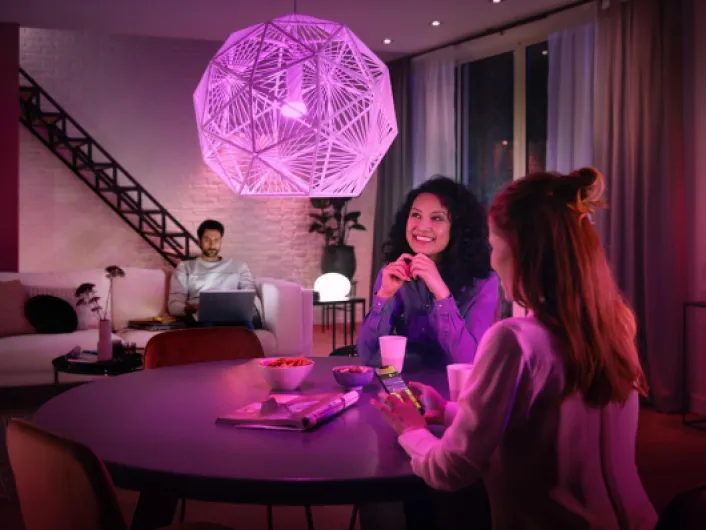
Looks like a normal bulb, behaves like a smart one
Design-wise, the bulbs themselves are pretty standard. White plastic base, frosted dome, E27 screw – they look like slightly chunky normal LEDs. If you’re putting them in a pendant or a lamp with a shade, you won’t care at all. If you have fully exposed bulbs in some designer fixture, they’re not ugly but they’re not stylish either; they just look like techy LED bulbs. No fancy filament look or anything like that.
The Hue Bridge is a small white square with a glowing ring when it’s on. It’s light, plastic, and just sits near your router. It doesn’t scream “high-end” but it’s fine. You plug it in, forget it exists. I stuffed mine behind the router and never look at it. At least the status LEDs are not blinding, so it doesn’t light up the room at night, which I appreciate.
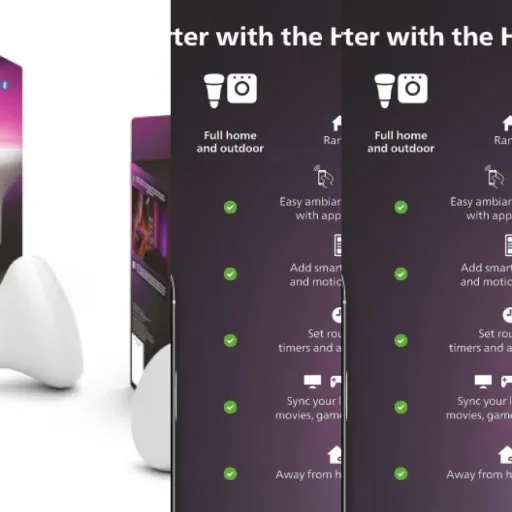
The smart button is actually the nicest bit from a design point of view. It’s small, round, white, and comes with a magnetic back and a wall plate. You can stick the plate on the wall and the button snaps onto it, or just throw the button on the coffee table. It’s simple and doesn’t look cheap. Press feel is okay: a bit soft, not super clicky, but you clearly feel when you press it. It’s not as satisfying as a proper wall switch, but it gets the job done.
One thing I like is that nothing screams “gadget” once it’s installed. Friends coming over just see normal lamps, a small white puck on the wall, and that’s it. No flashing hubs or weird antennas. On the downside, if you’re into flashy RGB gear and want something that looks as fancy as it acts, this whole kit is visually pretty plain. Function over style, basically.
The smart button battery situation
The bulbs themselves are wired, obviously, so no battery there. The only thing with a battery is the smart button, and that’s actually worth talking about because if the button dies quickly, the whole thing becomes annoying. Philips doesn’t shout the exact battery type on the front, but it’s a standard coin cell inside. I haven’t had it long enough to kill the battery, but based on other Hue gear I’ve used, you’re usually looking at many months to a year+ before you need to swap it.
In daily use, I press the button maybe 10–20 times a day: turning lights on in the morning, cycling scenes in the evening, turning them off at night. So far, no lag, no missed presses, and no sign of the battery getting weak. That’s obviously early days, but Hue gear generally has a decent reputation for remote battery life, so I’m not too worried. When it does die, you just pop it open and replace the coin cell – not fun, but not a big drama either.
One thing I like is that the button doesn’t need to be recharged with a cable. I’ve had some other smart buttons and remotes that are USB-charged, and they always die right when you actually need them. Here, you’ll probably forget about the battery for months. When it finally gives up, it’s a two-minute job with a new coin cell and you’re done for another long stretch.
If you’re the type who hates dealing with batteries at all, this might annoy you eventually, but honestly, for how often you use the button, battery is not a real problem. It’s not something that would make me avoid the kit. I’d just keep a spare coin cell in a drawer and move on.
Build quality and how long I expect this stuff to last
The bulbs are plastic-bodied LEDs, made in China, like most smart bulbs. They don’t feel premium in the hand, but they also don’t feel flimsy. Once they’re screwed in, you’ll never touch them anyway. Philips claims an average life span of about 2.92 years at typical use – that’s not crazy high on paper, but that number is usually based on a certain number of hours per day. In reality, most Hue users I know get several years out of their bulbs unless they’re on 24/7.
Over the weeks I’ve used them, there’s been no flicker, no buzzing, no weird heating. The bulbs get warm but not hot, which is normal for LEDs. I’ve turned them on and off a lot while testing, changed colours, dimmed them, and they behaved consistently. If something was badly built, you’d often notice small issues pretty fast, like random flickers at low brightness. I didn’t see any of that.
The bridge is super lightweight plastic, but it just sits near the router and never moves, so durability isn’t a big concern there. As long as it doesn’t overheat or randomly die (which I haven’t seen), it should be fine. Hue bridges have been around for years and don’t have a big reputation for failing all the time, so I’m reasonably confident here.
The smart button is the only part that actually gets handled. It feels solid enough for what it is. I’ve dropped it on the floor twice already and it survived without any marks or issues. The magnet and wall plate still hold it fine. I wouldn’t give it to a toddler to chew on, but for normal adult use, it seems sturdy. Overall, nothing feels premium, but nothing feels fragile, which for home lighting is good enough for me.
Brightness, colours and how well it actually responds
Let’s talk about what matters most: how it performs day to day. In terms of brightness, these are rated around 1055–1100 lumens, so they’re meant for full rooms. In my living room (one bulb in the ceiling, one in a floor lamp), I’d say the white light is strong enough for normal use: reading, working on a laptop, cooking if the room is open to the kitchen, that kind of thing. It’s not like a floodlight, but I never felt like I was sitting in a cave either.
Colours are decent. You get the usual 16 million colours marketing line, but in practice, some colours are more vivid than others. Blues, greens, and purples look good. Reds and yellows are okay but not super deep. Compared to the LIFX bulb I used before, the Hue colours are a bit less intense, especially at full brightness. If you want very punchy neon-style colours, Hue is a bit calmer. For movies and mood lighting, it’s enough for me, but if you’re really into super strong colour effects, you might find it slightly underwhelming.
Response time is where Hue shines. Commands from the app or Alexa are basically instant. I say “Alexa, living room lights off” and they’re off in under a second, every time. No spinning icons, no “device not responding” nonsense. Same with the smart button – single press cycles between scenes reliably. Over a couple of weeks, I didn’t have a single case where a bulb just ignored a command or disappeared from the app, which is exactly what annoyed me with cheaper bulbs.
The only small downside on performance is that maximum brightness in colour mode is lower than in pure white mode. That’s pretty standard, but worth mentioning. If you set a deep blue or red, the room feels dimmer than with bright white. Also, the CRI is around 80, so colours of objects in the room are fine but not super accurate if you’re picky about that. For normal home use, it’s perfectly okay. Overall, performance is solid: not mind-blowing in terms of colour punch, but very stable and fast in actual use.
What you actually get in the box and how it behaves
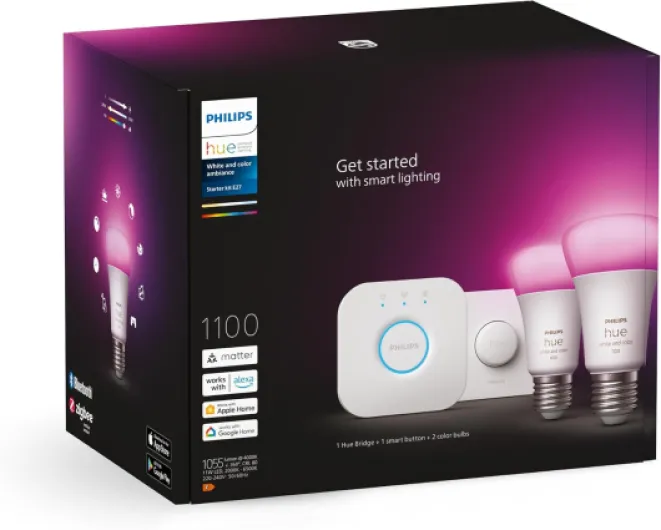
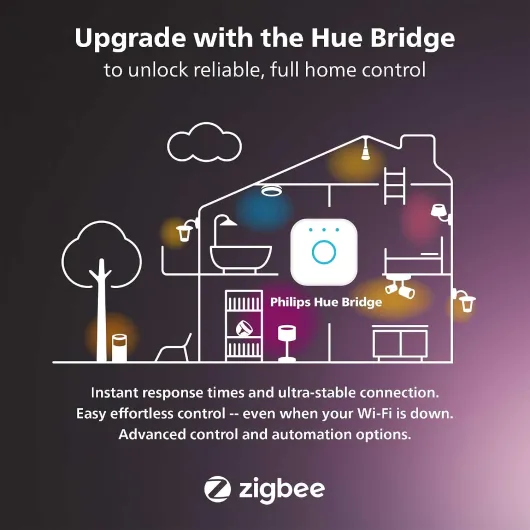
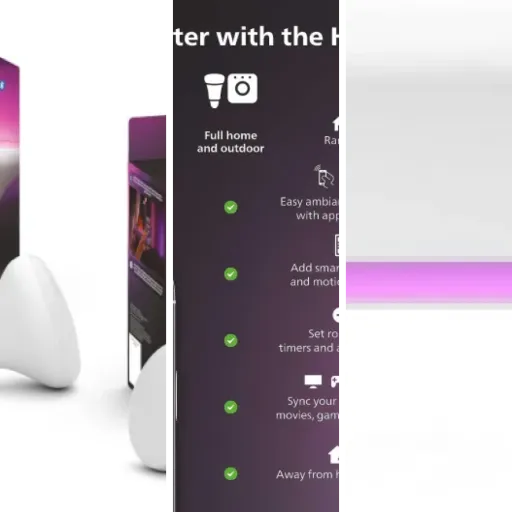
In the box you get 2 colour bulbs (E27), the Hue Bridge, a smart button, a wall bracket and a little holder. So it’s a complete starter kit – you don’t need to buy anything else to get proper smart control. The bulbs are rated at around 1055–1100 lumens, so on paper they’re like a 75W incandescent. They do full colour plus white from warm to cold (up to 6500K). Connectivity-wise, you’ve got Bluetooth and Zigbee. Bluetooth means you can use them without the bridge in a pinch, but honestly, the bridge is where Hue becomes actually good.
Setup was straightforward. I plugged the bridge into my router, opened the Philips Hue app, it found the bridge, then the bulbs. It took about 10–15 minutes to go from sealed box to working scenes. No weird firmware panic, no random disconnects. After that I linked it with Alexa and HomeKit. Alexa picked it up via the Hue skill, and HomeKit via the bridge. Both worked on the first try, which is already better than my experience with some Wi‑Fi-only bulbs that needed several attempts.
In daily use, I’ve set up a few basic things: an evening scene, a bright white “work” scene, and a very dim warm scene for late at night. I also set up an away routine so lights come on at night when I’m not home. The system actually runs these automations on time and doesn’t randomly forget bulbs, which is what I care about most. Compared to my old LIFX bulb that would randomly show as “offline” in the app, this is just boringly reliable – and I mean that in a good way.
Overall, the presentation is clear: this is a full ecosystem starter. You’re not just buying two bulbs; you’re buying into Hue’s way of doing smart lighting. If you think you’ll add more lights later (strips, lamps, more bulbs), it makes sense. If you only ever want two smart bulbs and nothing else, then this starts to feel like too much kit for a simple job.
Does it actually make your lighting smarter, or just more complicated?
In terms of effectiveness as a smart lighting system, this kit does what it’s supposed to do without turning your life into a settings menu. After the first couple of days of playing with all the colours, I settled into a routine: warm white in the evening, cool white when I need to focus, and a couple of dim scenes for TV and bedtime. The nice thing is that switching between these is dead simple – either a quick tap in the app or a press on the smart button.
The Home & Away features are actually useful. I set it so that when I leave, the lights turn off, and in the evening they turn on randomly in a couple of scenes when I’m out. It’s not bulletproof home security, but it does make the place look lived-in if I’m gone for a weekend. It also solves the “did I leave the lights on?” question. I just check the app and turn them off remotely if needed. This worked every time over a couple of weeks, no weird delays or failures.
Voice control is where I really see the benefit. With Alexa and HomeKit both connected, I can say things like “Alexa, set living room to 30%” or use Siri on my phone to turn them on before I get out of bed. No drama, no timeouts. Compared to my old Wi‑Fi bulbs that would occasionally pretend they didn’t exist, Hue feels boringly reliable. That makes a big difference if you actually use voice control every day and not just as a party trick.
If you hate apps and automations, you can pretty much live with just the smart button + default scenes and ignore the fancy stuff. But if you like tinkering, there’s enough depth in the Hue app to set schedules, sunrise/sunset triggers, and room-based control. Personally, I didn’t go crazy – a few automations and that’s it – and for that level of use, the system is very effective. It makes lighting more convenient without feeling like you’re managing an IT project.
Pros
- Very reliable connection and fast response with the bridge, app and voice assistants
- Good overall brightness for a normal living room, with flexible white and colour options
- Smart button and automations (Home & Away, routines) are practical and easy to live with
Cons
- Higher price than many other smart bulbs with similar basic specs
- Colours are decent but less vibrant than some competitors like LIFX
- Bridge feels like overkill if you only ever want one or two smart bulbs
Conclusion
Editor's rating
After living with the Philips Hue White and Colour Ambiance Starter Kit for a bit, my overall take is pretty clear: it’s a solid, reliable smart lighting setup that costs more than the flashy specs alone would justify, but actually behaves properly day-to-day. The bulbs are bright enough for a normal room, colours are decent (even if not the most intense on the market), and the combination of bridge + app + smart button + voice control works smoothly. No random offline bulbs, no constant troubleshooting – which is more than I can say for some cheaper options I’ve tried.
This kit makes sense if you want to build a stable smart home base. The bridge gives you a proper ecosystem, the smart button keeps things simple for guests or family members who don’t care about apps, and integration with Alexa/Google/HomeKit is straightforward. On the downside, you’re paying a clear premium, the bulbs are visually basic, and if you only ever plan to use two smart bulbs, you’re probably overspending for what you need. Also, if you’re chasing the brightest, most vibrant colours out there, there are alternatives like LIFX that hit harder on that front, even if they’re less reliable.
So who is this for? It’s for people who are done messing around with flaky Wi‑Fi bulbs and want something boringly dependable. It’s good if you plan to expand to more Hue lights over time and like the idea of everything living in one app and one ecosystem. Who should skip it? If you’re on a tight budget, only need one or two bulbs, or mainly care about crazy-bright colours rather than reliability, you can save money elsewhere. For me, I’d rate it well: not perfect, not cheap, but it gets the job done properly, and that’s kind of the point.


![L510E Smart Bulb, Smart WiFi LED Light, E27, Works with Amazon Alexa(Echo and Echo Dot), Google Home, Dimmable Soft Warm White, No Hub Required [Energy Class F] 1 Pack](https://www.smart-light-guru.com/storage/939180/conversions/71WGq8rBN-L._AC_SL1500_-medium.webp)

![NEW White and Colour Ambiance Smart Light Bulb Starter Kit, 75W - 1100 Lumen [E27 Edison Screw] 2 Bulbs + Smart Button - With Bluetooth - Works with Alexa, Google Assistant and Apple Homekit E27 2 Pack Starter Kit + Button](https://www.smart-light-guru.com/storage/1015385/71yJIPbE0LL._AC_SL1500_.jpg)