Summary
Editor's rating
Value for money: solid product, painful price
Design and everyday handling: looks premium, feels a bit clicky
Build quality and long-term feel
Performance, dimming behaviour and app/voice control
What this thing actually does (and what you need to make it work)
Does it actually make your lighting "smarter" in a useful way?
Pros
- Proper wall-mounted 4-gang dimmer that works like a normal switch but adds app and voice control
- No neutral required in most UK installations, making it suitable for older homes
- Stable performance with compatible bulbs and good integration with HomeKit, Alexa and Google Assistant
Cons
- High upfront cost, especially once you factor in the hub and multi-way circuits
- Requires compatible bulbs and all switches in a multi-way circuit to be Lightwave dimmers, which complicates upgrades

Specifications
View full product page →| Brand | Lightwave |
A smart switch that actually replaces your wall switch
I’ve been using the Lightwave LP24MK2 4-gang stainless steel smart dimmer in my living room / hallway setup for a few weeks. I went for this instead of smart bulbs because I wanted the house to work normally for guests and family, with real switches on the wall, not apps and weird routines. This model is basically a four-button dimmer that drops straight into a standard UK back box and then talks to the Lightwave hub, Alexa, Google or HomeKit.
On paper it ticks a lot of boxes: proper wall switch, dimming, energy monitoring, works with the main voice assistants, and it looks a bit more premium than a plastic white plate. But it’s not cheap, and it’s not as plug-and-play as a simple Wi‑Fi bulb. You also have to be aware of the multi-way limitation: if your light is controlled from more than one switch, they all have to be Lightwave dimmers, which can double or triple the bill very fast.
In daily use, it’s been mostly reliable and fairly easy to live with, but there are some quirks. The app is okay but not the cleanest, setup with the hub is fine once you’ve done one device, and the biggest headache is bulb compatibility. If you ignore their compatibility list and just stick any random dimmable GU10 or LED on it, you’re asking for flicker or weird behaviour. I had to swap a couple of bulbs before everything settled down.
So this review is basically my honest take after actually wiring it in and living with it: how it looks, how it behaves day to day, what annoyed me, and whether I think it’s worth the money compared to just buying smart bulbs or a cheaper brand. It’s not perfect, but it does solve a real problem if you want your lights smart while still behaving like normal wall switches.
Value for money: solid product, painful price
This is where things get a bit uncomfortable. The Lightwave LP24MK2 4-gang dimmer is not cheap, especially once you factor in the required hub and any extra dimmers for multi-way circuits. If you’re just looking to turn a light on and off with your voice, there are far cheaper ways to do it: smart bulbs, budget Wi‑Fi switches, or even cheaper brands of smart wall switches. On pure price, Lightwave is definitely on the pricey side of the market.
What you’re paying for here is basically three things: the look and feel of a proper wired wall dimmer, the reliability of a dedicated ecosystem, and the integration with Apple HomeKit, Alexa and Google. Compared to random Wi‑Fi switches, Lightwave does feel more polished and better supported in the UK. The fact it’s designed as a direct UK replacement with no neutral needed in most cases is also a big plus. A lot of cheaper smart switches want a neutral at the switch, which many older UK homes don’t have. So for that specific use case – no-neutral UK wiring, multi-gang, decent app, HomeKit support – it’s actually one of the few solid options.
Still, if you start doing the maths on a whole house, the price stacks up quickly. Several Amazon reviewers basically say the same thing: they like the system but admit you need "deep pockets". My approach has been to roll it out slowly: key rooms first (living room, hallway, kitchen), then maybe bedrooms later. If you treat it as a gradual upgrade rather than a weekend full-house refit, the cost is easier to swallow.
So in terms of value, I’d call it "pretty solid but not cheap". You’re paying a premium for a more integrated and UK-friendly solution, and it mostly delivers. If you’re on a tight budget or you don’t care about the wall switches looking nice and behaving like normal dimmers, you can definitely get the job done cheaper with other brands or just smart bulbs. But if you want a clean, wall-based solution that works with HomeKit and doesn’t need a neutral, the price, while painful, is at least understandable.
Design and everyday handling: looks premium, feels a bit clicky
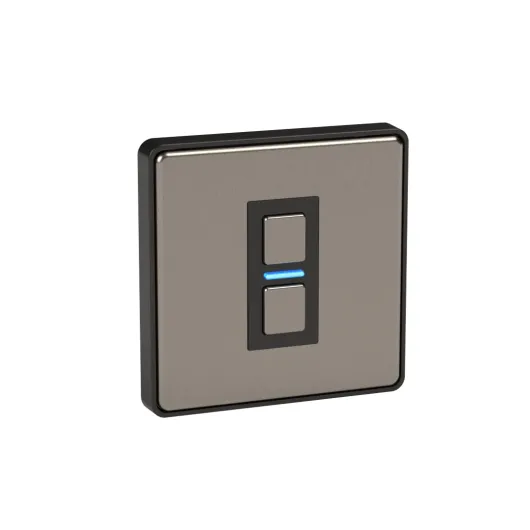
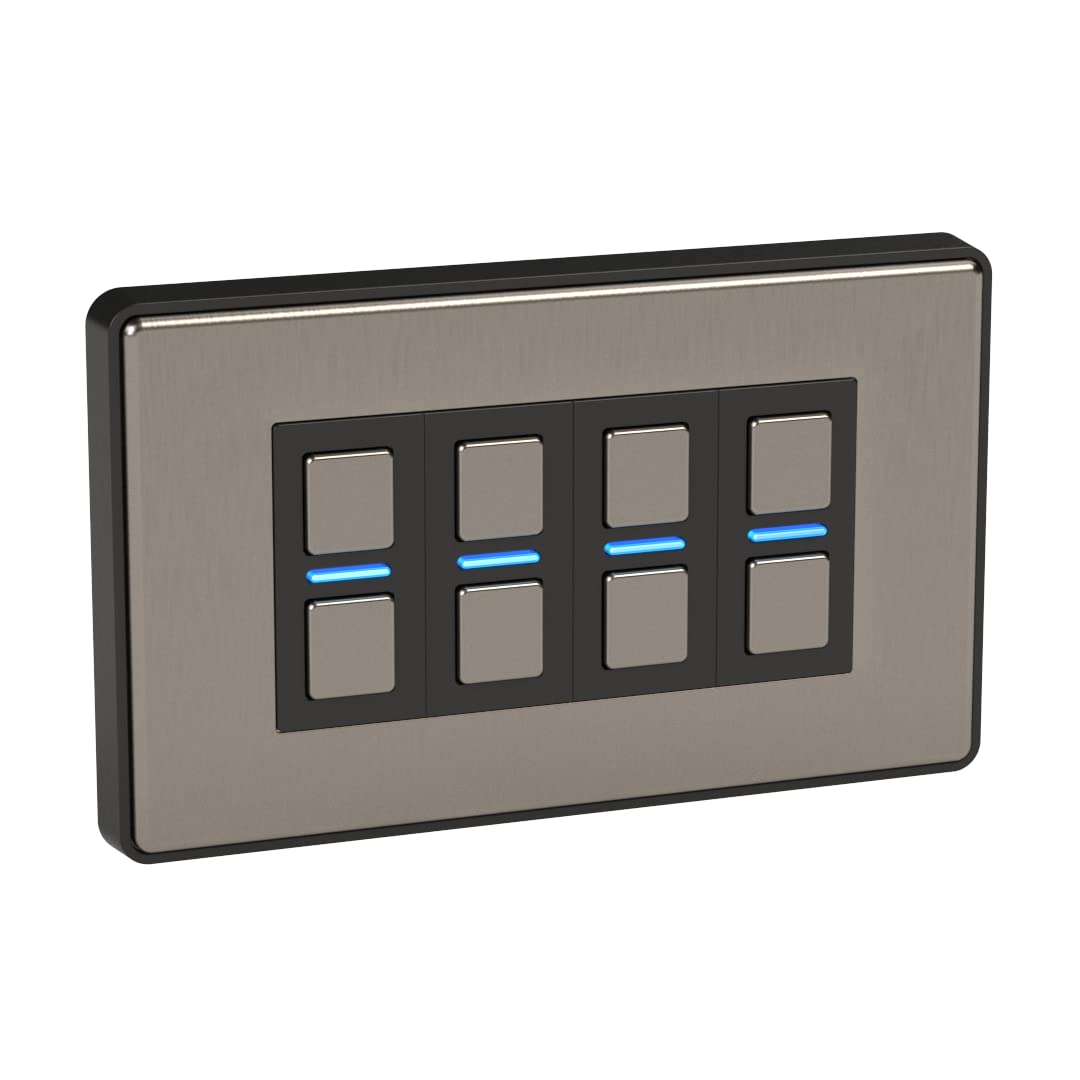
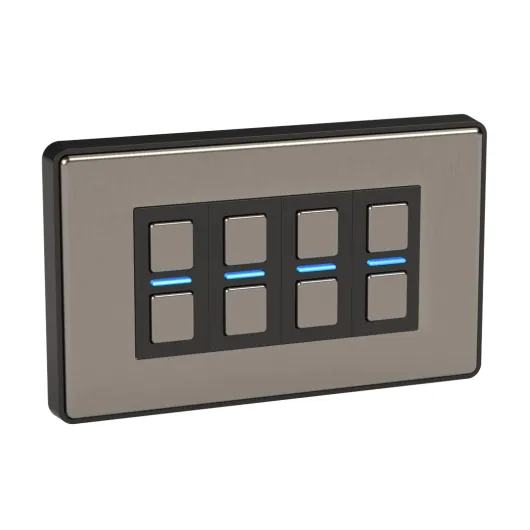
From a distance, the design is pretty clean. The stainless steel faceplate looks nicer than a cheap white plastic switch, especially in a hallway or living room where you actually see the thing. It’s a brushed finish, not mirror, so fingerprints aren’t a disaster, although you’ll still see smudges if you’re picky. On the wall next to my standard white sockets, it definitely stands out as the "fancier" bit of hardware. If you’re going for a consistent look across the house, that’s good, but you might end up wanting to swap other plates to match.
Each of the four buttons is a small rectangular rocker/push button combo. You press the top to turn on / increase brightness, the bottom to dim / turn off (depending on configuration). The buttons have a clear click – not soft, not mushy. Personally I like the tactile feel, but compared to some higher-end switches it does feel a touch "plastic" in the press. You can hear the click in a quiet room. It’s not loud enough to be annoying, but if someone is sleeping in the same room and you’re tapping it at night, it’s noticeable.
There are small indicator LEDs that show status. They’re practical but not super pretty. They help you see if a circuit is on when the brightness is very low, and they’re useful during pairing or troubleshooting. In the dark, they’re visible but not blinding. If you hate any kind of status light, you might find them a bit much, but for me they’re fine. I’ve seen people complain about bright LEDs on other brands; this one is somewhere in the middle.
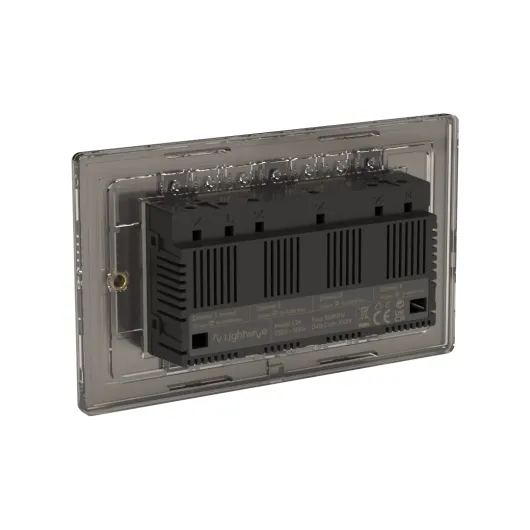
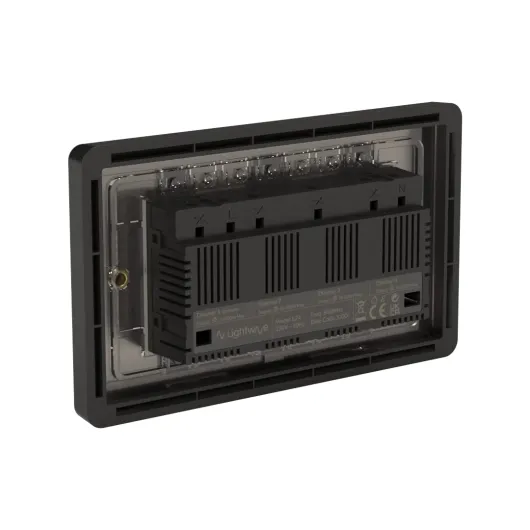
Installation-wise, the shallow electronics help it sit fairly flush. On my standard depth metal back box, I didn’t need the supplied spacer, and the plate sits neatly against the wall. The screw holes lined up with the existing box so there was no drama. The only point where design meets pain is the wiring space: on a busy 4-gang with several feeds and loop-throughs, it gets tight behind the unit. If your existing wiring is a messy bundle, be ready to spend some time tidying and pushing cables around to get the plate to sit flat. Overall, design is more practical than fancy: nice enough to look at, clearly laid out, and you can tell it’s made for real UK wiring rather than just looking good in photos.
Build quality and long-term feel
I obviously haven’t used this for years yet, but I’ve had other Lightwave gear (older-gen dimmers and a couple of smart sockets) running for a while, and the general build quality has been decent. This 2023 MK2 4-gang feels in the same ballpark. The stainless steel plate is rigid, doesn’t flex when you tighten the screws, and hasn’t marked easily from day-to-day use. After a few weeks of regular pressing, the buttons still feel the same as on day one: same click, no wobble or looseness.
The electronics are the boring but important bit. The unit is rated IP00, so it’s strictly for dry indoor use – no bathrooms or places where it might get splashed. Operating temp is 5–35°C, which is basically normal room conditions. It’s CE marked and rated 230V at 3.48A, so within standard UK expectations. I haven’t noticed any buzzing or humming from the dimmer itself when running compatible bulbs. With the original random bulbs I had some faint noise at certain dim levels, but that disappeared once I switched to recommended LEDs. That’s more a bulb issue than the dimmer itself.
One thing I like is that Lightwave offers a 2-year manufacturer warranty and, according to other reviewers, their support is at least responsive enough to send replacements. The 1-star review mentions getting a replacement unit when things didn’t work, even though the user still couldn’t get it going. That tells me that if you do get a dud, they’ll probably swap it rather than leaving you stuck. Obviously, throwing it in the bin is a bit extreme, but I can see how someone would lose patience if they expect plug-and-play and run into wiring or pairing issues.
Long term, the main durability risk is probably less the metal plate and more the electronics behind it, especially if you run loads near the limit or use dodgy bulbs. The 200W rating per unit (and lower recommended LED loads) means you shouldn’t be wiring massive halogen banks to it. If you respect the load limits and stick with tested bulbs, I don’t see a big reason to worry. It’s not a tank, but it feels like a reasonably solid bit of kit designed for normal home use, not a cheap no-name switch off eBay.
Performance, dimming behaviour and app/voice control
In daily use, performance is mostly solid, but it really depends on using compatible bulbs. When I first installed it, I left my old random mix of "dimmable" LEDs in place. Result: one circuit flickered at low levels, one wouldn’t dim smoothly and jumped from almost off to too bright, and one behaved fine. After checking Lightwave’s compatibility list and swapping to Aurora dimmable GU10s (as one Amazon reviewer also mentioned), the difference was obvious. With the right bulbs, dimming is smoother and the flicker basically disappeared.
From the wall, response is instant. Press on, light comes on. Hold to dim, you see the level change right away. There’s a small ramp-up and ramp-down which makes it feel nicer than a blunt on/off. I didn’t notice any serious lag between pressing the button and the light reacting. Over the app and via Alexa/HomeKit, there is a tiny delay, like half a second, which is normal for this kind of system. It’s not something that bothered me. Saying "Alexa, set living room lights to 30%" works reliably once everything is set up.
Connectivity to the Lightwave Link Plus hub has been stable for me. The switch is on the edge of my house, and the hub is in the middle. I haven’t had dropouts so far. Some people mention range limitations in their reviews, and I can see how that might happen in a big house or with thick walls, because it’s using its own 868 MHz RF system, not mesh Wi‑Fi. In my fairly average UK semi, it’s been fine. If your place is large or oddly shaped, you might need to think about hub placement more carefully.
Energy monitoring is there, but I’ll be honest: it’s more of a "nice to have" than a killer feature. The app shows power usage per circuit, which is useful if you’re trying to understand which room is wasting the most electricity. But it’s not super detailed analytics; it’s just basic figures and graphs. For automations, schedules work reliably – I’ve set lights to come on around sunset and to randomise in the evening when I’m away. The randomisation is simple but does the job for presence simulation. Overall, performance is pretty solid as long as you accept the two big conditions: use compatible bulbs and accept you’re tied to the Lightwave hub.
What this thing actually does (and what you need to make it work)
The Lightwave LP24MK2 4-gang is a smart dimmer module that replaces a standard UK 4-gang light switch. Each of the four buttons can control a separate lighting circuit, and each channel is dimmable up to a total of 200W (for LEDs that usually means a lot of bulbs, but you still have to check the per-channel limit and bulb compatibility). It runs on 230V and uses Lightwave’s 868 MHz RF protocol, so it does not connect directly to Wi‑Fi. To get app control, energy monitoring and voice control, you need the Lightwave Link Plus hub. No hub = it still works as a basic dimmer at the wall, but no app, no automations.
Out of the box you get the stainless steel faceplate with the electronics already attached, plus a 10 mm spacer if your back box is too shallow. The idea is that it’s a DIY-friendly swap for your existing switch: same screw terminals, same live feed, and you don’t usually need a neutral. In my case I only had live and switched lives in the box, and it still worked fine. That matches what another Amazon reviewer said: it only needs the live.
The "smart" side is fairly standard: you can control it from the Lightwave app on iOS or Android, add it to Apple HomeKit, Alexa, or Google Assistant, and then set schedules, scenes, and automations (e.g. turn lights on at sunset, dim in the evening, randomise when away to simulate someone being home). It also does two-way communication, so the app shows whether a circuit is on or off and at what brightness, which is handy when you’re away.
The catch is the ecosystem buy-in. For multi-way circuits (2/3/4-way), every switch in that circuit has to be a Lightwave dimmer of the same series. So if you have a hallway with two switches controlling the same light, you can’t just do one Lightwave and one dumb switch. You need two Lightwaves, plus the hub. That’s where the cost climbs quickly. If you’re okay with that, the feature set is pretty solid, but you really want to plan your circuits before buying a pile of these.
Does it actually make your lighting "smarter" in a useful way?
In terms of real-world usefulness, this dimmer does what I wanted: it lets my house work like a normal home for everyone else, while still giving me app control, schedules and voice commands. Compared to smart bulbs, the big win is that the wall switch remains the main control. My partner presses the buttons like any normal switch, doesn’t have to think about scenes or apps, and everything still works. That alone makes it more practical than a setup where someone accidentally turns off the physical switch and kills power to the smart bulbs.
The multi-way behaviour is where it gets more complicated. I have one circuit that’s two-way (two switches controlling the same light). With Lightwave, you have to replace both switches with Lightwave dimmers and configure them as a virtual 2-way in the app. Once it’s configured, it works fine – both switches control the same light, and the app always knows the correct on/off state. But it’s definitely not as simple as just wiring a regular two-way circuit. If you only replace one switch and try to hack it, you’ll just end up frustrated, a bit like the 1-star reviewer who said some buttons were controlling random lights and the app wouldn’t find the device. If you’re not comfortable with wiring and app configuration, this isn’t a 5-minute job.
For automations, I’d say it’s effective but not fancy. You can set schedules, timers, scenes and basic conditions. For example, I’ve got a "movie" scene that dims two circuits to 20% and turns the others off, and another scene for "bright" cleaning mode. These run reliably from the app and via voice. If you’re into more complex stuff (like motion sensors triggering lights differently depending on time of day), you can do some of that via HomeKit or other platforms like Home Assistant, but that’s more for tinkerers.
Overall, as a way to get centralised control over multiple circuits from a single neat wall unit, it works well. It doesn’t magically fix bad wiring, it doesn’t like random cheap bulbs, and it expects you to buy into the Lightwave ecosystem properly. But if you accept those limits, it genuinely makes it easier to manage lighting in a room with several circuits – especially with the 4-gang layout, where you can group a whole open-plan area on one plate and still run everything through schedules and scenes.
Pros
- Proper wall-mounted 4-gang dimmer that works like a normal switch but adds app and voice control
- No neutral required in most UK installations, making it suitable for older homes
- Stable performance with compatible bulbs and good integration with HomeKit, Alexa and Google Assistant
Cons
- High upfront cost, especially once you factor in the hub and multi-way circuits
- Requires compatible bulbs and all switches in a multi-way circuit to be Lightwave dimmers, which complicates upgrades
Conclusion
Editor's rating
Overall, the Lightwave LP24MK2 4-gang smart dimmer is a solid bit of kit if you know what you’re getting into. It looks good on the wall, works like a normal dimmer for everyone in the house, and gives you reliable app and voice control once it’s paired with the Lightwave Link Plus hub. Dimming performance is smooth with compatible bulbs, the app is decent, and things like schedules and scenes run without drama. For an everyday smart home setup in a UK house with no neutral at the switch, it ticks a lot of practical boxes.
On the flip side, it’s not plug-and-play for beginners. You need to be comfortable with basic wiring or pay an electrician, you absolutely need to respect the multi-way rule (all switches in the circuit must be Lightwave), and you should stick to the official bulb compatibility list to avoid flicker and weird behaviour. The price is also high, especially once you add the hub and multiple units. If you want to smarten a whole house in one go, your wallet will feel it.
I’d recommend this to people who: live in the UK, don’t have neutrals at their switches, care about having physical dimmers that look decent, and are okay buying into a closed ecosystem. If you’re just curious about smart lighting, on a strict budget, or you only need basic control in one room, cheaper smart bulbs or simpler switches might make more sense. For me, used selectively in key rooms, it’s a good but not cheap solution that gets the job done without driving the rest of the household mad.