Summary
Editor's rating
Is it worth the money or just expensive RGB?
Looks: triangles look good, cable is the weak spot
Build quality and feel: plastic but not flimsy
Long-term use and how confident I feel about them
Brightness, colours, and all the smart features in real life
What you actually get in the box
Pros
- Very good visual effect with bright, even colours and flexible layouts
- Easy, drill-free installation on painted walls with everything included in the box
- Works with major smart home platforms (Alexa, Google Assistant, HomeKit) and supports expansion packs
Cons
- High price compared to other RGB lighting options
- App and voice assistant integrations can be unreliable or laggy
- Adhesive is basically permanent on paint, and the power cable can ruin the clean look if not hidden

Specifications
View full product page →| Brand | Nanoleaf |
Cool toy or overpriced wall light?
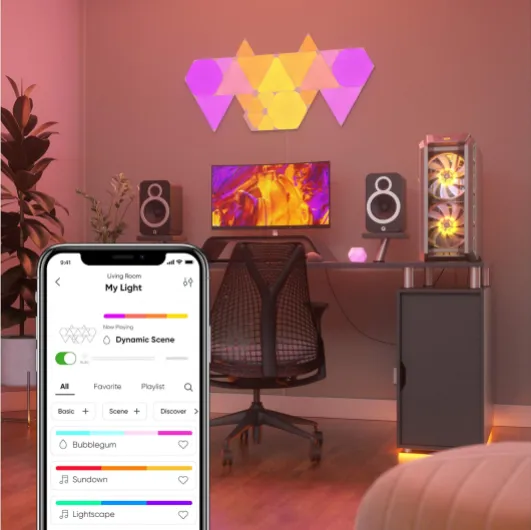
I’ve been using the Nanoleaf Shapes Triangle Starter Kit (15 panels) in my home office / gaming corner for a few weeks now. I didn’t get them as some life-changing smart home gadget, more as a “let’s see if this makes the setup look cooler” purchase. Short version: they do look very cool, but they’re not perfect, and you definitely pay for the visual effect and ecosystem more than the raw light output.
I mounted them behind my monitors, kind of like a backdrop for video calls and gaming. The first thing that hit me is that these are more of a decorative light than a main room light. Yes, they get bright, but if you expect them to replace your ceiling light, you’ll be disappointed. They’re more like a mood / accent thing that just happens to be very configurable.
In daily use, I mostly stick to a couple of calm scenes and some basic white tones. All the fancy music and touch stuff is fun to show off once or twice, but for me it’s more of a party trick than something I use every day. That said, when you walk into the room and they’re glowing in a nice pattern, it does give the space a bit of personality compared to a regular lamp.
If you’re already into RGB gear and smart home stuff, these fit in nicely. If you just want cheap coloured lights, this kit is probably overkill. The price is high, the software can be annoying at times, but when it works the way it should, it does exactly what you expect: it makes your wall look good and reacts well to scenes and automations.
Is it worth the money or just expensive RGB?
This is where it gets tricky. The Nanoleaf Shapes Triangle Starter Kit is not cheap, especially the 15-panel version. If you break it down per triangle, you’re paying quite a bit for each piece of plastic with LEDs. There are definitely cheaper RGB options out there, like LED strips, basic smart bulbs, or generic RGB wall panels from no-name brands. If your only goal is to have coloured light in a room, this is overkill, no question.
Where the value starts to make more sense is if you care about design, ecosystem, and expandability. The fact that you can easily add more panels later, sync everything in one app, and integrate with Alexa/Google/HomeKit is a plus. Also, these do look cleaner and more polished than the random AliExpress RGB panels I’ve seen. The light diffusion is better, the app (even with its flaws) is still ahead of the cheap stuff, and the brand actually offers firmware updates and a 2-year warranty.
In practice, I’d say the value is decent if you’re the type of person who spends money on a gaming setup, nice monitor, mechanical keyboard, and other “unnecessary but cool” things. Then this fits right into that budget and makes the whole setup look more put together. If you’re very price-sensitive or just want “a bit of colour on the wall”, then this is hard to justify, and you’d probably be happier spending half as much on something simpler.
So for value, I’d rate it as: not a bargain, not a rip-off either. You’re clearly paying a premium for brand, design, and ecosystem. If those matter to you, the price is acceptable. If you only care about lumens per euro, it’s not a good deal. I don’t regret buying it, but I’m also very aware that a big chunk of the cost is for the aesthetic and the smart features, not raw lighting performance.
Looks: triangles look good, cable is the weak spot
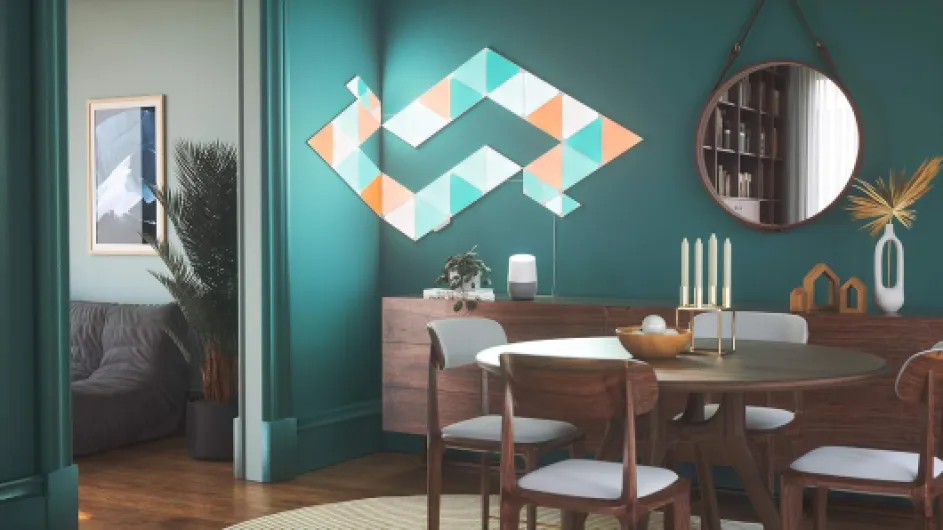
Design-wise, I actually like the triangles more than the other Nanoleaf shapes. They look more uniform and cleaner on the wall. Once mounted, the individual panels blend pretty well into one big pattern, especially when the lights are on. The bezels are visible if you look closely, but from normal distance it just looks like a single geometric light sculpture on the wall.
The biggest design win is the modularity. You can arrange them into basically any pattern that makes sense with triangles: lines, arrows, abstract shapes, whatever. The downside is that once they’re stuck with the adhesive, you won’t want to move them. So you spend time on the floor or in the app trying patterns before committing. I ended up laying them on the floor, taking a photo, and then copying it on the wall as best as I could. There’s no easy way to temporarily stick the whole layout and then adjust, which is a bit annoying if you’re picky.
One thing that doesn’t look great is the power cable. By default, there’s a white cord hanging down from whichever panel you plug the power into. If you don’t plan for that, it can ruin the clean look. I had to route it behind my monitor and along the edge of the desk to hide it. It’s not the end of the world, but for a product that is clearly sold on the visual side, they could have done better with cable management options.
Overall, as a design object, I liked it. On the wall, it looks way better than a cheap LED strip or those generic RGB bars. It feels like a proper decorative piece rather than just “more lights”. But you have to accept that it’s plastic, there’s a visible cable, and if you misplace one panel by a few millimetres, you’ll notice it every time you look at it.
Build quality and feel: plastic but not flimsy
The panels are made of plastic, no surprise there. When you take them out of the box, they don’t feel premium like metal or glass, but they also don’t feel super cheap. I’d call it decent mid-range plastic: light, a bit hollow, but solid enough that you’re not scared to handle them. You can flex them a tiny bit if you try, but in normal use they’re just hanging on the wall and not under any real stress.
The linkers (the little connectors between panels) are also plastic, and this is where I was a bit more cautious. They slide into the back of each panel and carry both power and data. They work, but they feel like a part you don’t want to be constantly unplugging and replugging. If you plan to regularly change your layout, I can see these getting loose or worn over time. For a “set it and forget it” install, they’re fine.
The adhesive mounting plates and tape are okay, but not magical. On a clean painted wall, they stick well. On rougher surfaces or if you don’t clean the wall, you’re taking a risk. I’ve had no panels fall yet, but I wouldn’t trust them on brick or textured wallpaper without extra support. Also, once you press them on properly, you won’t remove them without at least some damage to paint, so keep that in mind if you’re renting.
In terms of heat and noise: the panels don’t get hot, just slightly warm at higher brightness, and there’s no buzzing or coil whine that I noticed. That’s good, because some cheaper LED products do buzz. Overall, the materials are nothing fancy but they’re good enough for what this is: a decorative, indoor-only, wall-mounted RGB system. Just don’t expect some heavy, “premium” feel when you unbox it, it’s mainly well-finished plastic.
Long-term use and how confident I feel about them
I haven’t had these for years, but based on a few weeks of daily use and what I know from similar Nanoleaf products, I can give a decent idea of durability. Once they’re on the wall and left alone, there isn’t much that can go wrong mechanically. No moving parts, no hinges, just panels, connectors, and a controller. So the main risks are: adhesive failing, connectors getting loose if you mess with them, or electronic glitches over time.
So far, the adhesive is holding well on painted drywall. I did clean the area quickly before sticking them. If you skip that, you’re increasing the chance of a panel peeling off in a few months, especially if the room gets warm. The backing plates feel solid enough, and the tape is standard strong double-sided stuff, nothing fancy but not cheap foam either. My only concern would be if you live in a very humid place or have rough walls, then I’d consider extra mounting methods.
On the electronics side, I haven’t seen any dead LEDs, flickering, or random panels turning off. The 2-year manufacturer warranty is reassuring, but obviously you don’t want to rely on that. The controller and power supply don’t get hot, and there’s no weird smell or noise, which is usually a good sign. I’ve left them on for long sessions (4–6 hours) and they behaved fine.
The weak point long-term will probably be the software and ecosystem, not the hardware. If Nanoleaf stops updating their app or changes cloud stuff, you might lose some features or have more connection issues. But as a basic Wi-Fi light that keeps its last state, even if the app gets worse, you’ll still be able to turn them on and cycle scenes with the controller. So in terms of physical durability, I’m reasonably confident. Just don’t expect to move them around every few months without eventually damaging paint or loosening connectors.
Brightness, colours, and all the smart features in real life
On the performance side, the lights themselves are pretty solid. The brightness is more than enough for ambient and accent lighting. At 100%, it’s actually too bright for me when I’m sitting close to them, so I usually keep them around 30–40%. The colours are strong and fairly accurate for an RGB product. Whites are adjustable from very warm to very cold, and the transition between scenes is smooth. No visible flicker, no weird colour patches, each panel lights evenly.
Where it gets less clean is the software and integrations. The Nanoleaf app works, but it’s not always responsive. Sometimes it connects instantly, other times it hangs for a bit or says the panels are unreachable, then suddenly they respond. It’s not constant, but it happens enough to be mildly annoying. Setting up the first time also took longer than it should. I had to reset once and fiddle with my Wi-Fi before it finally stayed connected.
The “Rhythm” music reactive mode is okay on paper but kind of random in practice. Yes, it reacts to sound, but it doesn’t really feel in sync with the music in any meaningful way. More like generic flashing rather than something that matches the beat properly. Fun for 10 minutes, then I never really used it again. Same for touch games: cool to show friends, but not a daily feature for me.
Screen Mirror is more interesting if you game or watch movies on a PC. When it works, it’s a nice effect: colours on the panels roughly follow what’s on your monitor. It’s not 100% precise, but it does add a bit of immersion. The catch is that you need the desktop app running and your layout correctly set up, so it’s not just plug-and-play on a console or TV without a PC. Overall, the core performance (light quality, colours, brightness) is good. The “smart” extras are hit and miss, usable but not perfect.
What you actually get in the box
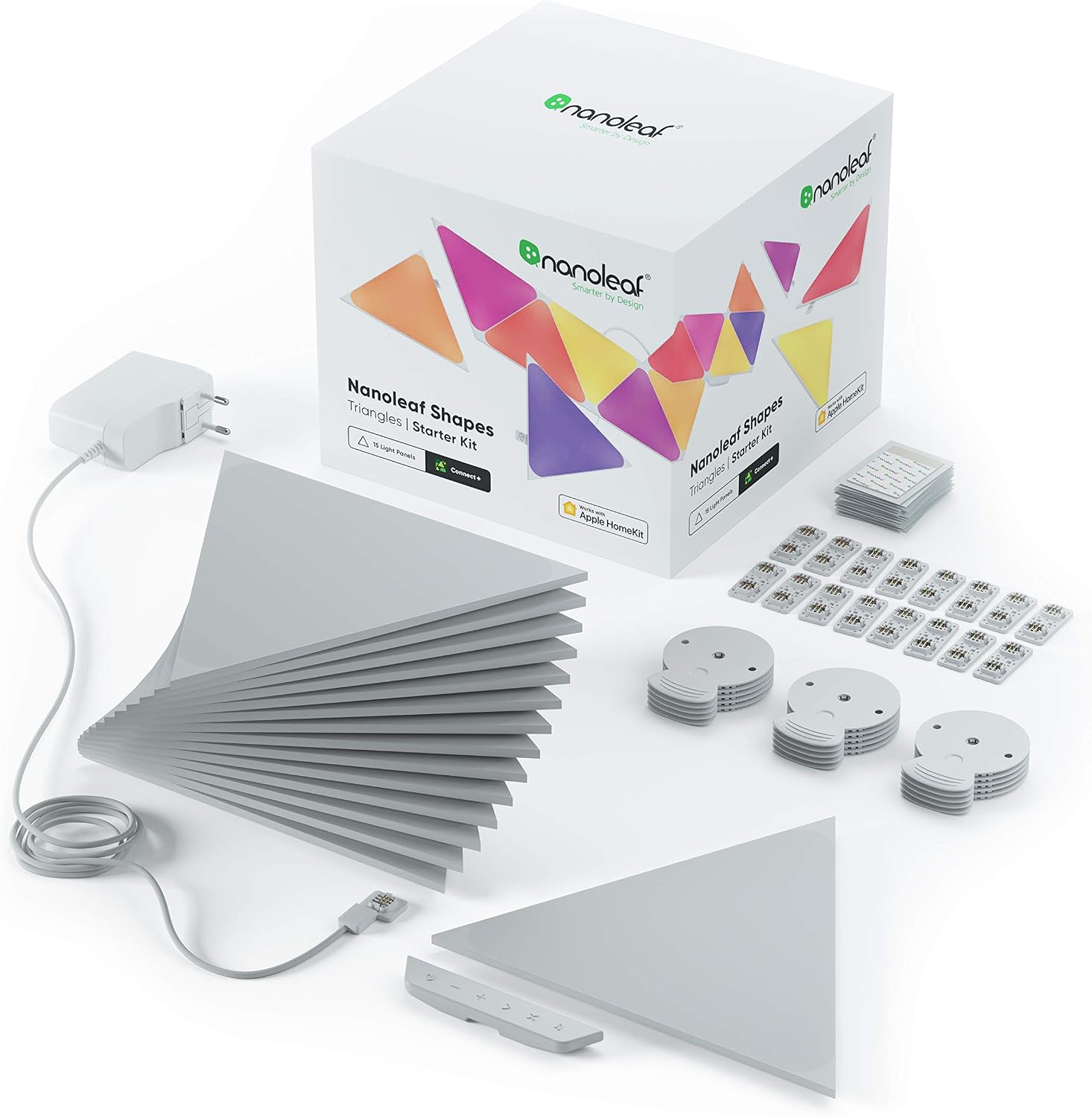
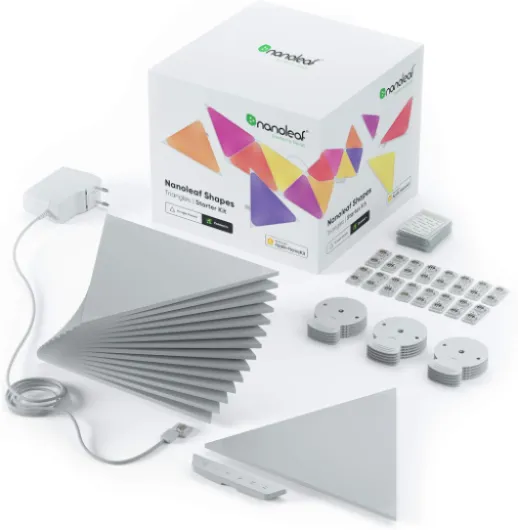
The kit I tested is the 15-panel starter pack. Inside the box you get: 15 triangle panels, 15 mounting plates, 15 double-sided adhesive strips, 15 linkers (the little plastic connectors between panels), one power supply, one controller, and a quick start guide. So you don’t need to buy anything extra to get going unless you plan a huge layout that needs more power or more panels.
The panels themselves are light and fairly thin, so they don’t feel like heavy glass or metal, more like decent plastic. Each triangle is roughly hand-sized, so 15 panels is enough to make a layout that actually looks like something, not just a tiny cluster stuck in a corner. For a gaming setup or behind a TV, 15 is a good starting point. I’d say 9 would look a bit small on a bigger wall, so I get why people buy expansion kits quickly.
On the feature side, you get Wi-Fi control, app control, touch control on the panels, voice control with Alexa/Google/Apple HomeKit, and stuff like Screen Mirror and Rhythm (music reactive). In practice, the main things you’ll actually use every day are: on/off, brightness, a few favorite scenes, and maybe voice control. The rest is there, works more or less, but is secondary unless you love tweaking.
The product listing mentions 16M+ colours, 1200K-6500K white range, up to 1500 lumens total, and various smart integrations. All of that is technically true, but don’t get too obsessed with the numbers. The important part is: they get bright enough for a strong glow, you can go from very warm orange-ish white to cold blue-ish white, and you can save scenes. Everything else is mostly convenience or fun extras rather than core value.
Pros
- Very good visual effect with bright, even colours and flexible layouts
- Easy, drill-free installation on painted walls with everything included in the box
- Works with major smart home platforms (Alexa, Google Assistant, HomeKit) and supports expansion packs
Cons
- High price compared to other RGB lighting options
- App and voice assistant integrations can be unreliable or laggy
- Adhesive is basically permanent on paint, and the power cable can ruin the clean look if not hidden
Conclusion
Editor's rating
After living with the Nanoleaf Shapes Triangle Starter Kit for a while, my feeling is pretty clear: it looks great and does what it says, but it’s not magic and it’s not cheap. The panels give off strong, clean light, the colours are nice, and the modular triangle design makes your wall look way more interesting than a regular lamp or strip. For a gaming room, streaming background, or a modern office corner, it fits perfectly and actually changes how the space feels.
On the downside, the software and integrations are the weak points. The app can be slow or unresponsive at times, the Alexa integration is hit and miss, and the music reactive modes are more gimmick than useful. Installation is easy if you’re not too fussy, but once the panels are stuck, you won’t want to move them, and you need to plan around the visible power cable. You’re also paying a clear premium versus generic RGB products, so you need to actually care about the look and the ecosystem to justify it.
If you love tweaking your setup, want something that looks good on camera, and don’t mind paying extra for design and modularity, this kit makes sense. If you just want cheap smart lighting or hate dealing with apps that sometimes act up, I’d skip it and go for simpler bulbs or strips. For me, it lands in the “expensive but satisfying” category: not perfect, but I liked it enough that I’d consider adding more panels later rather than replacing it with something else.