Summary
Editor's rating
Is the 2-pack worth the money?
Simple, familiar design with one small learning curve
Basic, installer-style packaging (and no wall plates)
Build quality and long-term feel
How it actually behaves with real LED bulbs
What you actually get with this 2-pack
Does it actually make your lighting more usable?
Pros
- Works well with a wide range of dimmable LED bulbs once minimum level is adjusted
- Simple paddle + slider design that behaves like a normal switch with dimming memory
- Supports both single-pole and 3-way setups with clear wiring diagrams
Cons
- No wall plates included and no locator light for finding the switch in the dark
- Performance at very low dim levels depends heavily on bulb quality, especially in 3-way setups

Specifications
View full product page →| Brand | Lutron |
A dimmer that doesn’t try to be smart, just useful
I installed this Lutron Diva LED+ 2-pack because I was tired of either blinding light or total darkness in a couple of rooms. No smart home hub, no app, just a physical dimmer that I could slap into an existing switch box and be done. I’ve used a bunch of random dimmers over the years, and the usual problems are buzzing, flicker, or the lights not turning back on at the same level. So I went into this kind of skeptical, especially with LED bulbs which can be picky.
In practice, this thing is pretty straightforward: a big paddle you use like a normal switch, and a side slider to set the brightness. I put one in a bedroom and one in a living room, both with dimmable LED bulbs from different brands. I wanted to see if it would freak out with mixed bulbs or low loads, because that’s usually where cheaper dimmers struggle. So far, it’s handled those scenarios better than the budget hardware store dimmers I’ve tried before.
What stood out to me quickly is that the on/off behavior feels like a regular switch, which my family appreciated. You don’t have to teach anyone how to use it: tap the paddle, light goes on to the last level; tap again, off. The slider is almost an afterthought once you set your preferred brightness. That’s the main upside: it behaves predictably, which sounds basic, but a lot of dimmers screw that up with LEDs.
It’s not perfect though. Price-wise, it’s not the cheapest option, and you don’t get a wall plate in this contractor-style pack. Also, it still depends heavily on what bulbs you use. With some cheaper LEDs, the low end of the dimming range isn’t smooth, and you have to tweak the little adjustment wheel on the front (hidden behind the plate) to keep flicker under control. So it gets the job done, but it’s not magic. You still need decent bulbs and a bit of patience during setup.
Is the 2-pack worth the money?
Price-wise, this Lutron Diva LED+ sits in that middle zone: not dirt cheap, not premium smart-switch expensive. As a 2-pack, the per-switch cost is decent, especially compared to buying singles at a big-box store. That said, I’ve seen people mention finding these on closeout at Home Depot for less, so it’s worth checking local prices before pulling the trigger online. If you pay full online price, you’re mostly paying for the reliability and LED compatibility rather than fancy features.
Compared to the real budget dimmers I’ve used, the value shows up over time. The cheap ones often flicker more, buzz, or behave weirdly with different LED brands. You end up either replacing bulbs or replacing the dimmer, which kind of kills the savings. With this Diva LED+, I spent a bit more upfront, but I haven’t had to fight with it daily. Once I set the minimum brightness and picked decent bulbs, it just works like a normal switch with dimming. For me, that’s worth a few extra bucks.
Where the value takes a small hit is the lack of included wall plates and the fact it’s not a smart switch. If you wanted app control, schedules, or integration with Alexa/Google, this does none of that. It’s purely manual. For my use in a bedroom and living room, that’s fine. But if you’re already deep into smart home stuff, you might feel like you should just put that money toward a smart dimmer instead and get more features for not much more cash.
Overall, I’d say the value is pretty solid if your goal is simple, reliable dimming for LEDs and you don’t care about smart features. It’s more expensive than the bargain-bin options but cheaper and simpler than going full smart-home. If you catch it on sale or in a multi-pack, it’s an easy choice. At full price, it’s still reasonable, but you’ll appreciate it most if you’ve already been burned by flickery, annoying dimmers in the past.
Simple, familiar design with one small learning curve
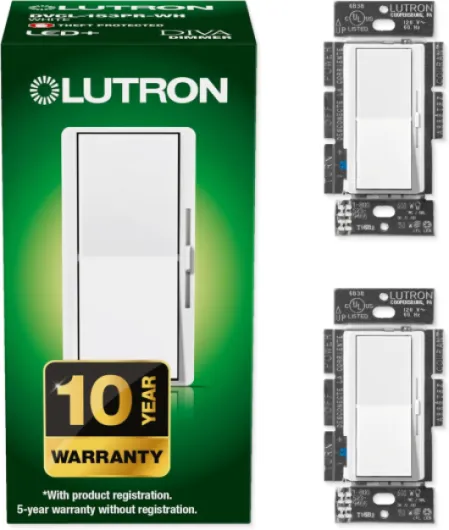
Design-wise, this is as standard as it gets, which I actually liked. It’s a Decora-style paddle that blends in with most modern switches. No glowing ring, no weird shapes, just a big white rocker that looks like every other Lutron or Leviton paddle in a typical house. I put one in a 3-gang box next to regular switches and it didn’t stand out at all, which is what I wanted. If you’re picky about uniform look, this fits in nicely.
The slider is where the design is a bit mixed. It’s small and tucked to the right of the paddle. On the plus side, it’s discreet and doesn’t scream “dimmer”. On the downside, if you have bigger fingers or the box is tight next to another device, it can feel a bit cramped. My partner took a day or two to get used to not accidentally hitting the slider when they just wanted to flip the switch. After that, it became second nature: tap the paddle for on/off, nudge the slider when you actually care about brightness.
One thing this model doesn’t have is a little locator light. Some older Lutron models have a faint glow so you can find the switch in the dark. This one is just dark when off. For a bedroom or hallway, that might matter. In our bedroom, I honestly missed that tiny night-light feature from my older incandescent-only Lutron dimmer. Not a deal-breaker, but worth knowing before you swap out an older model and wonder where the glow went.
Overall, the design is practical, not fancy. It looks clean on the wall, it matches standard white plates, and once you learn the paddle + slider combo, it’s easy to use. The only small minus is the lack of a locator light and, for some people, the slightly fiddly small slider if your switch box is crowded or your hands are big. But for everyday use, it’s pretty solid and blends into the room instead of drawing attention.
Basic, installer-style packaging (and no wall plates)
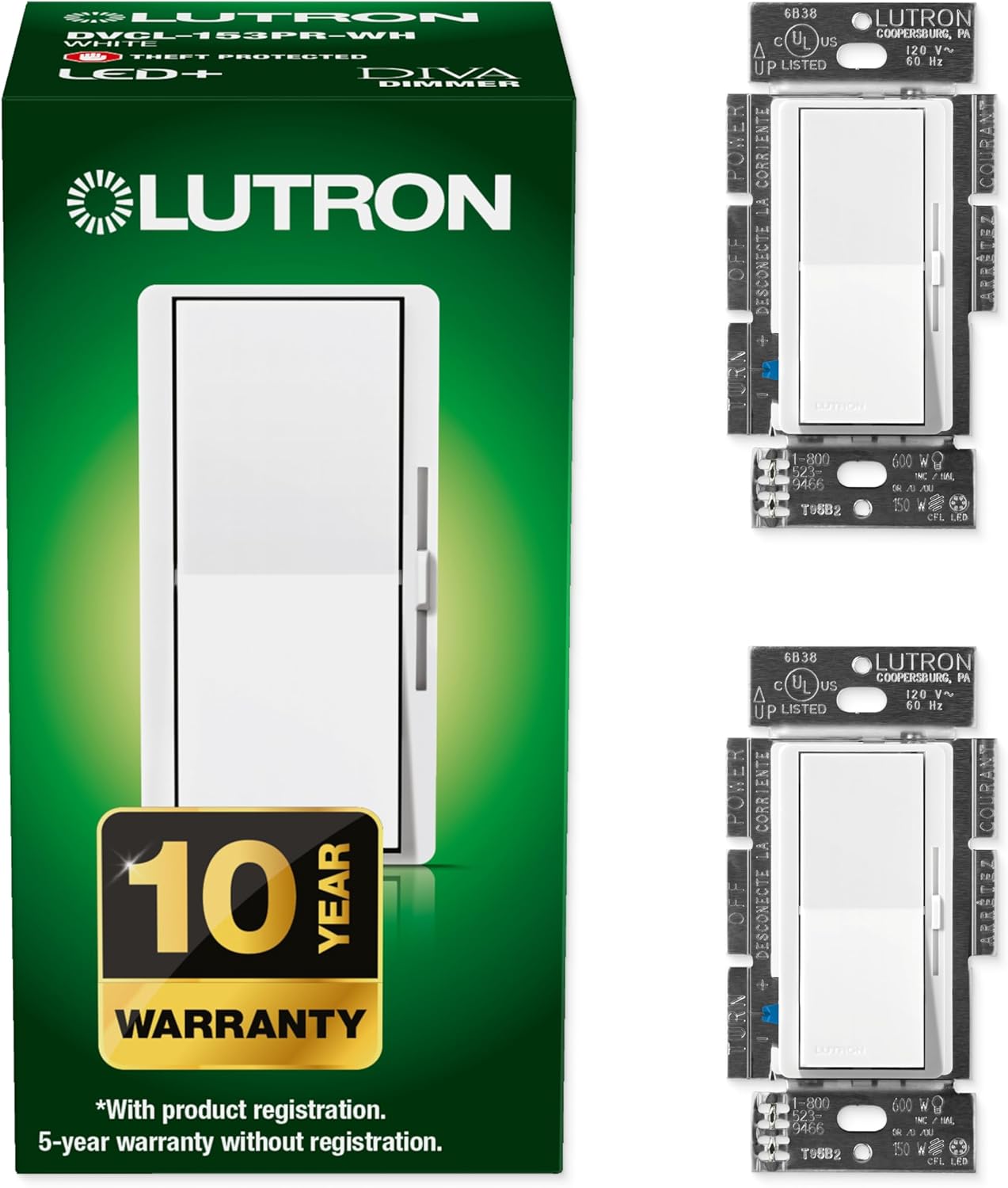
The packaging on this 2-pack is very plain. It comes in a small cardboard box, each dimmer wrapped in a simple plastic bag, plus a folded instruction sheet. No glossy retail art, no big plastic clamshell. Personally, I liked that because there’s less packaging waste and it’s easy to open. But if you’re used to retail store versions, it might feel a bit bare.
The main thing to understand is: you don’t get wall plates in this version. If you expect to open the box and have everything needed to swap out an old toggle switch, you’ll be missing that last piece. You either reuse your existing Decora plate or buy a matching Lutron Claro plate separately. Not a big deal if you already have paddle-style plates on the wall, but if you’re upgrading from old-school toggles, that’s an extra purchase you need to plan for.
The instructions are decent, not fancy. You get wiring diagrams for both single-pole and 3-way setups, plus a short section on using the little minimum brightness adjustment wheel. It’s not written like a beginner’s guide, but if you’ve ever swapped a switch before, it’s enough. If you’re totally new to electrical work, you’ll probably end up watching a YouTube video anyway, which there are plenty of for this exact model.
So on the packaging front, this is clearly aimed more at electricians or DIYers who know what they’re buying rather than someone casually picking it up as a gadget. I don’t mind that at all, but it does mean you need to pay attention to the model number and know that plates aren’t included. No frills, no fancy unboxing, just the product and the basics to get it installed.
Build quality and long-term feel
I haven’t had this specific 2-pack running for years yet, but I’ve used similar Lutron Diva dimmers in other places for a long time, and they’ve held up decently. This one feels in line with that. The paddle has a firm, consistent click and doesn’t feel loose or mushy. The slider has enough resistance that it doesn’t drift if you bump the wall, but it’s not stiff. After a few weeks of daily use in high-traffic rooms, there’s no wobble or weird grinding feeling.
Physically, the front plastic feels solid enough for home use. It’s not luxury-level, but it doesn’t feel cheap either. The metal mounting plate is standard, and the clamp-style terminals on the back feel more secure than the old-school screw-and-wrap style. Once you tighten the wires correctly, nothing has come loose or heated up noticeably, even on the circuit with multiple recessed lights that get used a lot.
From past experience with Lutron dimmers, the electronics tend to be fairly reliable as long as you don’t overload them or pair them with sketchy fixtures. I’ve had cheaper dimmers from big-box stores start buzzing loudly or failing partially (they’d only dim halfway, for example) after a couple of years. I haven’t seen that with my older Lutron units. This Diva LED+ feels similar in terms of build, so I’m expecting it to last several years without drama, assuming the house wiring is sound.
If I had to nitpick, I’d say the slider is probably the weak point over the long term just because it’s the moving part that gets the most abuse. But since you don’t actually move it that often day-to-day, I’m not that worried. Overall, durability seems good for the price bracket. It feels more reliable than bargain dimmers, but it’s also not some industrial-grade monster. For normal home use, I’d be comfortable installing these in most rooms and not thinking about them again for a long while.
How it actually behaves with real LED bulbs
This is where dimmers usually fall apart: LED compatibility. I tested this Diva LED+ with a mix of dimmable LEDs – cheap Amazon basics in one room and brand-name bulbs in another. On the better bulbs, the dimming range was smooth from very low to full, with no noticeable flicker or buzzing. The lights turn back on at the last brightness level like they’re supposed to, which is key for bedrooms or nurseries where you don’t want full blast in the middle of the night.
On the cheaper LEDs, things were a bit more hit-or-miss. At the very bottom of the slider, I got some small flicker and a tendency for lights to just shut off instead of staying at a super dim glow. Adjusting the little minimum brightness wheel on the front helped a lot. Once I bumped the minimum up slightly, the flicker basically went away, but I lost that very lowest night-light level. So yes, the dimmer helps, but it can’t fully fix junk bulbs. If you pair it with decent dimmable LEDs, it behaves way better.
I also tried it in both single-pole and 3-way setups. In single-pole, it was rock solid. In 3-way, performance was mostly good, but like one of the Amazon reviewers mentioned, some combinations of high-wattage equivalent bulbs and 3-way wiring can get a bit quirky. In one test setup, if I left the slider too low and turned the light off from the dimmer side, it didn’t always want to turn back on unless I raised the slider. It wasn’t common, but it happened enough that I’d say: if you’re doing a 3-way with LEDs, expect to spend a few minutes tweaking and maybe swapping bulbs if you get odd behavior.
Overall, performance is pretty solid once you dial it in. It handles mixed LED brands better than budget dimmers I’ve used, especially in terms of avoiding constant flicker. But it’s not magic – the dimmer is good, the bulbs still matter. If you pair it with bulbs from Lutron’s compatibility list or other known good dimmable LEDs, you’ll likely be happy. If you use random bargain LEDs, you might need to compromise on how low it will dim to keep things stable.
What you actually get with this 2-pack
Out of the box, this 2-pack is very barebones: two dimmer switches, basic instructions, no wall plates. It’s clearly the contractor/installer version, not the fancy retail blister pack. That worked for me because I already had standard Decora plates on the wall and didn’t want extra plastic lying around. If you’re expecting a complete kit with plates included, you’ll be annoyed. Just know you probably need to buy matching Lutron Claro plates or reuse what you have.
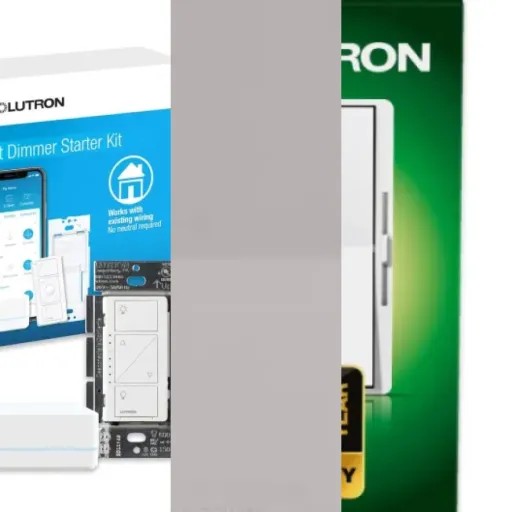
The model here is the DVCL-153P, which matters because Lutron has a ridiculous number of models that all look almost the same. This one handles up to 150W of dimmable LED/CFL or 600W of incandescent/halogen. In normal language: it’s fine for most household setups like a chandelier, recessed cans, or a ceiling fixture. I tested it on a small 3-bulb bedroom fixture and a 6-recessed-light living room circuit with LED bulbs, both worked without hitting the wattage ceiling.
Function-wise, you get a paddle switch for on/off and a tiny vertical slider right next to it for brightness. There’s also a small adjustment wheel on the front (you can only reach it with the plate off) to set the minimum brightness so your LEDs don’t flicker or randomly shut off at the bottom of the range. That’s not obvious unless you read the instructions, but it’s important if your bulbs act weird.
So in terms of presentation, this is a very no-nonsense product: not pretty packaging, no extra accessories, just the switches and enough documentation to get them wired. It feels more like something you’d grab from the electrical aisle than a polished consumer gadget. If you’re fine with that and you know you’re getting the right model number for LED compatibility, it’s pretty straightforward. If you like plug-and-play with zero reading, you might have a slightly steeper first-time setup than with a super basic non-LED dimmer.
Does it actually make your lighting more usable?
In daily use, the big win for me is how this dimmer changes how we use certain rooms. In the bedroom, I set the slider pretty low and basically never touch it again. Now the light comes on at a soft level at night instead of blasting full brightness. For middle-of-the-night trips or reading before bed, it’s just more comfortable. My partner went from rarely using the ceiling light to using it regularly because it’s not harsh anymore.
In the living room, it’s more about flexibility. We crank it up when cleaning or doing something that needs bright light, then slide it down for watching TV. Before this, we just had an on/off switch and ended up relying on lamps to get softer light. With the dimmer, the main fixture actually gets used properly. That sounds basic, but it genuinely changes how often we use the ceiling lights instead of juggling lamps and remotes.
From a practical standpoint, the on/off memory is what makes it effective. You set your level once, and the paddle always returns to that level when you turn it back on. You’re not constantly fiddling with the slider. For guests and kids, it still behaves like a normal switch, which means fewer questions and less confusion. It’s just brighter or dimmer depending on how you left it.
Is it perfect? No. In one room with cheaper bulbs, I had to accept that the bottom 10–15% of the physical slider was basically unusable because it caused flicker. After adjusting the minimum, the effective dimming range was more like 20–100% instead of 0–100%. But that’s still good enough for most activities. So in terms of effectiveness, it definitely makes lighting more practical and comfortable, as long as you’re okay spending a little time pairing it with decent bulbs and tweaking that minimum level during setup.
Pros
- Works well with a wide range of dimmable LED bulbs once minimum level is adjusted
- Simple paddle + slider design that behaves like a normal switch with dimming memory
- Supports both single-pole and 3-way setups with clear wiring diagrams
Cons
- No wall plates included and no locator light for finding the switch in the dark
- Performance at very low dim levels depends heavily on bulb quality, especially in 3-way setups
Conclusion
Editor's rating
After using the Lutron Diva LED+ dimmer in a couple of busy rooms, my overall take is that it’s a reliable, no-drama way to dim LED lights without diving into smart home setups. The paddle + slider combo is easy to live with, the memory function works as expected, and once you pair it with decent dimmable bulbs and tweak the minimum setting, it mostly just does its job quietly. It’s not flashy and it doesn’t try to be. It feels like a normal switch that happens to dim, which is exactly what most people in my house wanted.
It’s not perfect. The lack of a locator light might bug you if you’re used to older Lutron models. Performance in 3-way setups can be a bit sensitive to bulb choice, and super cheap LEDs can still cause flicker at the very low end. You also don’t get wall plates in this 2-pack, which adds a small hidden cost if you’re starting from scratch. And if you’re hunting for smart features, this isn’t it – no Wi‑Fi, no app, just a physical control.
I’d recommend this dimmer to anyone who wants simple, consistent control over LED, halogen, or incandescent lights, especially in bedrooms, living rooms, or nurseries where adjustable brightness actually matters. If you’re okay spending a bit more than the bargain options to avoid daily annoyances like buzzing and flicker, it’s a solid pick. On the other hand, if you’re on a tight budget, don’t care much about dimming quality, or you’re going all-in on smart switches, you might want to look elsewhere or step up to a connected model instead.