Summary
Editor's rating
Value for money: good, but shop around
Design and usability: simple, functional, not fancy
Packaging and installation: basic, but gets the job done
Build quality, heat, and long-term feel
Performance with LEDs and halogens: mostly smooth, sometimes picky
What this switch actually does (and what the model number really means)
Does it actually make your lighting more usable day to day?
Pros
- Handles dimmable LEDs and incandescent/halogen with a wide dimming range when paired with compatible bulbs
- No neutral wire required, so it works well in older homes and existing switch boxes
- Paddle + slider design is practical: remembers last brightness level and feels natural to use
Cons
- Can be picky with some LED bulbs, leading to limited dim range or odd on/off behavior
- No locator/night light, so the switch is hard to see in the dark
- Wall plate not included, which adds to the total cost if you don’t already have one

Specifications
View full product page →| Brand | Lutron |
A dimmer that finally behaves with LED bulbs (most of the time)
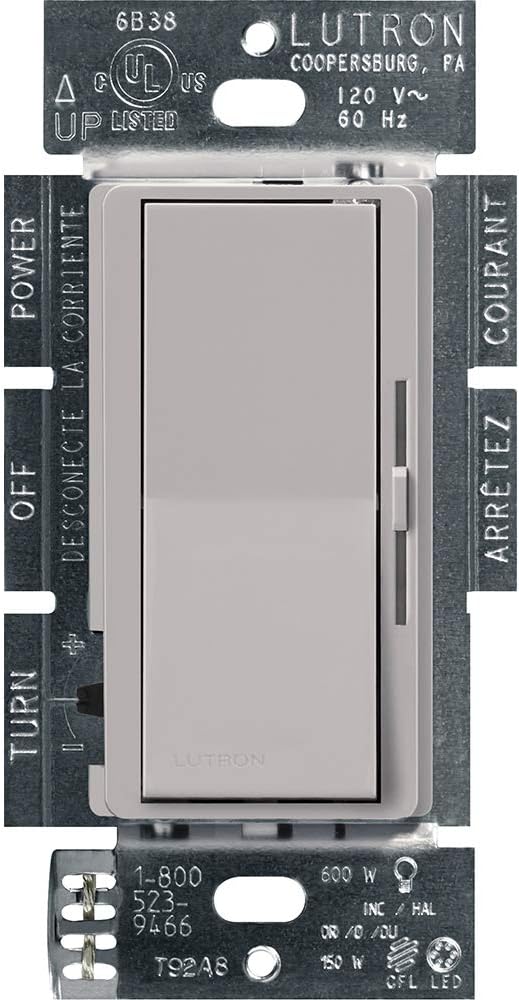
I put this Lutron Diva LED+ dimmer (DVCL-153P-GR) in a room where we use dimmable LED bulbs and sometimes swap in halogens. I’m not an electrician, just a reasonably handy homeowner who’s wired a few switches and outlets. I wanted something simple: no smart-home nonsense, just a reliable dimmer that doesn’t flicker or buzz every time I touch it. This one is clearly designed for that kind of use, and it shows once you live with it for a bit.
The first thing I noticed is that it really does handle mixed LED and incandescent loads better than the cheap dimmers you grab off the bargain rack. With a compatible LED bulb, the dimming range is pretty wide and there’s a small adjustment wheel hidden behind the plate to set the minimum level. That sounds like a geeky detail, but in practice it’s what stops the annoying flicker at low brightness. Once I set that, the light just behaved like a normal dimmer should.
In daily use, the on/off paddle is what you actually touch 95% of the time, and the slider just sits there holding your preferred level. That layout is handy at night: you don’t have to fiddle with brightness every time, you just tap the paddle and it goes to the last setting. Compared to the older rotary dimmers in my house, this feels more natural and less clumsy, especially when you’re half-asleep walking into a room.
It’s not perfect though. LED compatibility is good but not magic. With certain LED bulbs, especially higher wattage equivalents or random no-name brands, the behavior can be weird: lights sometimes only turn back on at full power, or the dimming range is shorter than you’d expect. So it’s a pretty solid dimmer, but you still need to pair it with decent bulbs and be ready to tweak that little minimum-level wheel during setup.
Value for money: good, but shop around
On price, this dimmer sits in the mid-range. It’s more expensive than the generic dimmers you find in bulk at big-box stores, but cheaper than most smart dimmers. Considering it’s Lutron, the price feels fair for what you get: better LED compatibility, wide dimming range, and a design that works in both single-pole and 3-way setups. You’re mostly paying for reliability and less hassle with flicker and buzzing compared to no-name options.
That said, you can sometimes find this exact model on clearance locally for less than online, as one reviewer mentioned with Home Depot. So if you’re doing a whole house or several rooms, it’s worth checking local prices before ordering a bunch. The fact that this version doesn’t include a wall plate also matters. If you need plates for every switch, add that to the total cost. For me, since I already had decorator plates, this version made more sense and kept the price reasonable.
Compared to cheaper dimmers I’ve tried, the main difference isn’t looks, it’s behavior. The Diva LED+ just works more consistently with decent bulbs, and the ability to set the minimum level is something you don’t always get on budget models. If you’ve ever wasted time swapping bulbs and dimmers to get rid of flicker, paying a bit more upfront starts to feel worth it. On the other hand, if you’re only dimming incandescent or halogen and never plan to move to LED, you could probably save a few bucks with a simpler incandescent-only dimmer.
Overall, I’d call the value good but not spectacular. You’re not getting a bargain basement deal, but you are getting a reliable, flexible dimmer that should last years and save you some frustration with LEDs. For a main living area, nursery, or any room you use a lot, I’d say it’s worth the price. For a random closet or rarely used space, it’s probably overkill.
Design and usability: simple, functional, not fancy
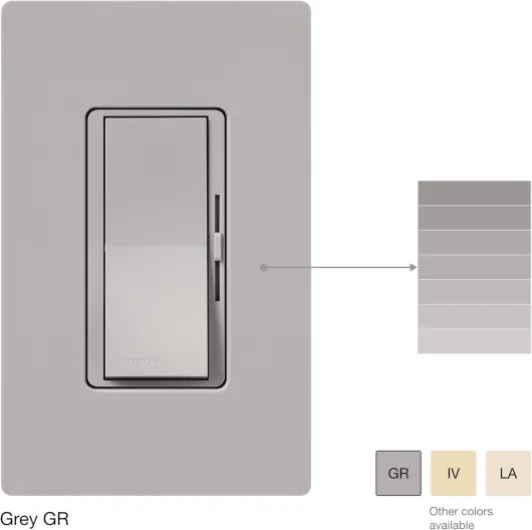
Design-wise, the Diva LED+ is pretty low-key. It’s a flat decorator-style switch with a large paddle and a skinny slider tucked on the right side. In gray, it looks clean and neutral, more "utility" than "decor statement". If you already have Lutron Diva switches, it blends right in. If your house still has old-school toggles, this will modernize the look a bit, but it’s not something anyone is going to compliment you on. It just looks like a normal, modern switch, which is fine.
From a usability standpoint, the layout makes sense. The paddle is the star: press the top for ON, bottom for OFF, and the light comes on at whatever level the slider is sitting at. That’s actually the best part of the design. Once you dial in a comfortable brightness with the slider, you basically ignore the slider and just use the paddle like a normal switch. Compared to round rotary dimmers that combine on/off and dimming in one knob, this feels much more natural. You don’t have to hunt for a tiny knob in the dark.
The slider itself is small but easy enough to move with a thumb. It’s not super smooth or luxurious, but it tracks well and doesn’t feel loose. You can fine-tune the brightness without much effort. The only quirk is that because it’s right next to the paddle, people who aren’t used to it might bump it accidentally the first few times and change the brightness without meaning to. After a few days, everyone in the house seemed used to it, so not a big deal.
One design trade-off: there’s no locator light. At night in a dark hallway or bedroom, the switch just disappears into the wall. Some of Lutron’s older dimmers for incandescent bulbs had a little glowing indicator so you could see the switch in the dark. This one doesn’t, and that’s intentional because LEDs don’t like the tiny leak current those locator lights use. If you’re used to that feature, you’ll miss it. If not, you’ll just reach for the switch like any other basic one. Overall, the design is practical and understated: it gets the job done, doesn’t scream for attention, and works fine in everyday use.
Packaging and installation: basic, but gets the job done
The packaging on this version (without the "H" in the model number) is very plain. It comes in a small cardboard box with the switch and an instruction sheet, and that’s about it. No plastic clamshell, no extra wall plate, no fancy printed marketing. Personally, I prefer that. It creates less trash and feels like it’s meant for people who actually plan to install it, not just look at it on a retail shelf. If you want the full retail experience with a faceplate included, you’d need the variant that comes in a clamshell, but you’ll pay a bit more.
The instructions are clear enough for anyone who’s replaced a switch before. There are diagrams for single-pole and 3-way setups, and they walk you through identifying the common wire and travelers. The only part that might trip up a beginner is matching the existing wires if your old switch wasn’t labeled clearly. That said, the diagrams are decent, and there are tons of online videos showing exactly how to install this exact model. As long as you cut power at the breaker and take your time, it’s a 15–30 minute job.
One practical detail: this dimmer does not require a neutral. That’s a big deal in older houses where the switch box only has hot and switched hot. In my case, it dropped into a 1960s box without any rewiring, which is exactly what I needed. The body of the dimmer is a bit deeper than a standard toggle, so in a very crowded box with lots of splices, you might have to work a bit to tuck everything back in. But it’s manageable, and the mounting screws line up correctly with standard boxes.
Overall, the packaging is no-frills and the installation is straightforward if you’re even mildly handy. It feels like a product aimed at both DIY homeowners and pros: minimal fluff, clear diagrams, and hardware that just fits. If you’re expecting a glossy manual and a bunch of extras, you’ll be disappointed. If you just want to get it into the wall without drama, it’s fine.
Build quality, heat, and long-term feel
In terms of build quality, the switch feels sturdy in the hand. The housing is solid, the mounting ears don’t bend like cheap metal, and the terminals are decent. Once installed, there’s no wobble in the paddle or slider. The action of the paddle has a clear click, so you know when you’ve actually switched it on or off. The slider moves smoothly enough without feeling loose. It doesn’t feel premium in a fancy way, but it also doesn’t feel like it’s going to fall apart after a year.
Heat-wise, it runs reasonably cool. All dimmers generate some heat, especially when you load them up, but in normal home use with LED loads under 100W or so, the faceplate only gets mildly warm, not hot. That’s a good sign for longevity. The switch is rated for typical residential temperature ranges (32°F to 104°F), which covers pretty much any indoor situation. I’ve had other Lutron dimmers from older generations running for years without failure, and this feels similar in terms of construction and reliability.
One thing I noticed is that the finish holds up well to fingerprints and daily use. The satin gray doesn’t show smudges as badly as glossy white plates. The slider track doesn’t collect dust as easily as some older designs either. It’s the kind of thing you don’t think about until you see a dimmer that looks grimy after a few months. Here, a quick wipe with a cloth now and then is all it needs.
Long-term, based on my short test and Lutron’s general reputation, I’d expect this to last many years. The weak link is more likely to be the bulbs than the dimmer itself. If you’re swapping bulbs and fixtures a lot, the dimmer will probably outlive several generations of LEDs. So on durability, I’d rate it as reliable, nothing flashy, but clearly not a disposable part.
Performance with LEDs and halogens: mostly smooth, sometimes picky
In terms of performance, this dimmer is solid but a bit picky about bulbs. With good quality dimmable LEDs (Philips, GE, or the better Costco ones), it gives a nice wide dimming range. You can get the lights down to a very low, almost night-light level without obvious flicker once you’ve set the minimum level using the little thumbwheel. That’s a big step up from generic dimmers that either flicker like crazy or jump from "too bright" to "off" with nothing in between.
Where it can get annoying is with some LED setups. I tested it on a few fixtures: a 6-bulb chandelier with 60W equivalent LEDs and a 4-bulb setup with higher 100W equivalent LEDs, similar to one of the Amazon reviewers. On the chandelier, it behaved exactly how you’d hope: smooth dimming, memory of the last level, no weird startup issues. On the 4-bulb 100W-equivalent setup, it got more temperamental. At certain dim levels, if I turned the light off with the paddle and then back on, it would refuse to light until I pushed the slider back up near full. That lines up with the review complaining about inconsistent performance in one room but not the other.
From what I can tell, the issue isn’t the total wattage (it’s well under 150W for LEDs), but how the driver electronics inside specific LED bulbs behave at low current. Lutron has an online compatibility tool, and it’s worth actually checking that instead of just grabbing random bulbs. When I swapped in a different brand of dimmable LEDs on the same fixture, the problem went away. So the dimmer itself is capable, but it doesn’t magically fix bad or picky LED drivers.
With incandescent or halogen bulbs, it’s basically flawless. The full 600W rating is more than enough for most home fixtures, and the dimming is smooth across the whole range with no buzz or flicker. If you’re still running halogens now but plan to move to LED later, this is a decent bridge: it behaves great today and is at least set up to play nicely with LEDs tomorrow, as long as you pick your bulbs with a little care.
What this switch actually does (and what the model number really means)
On paper, the DVCL-153P-GR is a pretty straightforward product: a paddle-style wall dimmer that works with up to 150W of dimmable LED/CFL or 600W of incandescent/halogen. It’s rated for single-pole or 3-way setups, so you can use it in a typical one-switch room or pair it with a regular switch to control the same lights from two spots (like a hallway or large living room). That’s already more flexible than a lot of cheap dimmers that only handle single-pole setups reliably.
The model name looks confusing, but the short version: "Diva" is the style (paddle + side slider), "LED+" means it’s designed for modern LED/CFL loads, and this specific DVCL-153P is the contractor-style package without a wall plate. The "GR" at the end is just the color code for gray. If you’ve ever browsed Lutron dimmers, you know half the battle is just figuring out which one supports LEDs, which one needs a neutral wire, and which one has extra features like a locator light. This one does not have a little night light or locator light, which some older incandescent-only Lutron dimmers had.
Out of the box, you basically get: the switch itself, a small instruction sheet with wiring diagrams for single-pole and 3-way setups, and that’s it. No wall plate, no fancy packaging. It’s clearly aimed at people doing multiple installs or folks who already have a matching wall plate. Personally, I’m fine with that. I’d rather not pay extra for plastic I’ll throw away. Just know that if you’re replacing a standard toggle switch and don’t have decorator-style plates, you’ll need to buy a separate Claro (or compatible) wall plate.
Functionally, you get two main controls: the big paddle for on/off, and the narrow vertical slider on the right for brightness. There’s also a tiny thumbwheel on the side (hidden once the plate is on) that lets you set the minimum dim level. That last one is crucial for LEDs. Without that, you’re stuck with either flicker at low levels or the light snapping off too early. So overall, the feature set is basic but well thought out for actual home use: no Wi-Fi, no app, just a physical control that covers the main dimming scenarios.
Does it actually make your lighting more usable day to day?
In daily life, this dimmer does what you’d expect: it makes bright ceiling lights more flexible and less harsh. In my case, it went into a nursery and a living room. In the nursery, it’s honestly a big quality-of-life improvement. For late-night diaper changes or feeding, I can keep the light at a very low level so the baby doesn’t fully wake up, but still see what I’m doing. I set the slider once to a comfortable low brightness, and from then on, the paddle brings it back to that level each time. That "set and forget" behavior is the main thing I liked.
In the living room, it’s more about mood and practicality. Full brightness for cleaning or working, mid-level for TV, low for late-night. The dimmer makes those transitions quick and simple, and since it doesn’t require a neutral wire, it dropped right into an older switch box without extra rewiring. There’s no humming from the dimmer itself with the bulbs I used, and heat from the faceplate is minimal, even after the lights have been on for a while.
Where it’s less effective is when someone in the house uses random "dimmable" bulbs they found on sale. That’s when you get the occasional weird behavior: limited dim range, or the lights needing a higher starting point to turn on. The dimmer can only do so much if the bulb driver is cheap. So its effectiveness really depends on pairing it with decent LED bulbs. Once you do that, it’s pretty much a set-and-forget solution that quietly improves how you use the room.
Overall, I’d say it’s very effective at what it’s meant to do: give you fine control over light levels without adding tech headaches. It’s not smart, it doesn’t connect to apps, and honestly that’s a plus here. If you just want your lights to be less blinding at night, this gets the job done with minimal fuss, as long as you respect its limits and match it with the right bulbs.
Pros
- Handles dimmable LEDs and incandescent/halogen with a wide dimming range when paired with compatible bulbs
- No neutral wire required, so it works well in older homes and existing switch boxes
- Paddle + slider design is practical: remembers last brightness level and feels natural to use
Cons
- Can be picky with some LED bulbs, leading to limited dim range or odd on/off behavior
- No locator/night light, so the switch is hard to see in the dark
- Wall plate not included, which adds to the total cost if you don’t already have one
Conclusion
Editor's rating
After using the Lutron Diva LED+ DVCL-153P for everyday lighting, my take is pretty straightforward: it’s a reliable, no-drama dimmer if you pair it with decent LED bulbs and you’re okay paying a bit more than the bargain options. The paddle + slider setup is practical, the dimming range is wide with the right bulbs, and the small minimum-level adjustment makes a real difference in avoiding flicker. It feels solid in the wall and doesn’t run excessively hot, which is what you want for something you’re going to forget about for years.
It’s not perfect. There’s no locator light, so in a dark hallway you’re just feeling around. It can be picky with certain LED bulbs, especially some higher-wattage equivalents, and in those cases you might see odd behavior like lights only turning on at higher levels. You also don’t get any smart features—no app, no remote, nothing. But if you’re specifically looking for a simple, compatible dimmer that doesn’t need a neutral and works in both single-pole and 3-way setups, this hits the mark pretty well.
Who is it for? People with older houses that lack neutral wires, anyone tired of flickery LED dimming, and folks who want a clean, basic look without jumping into smart-home ecosystems. Who should skip it? If you only use incandescent bulbs and want the cheapest possible dimmer, you can go lower-end. If you’re building a fully connected smart home, this isn’t the switch for you. For most normal users who just want their lights to be less harsh and more flexible, it’s a pretty solid, low-hassle choice.